You probably picture the Amalfi Coast as a couple of famous cliffside towns, and most people never look past them. That is where they go wrong.
Within the same easy stretch of coast, you can reach ancient cities and buried Roman ruins, dramatic ravines and working fishing harbors, quiet coves, hilltop gardens, and food you will still think about months later.
The best part is how close they sit, since most of these stops are just 10 to 30 minutes apart. Link them together and you get the full sweep of Campania, one short drive at a time. Here is the whole route, stop by stop. 😊
1. Naples
a. Start Where the City Has Never Stopped Living
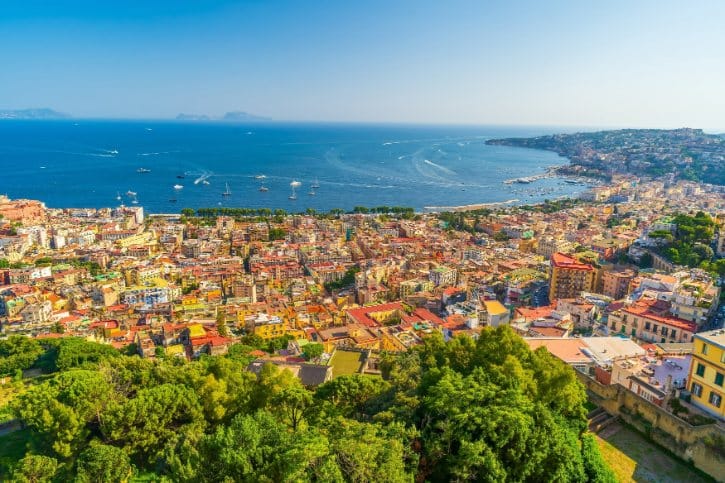
Naples sets the tone for everything ahead, so give it a full day before you move on. This is not a modern city with an old quarter bolted on. It is a living ancient metropolis, walked continuously for more than 2,700 years, and you feel that the moment you step into the streets.
b. Walk the Street That Splits the City in Two
Head for Spaccanapoli, the ancient street that seems to slice Naples in half when you look down from above. Along it you can find:
- Gesù Nuovo, a church with a stark diamond-point stone front
- Santa Chiara, whose cloister wraps 64 octagonal pillars and benches in painted 18th-century majolica tiles
- Cappella Sansevero, home to the astonishing Veiled Christ, carved so the marble veil looks almost see-through
- Via San Gregorio Armeno, the workshop lane where artisans still carve tiny nativity figures
c. See the Waterfront and the Volcano Together
Stroll the seafront to Castel dell’Ovo, a Norman fortress on a tiny islet. From its ramparts, the link between the city, the bay, and Mount Vesuvius suddenly clicks into place. That brooding peak on the horizon is the same volcano that preserved the ancient towns further down the coast.
d. Get Your Roman History Straight Before Pompeii
Stop at the National Archaeological Museum (MANN) first, and everything at Pompeii will mean far more. Inside you will find:
- The world’s greatest collection of Roman antiquities
- The colossal Farnese Hercules and the Farnese Bull
- The original Alexander Mosaic, lifted from Pompeii’s House of the Faun
e. Eat Like a Neapolitan
Naples takes its food seriously, and so should you:
- True Pizza Napoletana, made with San Marzano tomatoes and buffalo mozzarella in a blazing oven, a craft UNESCO honored as the Art of the Neapolitan Pizzaiuolo
- Espresso the local way, small and piping hot, served with a glass of water
- A ricotta-filled sfogliatella or a rum-soaked babà from a historic café
f. Then Head for the Buried City
Follow the coast around the base of Vesuvius, and in about 25 minutes you reach the town the volcano froze in time.
2. Pompeii
a. Give It More Than a Photo Stop
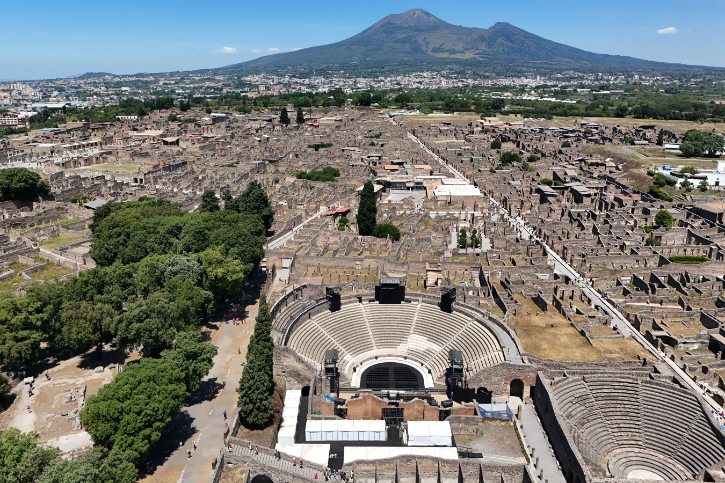
Pompeii is not a scatter of ruins. It is a whole Roman town, sealed by the AD 79 eruption of Vesuvius and listed by UNESCO. Take real time here, because you are walking through a complete city rather than imagining one.
b. Read the Streets Like a Roman Would
The layout is a lesson in Roman city planning:
- Deep ruts worn into the basalt paving by iron-rimmed cart wheels
- Raised stepping stones so you cross the street without touching the drains
- The Forum, ringed by a portico, with its market hall and law courts
c. Step Inside the Great Houses
The private homes show off Roman wealth and ambition:
- House of the Vettii, reopened after two decades of restoration, once owned by two formerly enslaved men who grew rich in the wine trade
- House of the Faun, filling an entire city block, where the famous Alexander Mosaic was found
- Villa of the Mysteries, just outside the walls, with a vivid red fresco cycle showing a secret Dionysian rite
d. Feel the Human Side
The plaster casts, formed from hollows left in the ash, capture people in their final moments. Recent DNA research keeps rewriting their stories, showing that some long-assumed relationships and identities were not what earlier generations believed. Treat these figures gently as you pass. They were real people.
e. See Why the Amphitheater Matters
A few highlights reveal how Romans lived and played:
- The oldest surviving stone amphitheater in the Roman world, older than Rome’s Colosseum
- A Greek-style theatre cut into the hillside for plays and music
- Vesuvius rising to the north, grounding the whole site in what really happened
f. Climb Toward the Sea
Leaving the volcanic plain, the road climbs the limestone coast of the Sorrentine Peninsula, and the water opens up ahead.
3. Sorrento
a. Settle In Above the Bay
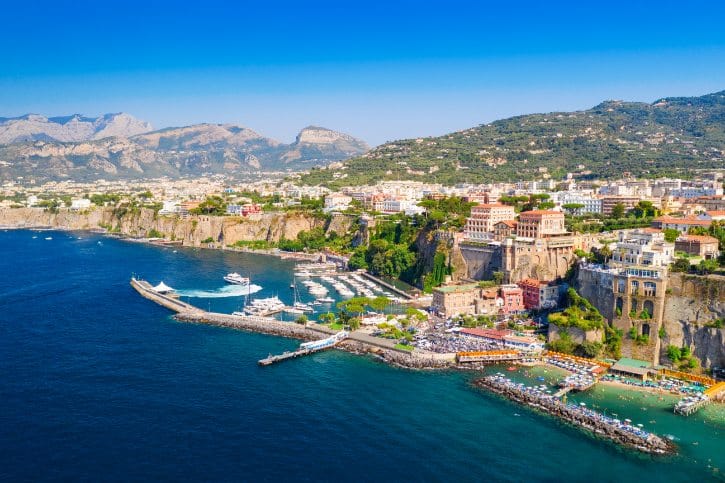
Sorrento sits on a limestone shelf about 50 meters above the sea, right on the Bay of Naples. For the classic view over the water to Vesuvius, head to the clifftop terrace of the Villa Comunale park and simply take it in.
b. Explore the Old Center
The heart of town rewards a slow wander:
- Piazza Tasso, the lively main square, named after a Renaissance poet born here
- The Sedile Dominova, the only surviving medieval noble loggia in Campania
- The cathedral, with its rebuilt neo-Gothic front and fine inlaid woodwork inside
c. Drop Down to the Fishing Harbor
Walk down through a steep gorge, past an ancient Greek gate, to Marina Grande. This old fishing harbor still works. Pastel cottages, open boat ramps, and family trattorias line the shore, where traditional wooden skiffs rest on the dark volcanic sand.
d. Find the Hidden Roman Ruins
Out on the western cape at Bagni della Regina Giovanna, you can find:
- A natural limestone footbridge over an emerald lagoon
- The ruins of a grand 1st-century Roman seaside villa
- Mosaic fragments, cisterns, and terraces built straight into the rock
e. Look for Craft and Lemons
Two local traditions shape Sorrento’s character:
- Tarsia lignea, the intricate wood inlay work you will spot in shop windows
- The Limone di Sorrento, an oval, oil-rich lemon grown on the flat plateau under woven straw mats
- The aromatic base for authentic Sorrentine limoncello
f. Head Into Greener Country
Leave the clifftops behind and the land opens into farming hamlets, olive groves, and coastal nature reserves.
4. Massa Lubrense
a. Meet a Scatter of Villages, Not One Town
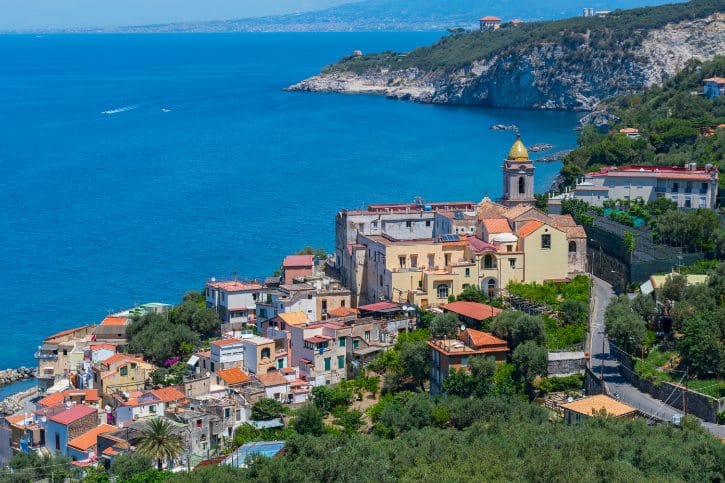
Think of Massa Lubrense as 18 small hamlets spread across the western tip of the peninsula. It feels far more rural than Sorrento, with working farms, olive terraces, and sea views over two gulfs at once.
b. Take In Two Gulfs From One Hill
The narrow headland gives you rare double views:
- Sant’Agata sui Due Golfi, at 390 meters, looks over both the Gulf of Naples and the Gulf of Salerno
- The Colle del Deserto viewpoint takes in Vesuvius, Capri, and the Li Galli islands
- A village church here holds a rare altar inlaid with marble, mother-of-pearl, and lapis lazuli
c. Wander the Coastal Hamlets
Each little settlement has its own feel:
- Marina della Lobra, a quiet fishing port set in a natural bowl
- Marina di Puolo, a sheltered cove of mixed sand and pebbles
- Marina del Cantone and Nerano, birthplace of Spaghetti alla Nerano, made with fried zucchini and sharp local cheese
d. Reach the Wild Point
At Punta Campanella, a windswept headland inside a marine reserve, you stand just five kilometers from Capri. This was a sacred site in ancient times, and a watchtower still crowns the rock. If you are up for a challenge, a long stone stair leads down to the dramatic Crapolla inlet with its Roman ruins and tiny chapel.
e. Notice Why It Feels Different
After busy Sorrento, this quiet spread of villages and cultivated hillsides is a genuine change of pace, and a good excuse to slow right down.
5. Positano
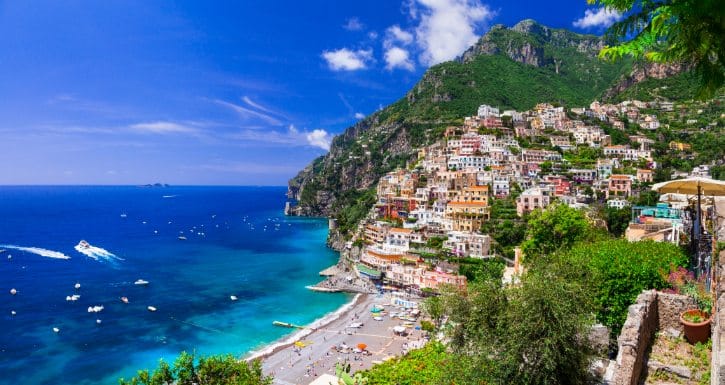
a. Look Up at a Town Built Into a Cliff
Positano climbs the walls of a narrow gorge, so it grew upward instead of outward. You will not find city blocks here, just stepped paths, vaulted passages, and terraces of pastel houses. Every turn reframes the sea, and every walk means a climb.
b. Choose Your Beach
Two very different beaches sit within a short walk:
- Spiaggia Grande, the main beach, gives you the classic view of houses stacked up the cliff
- Fornillo, reached by a cliffside path past an old watchtower, is smaller and far more secluded
c. Step Inside the Landmark Church
The Collegiata di Santa Maria Assunta wears a bright majolica dome and holds a 12th-century Byzantine icon of the Black Virgin. Local legend even ties the town’s name to that painting, and it is well worth a quiet look inside.
d. Dig Into What Most Visitors Miss
Skip the sights that are only famous online and seek out the real depth:
- MAR Positano, an underground Roman villa beneath the church, buried in AD 79 and now open as a museum
- Vivid wall paintings, including the centaur Chiron teaching young Achilles to play the lyre
- Moda Positano, the town’s own fashion tradition of linen dresses and handmade leather sandals
e. Climb for the Big View
For a bird’s-eye perspective, follow the steps up the mountain:
- Stone stairs lead to the hamlet of Nocelle
- From there the ridge-top Path of the Gods reveals the full drop of the cliffs into the sea
- Those connecting steps are the way up to the trail, not the famous walk itself
f. Carry On East
Around the headland, the coast opens into broad, sunlit terraces and a much quieter town.
6. Praiano
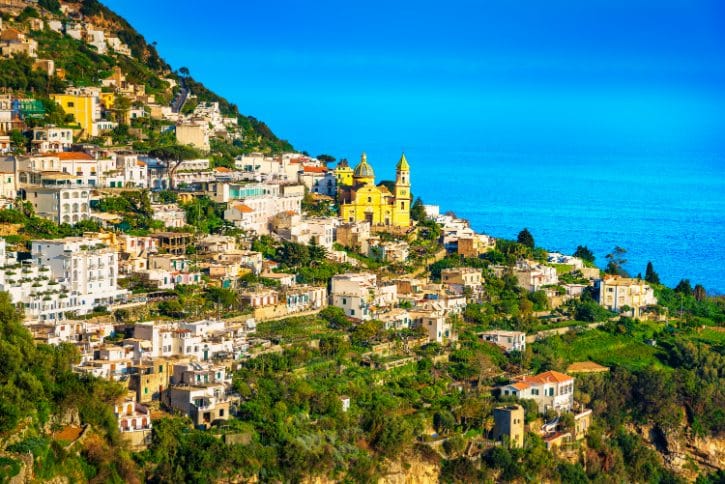
a. Slow Down in a Calmer Neighbor
Praiano is Positano’s quieter cousin, and its spread-out layout keeps the crowds thin. Daily coastal life carries on across two districts, upper Praiano on the slopes and lower Vettica Maggiore stepping down toward the water.
b. Notice the Painted Shrines
As you climb the stairways, look for the hand-painted majolica votive shrines set into walls and corners. Dating to the 17th and 18th centuries, they once served as:
- Navigation markers along the paths
- Expressions of family faith
- Nightly lamps for fishermen heading home from the sea
c. Catch the Sunset at La Gavitella
This cove is the reason many people linger in Praiano:
- A rocky inlet on the western edge, facing openly toward Capri
- One of the few spots on the coast that keeps direct sun right up to sunset
- A natural spring tucked into a cliffside cave nearby
d. See the Church and the Harbor
In Vettica Maggiore, the Church of San Gennaro shows a majolica cupola and a sea-view terrace. Down at the water, Marina di Praia is a dramatic pebble inlet squeezed between limestone walls, guarded by a medieval watchtower and still home to wooden fishing boats.
e. Next Comes the Gorge
Continue east and the road tightens into the deep, narrow ravine of Furore.
7. Fiordo di Furore
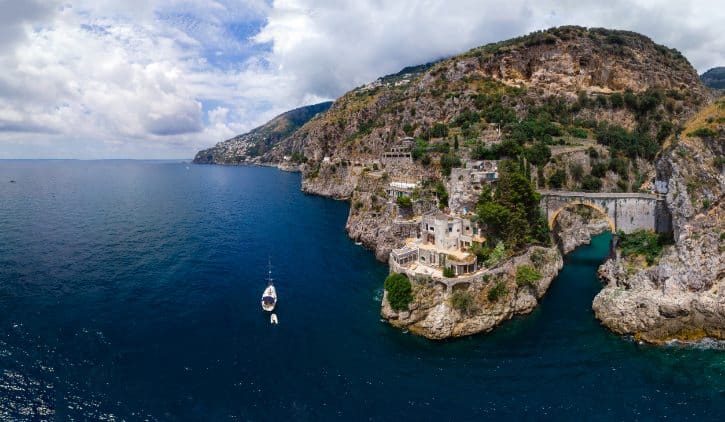
a. Know What You Are Really Looking At
Despite the name, no glacier ever carved this. It is a ria, a deep coastal canyon cut into the limestone by a mountain stream. The name means “Land of Fury”, after the roar of winter waves against the rock walls.
b. Take In the Bridge and Inlet
The view from the road is the whole draw:
- A 30-meter arched bridge carries the highway across the gorge mouth
- Below sits an emerald-green inlet and a small pebble beach
- A stairway of about 200 steps descends to the water, so check locally that it is open before you head down
c. Meet the Old Fishing Hamlet
Tucked deep in the gorge is a tiny world of its own:
- The monazzeni, vaulted stone shelters where fishermen once hauled up their boats
- An old paper mill and lime kiln, once powered by the rushing stream
- A small museum in two of the cottages, once a hideaway for a famous director and actress
d. Look Before You Leap
The bridge was long famous for a high-diving championship, but that contest is no longer held here every year, and casual jumping is strictly illegal because of shallow water and hidden rocks. Enjoy the view, and keep your feet firmly on the bridge.
e. On to a Maritime Town
Through the mountain tunnels, the gorge opens onto the sunlit bay of Amalfi.
8. Amalfi
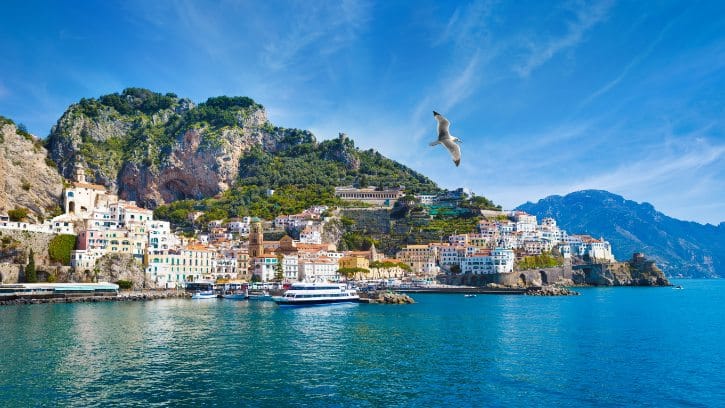
a. Stand in an Old Sea Power
Amalfi is beautiful, but it was also mighty. As the earliest of Italy’s great Maritime Republics, it ruled Mediterranean trade from the 9th to the 11th centuries and even wrote sea laws that guided shipping for generations. You can still feel that old confidence in its scale.
b. Climb to the Cathedral
From Piazza Duomo, a grand 62-step staircase leads up to the Cattedrale di Sant’Andrea:
- A striped Arab-Norman facade topped with a golden mosaic
- Bronze doors cast in Constantinople around a thousand years ago
- A crypt holding the relics of Saint Andrew the Apostle
c. Find the Quiet Corners
Step away from the square and the town gets more intimate:
- The Cloister of Paradise, with slender twin columns and interlacing Moorish arches
- The supportici, covered passages built to confuse pirates and offer shade
- The harbor front, where the whole town rises up before you
d. Trace the Paper and the Lemons
Two hand-made traditions still define the landscape:
- The Valley of the Mills, where Amalfi pressed rag paper for centuries
- A working paper museum with original wooden hammers and stone basins
- The Sfusato Amalfitano lemon, grown on terraces held up by dry-stone walls
e. Walk to the Smallest Town
A ten-minute stroll through a pedestrian tunnel east of the harbor brings you to Amalfi’s tiny neighbor.
9. Atrani
a. Discover Italy’s Smallest Town
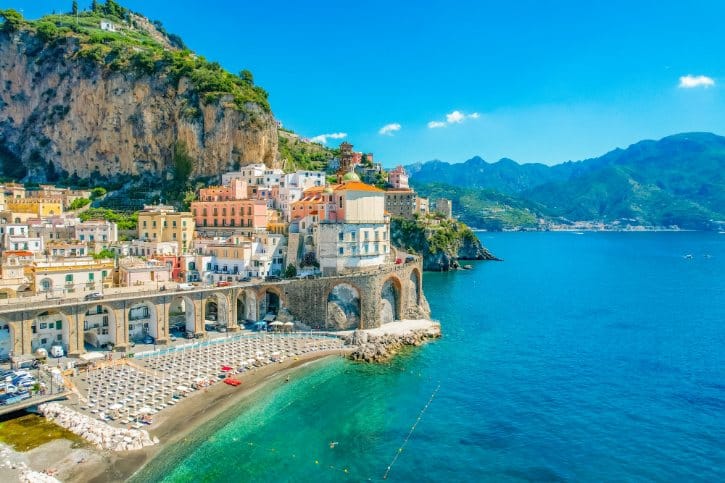
Right next to Amalfi, Atrani covers barely 0.12 square kilometers, making it Italy’s smallest municipality by area. That tiny size is exactly what makes it feel so special and so unlike its famous neighbor.
b. Explore the Medieval Maze
The whole village is built to be wandered:
- A dense tangle of whitewashed houses, stone stairways, and covered alleys
- Piazza Umberto I, an intimate square that acts as the town’s living room
- A crescent beach of sand and pebbles just beyond the highway arches
c. Look Up to the Church
On the eastern cliffside stands the Collegiata di Santa Maria Maddalena, founded to thank the saint for saving the village. It carries a Rococo facade and a yellow-and-green majolica dome, and it sits on the very spot where the Doges of Amalfi were once crowned.
d. Settle Into the Slow Pace
Atrani rewards you for doing very little:
- No cars in the historic core
- Fishing skiffs resting near the square
- A quiet, residential rhythm you can easily fall into
e. Then Climb Inland
The route now leaves the shore and winds up the mountain to Ravello.
10. Ravello
a. Rise High Above the Sea
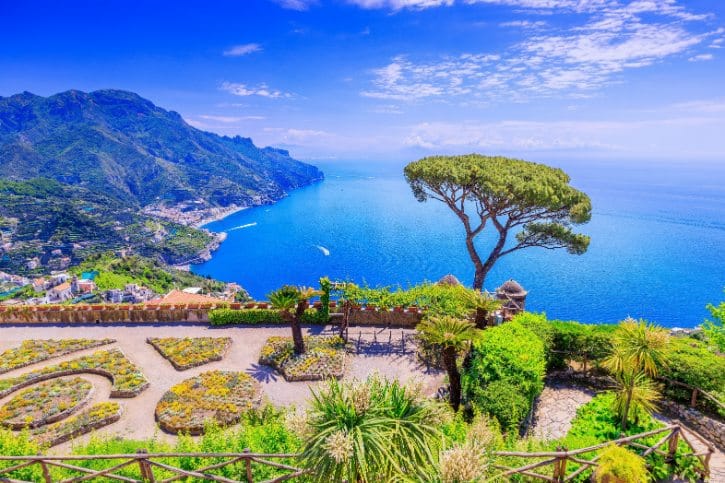
Ravello sits on a ridge about 350 meters up, and the change is dramatic. Founded as a refuge, it grew into an aristocratic stronghold whose wealthy families built grand villas with sweeping views over the gulf.
b. Wander Villa Rufolo
This 13th-century estate is the town’s showpiece:
- A history so admired it was praised in Boccaccio’s writing
- A Moorish cloister of pointed arches and carved stone
- Tiered gardens of bougainvillea and cypress that inspired the composer Wagner, and later the summer Ravello Festival held on a stage over the sea
c. Stand on the Terrace of Infinity
At Villa Cimbrone, formal gardens lead to the Terrazza dell’Infinito. A marble balustrade lined with classical busts opens onto an uninterrupted view across the water. It earns its fame because absolutely nothing gets in the way, and you will not forget it.
d. See the Cathedral and the Lanes
There is quiet beauty beyond the villas:
- Bronze door panels on the Duomo cast in the 12th century
- A marble pulpit resting on six spiral columns and crouching stone lions
- Peaceful lanes dotted with ceramic workshops and shaded gardens
e. Head Down to the Coast Again
The mix of height, historic villas, and celebrated gardens makes Ravello feel worlds away from the ports below. Descend the mountain road and a small seaside town rich in Roman history awaits.
11. Minori

a. Discover Roman Ruins at Sea Level
Minori is small but surprisingly rich. Its great treasure is a 1st-century AD Roman maritime villa built right at the shore. Unlike Pompeii, it was not buried by Vesuvius. Centuries of flooding and mud washing down the valley behind it slowly covered the site, and it stayed hidden until the 20th century. It is a rare window into Roman life on this coast.
b. Explore the Ancient Villa
The site is easy to visit and full of detail:
- A garden courtyard with a large swimming pool and portico
- Vaulted dining rooms and a private thermal bath suite
- Mosaic floors of marine animals, plus a small museum of finds
c. Pause at the Seafront Basilica
The 18th-century Basilica di Santa Trofimena watches over the lower town and holds the relics of the saint whose remains, by local tradition, washed ashore here long ago. It makes a nice, brief pause between the ruins and the beach.
d. Walk the Path of the Lemons
This cliffside trail is one of the loveliest walks on the coast:
- A route linking Minori and Maiori through the hamlet of Torre
- Lemon pergolas propped on chestnut poles arching overhead
- Open views over the coastline, taking around 45 minutes on foot
e. Taste the Town’s Sweet Side
Minori is known as the City of Taste, and its pastry culture is why. The town’s celebrated pastry maker Salvatore De Riso turned the Delizia al Limone into a household name, a soft sponge dome filled with fragrant lemon cream. The dessert was first created near Sorrento in the 1970s, but Minori is where you will most want to try one, ideally by the sea.
f. Move On to a Wider Beach
A few minutes east lies Minori’s bigger neighbor, with a long, open shore.
12. Maiori
a. Enjoy Room to Spread Out
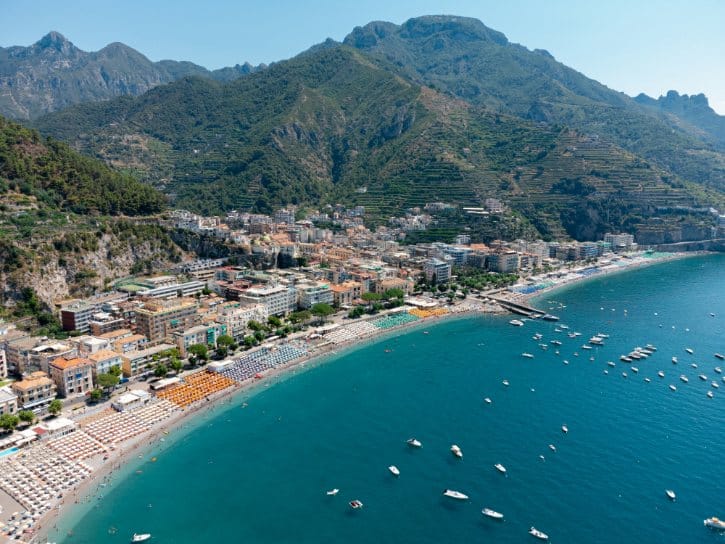
After the tight villages, Maiori feels roomy. It has the longest continuous beach on the Amalfi Coast, stretching about a kilometer, backed by a broad, palm-lined promenade made for easy days.
b. Learn the Beach’s Backstory
That open front is the result of recent history:
- A flood and landslide in the 1950s destroyed the old waterfront
- The rebuild created the wide boulevard and expansive beach you see today
- The result is a spacious, relaxed seafront unlike the smaller settlements nearby
c. Visit the Tower and the Churches
History still stands above the modern shore:
- Torre Normanna, a large 16th-century watchtower built against pirate raids, despite its name
- Santa Maria a Mare, with a green-and-yellow scale dome and a gilded coffered ceiling
- A hilltop fortress that once sheltered locals during attacks
d. Seek Out the Cliff Abbey
A few kilometers east along the highway hides the Badia di Santa Maria de’ Olearia, three chapels carved into the cliff back in the 10th century. Early medieval frescoes still cling to the rock walls. It is atmospheric, and very easy to miss if you are not looking for it.
e. Continue to a Fishing Village
Its open shore and larger scale make a real contrast with compact Minori, while still fitting the same journey. From here, the road heads to a village where the sea is a living trade.
13. Cetara
a. Step Into a Working Fishing Village
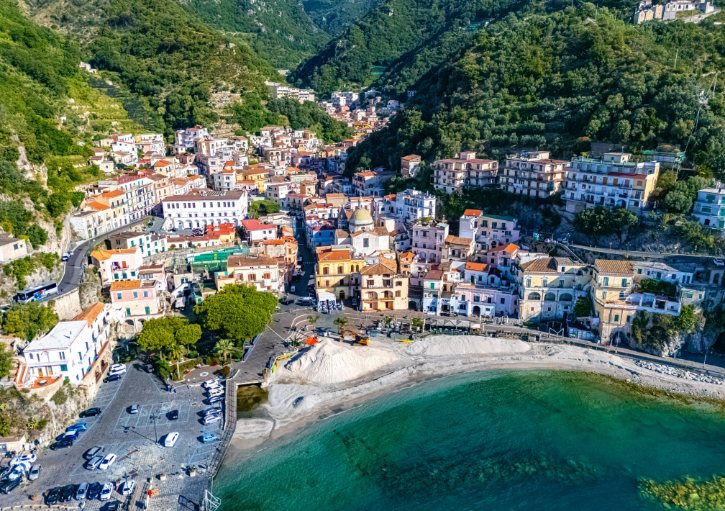
Cetara is a fishing village first and a tourist stop second, and that is exactly its charm. Tied to the sea for more than a thousand years, its very name comes from the Latin word for a tuna fishery.
b. Watch the Harbor at Work
Here you see real maritime life, not a staged scene:
- Purse-seine boats fitted with lanterns for night fishing
- Crews mending their nets along the quay
- A 16th-century cylindrical watchtower standing over the port
c. Taste the Famous Anchovy Sauce
Cetara’s star is Colatura di Alici, a protected anchovy sauce descended from ancient Roman garum. To make it:
- Anchovies are salted and packed into small wooden barrels
- They mature for at least nine months in cool, dark cellars
- The clear amber liquid is drawn off and filtered through linen
d. Eat the Local Specialties
Order spaghetti dressed simply with that colatura, garlic, and chili, and you taste the whole town in a single plate. Cetara also keeps a strong bluefin tuna tradition, served as carpaccio or grilled straight from the morning’s catch.
e. See Why It Is Worth the Stop
After the beaches of Maiori, Cetara gives you living fishing heritage and food you cannot find in quite the same form anywhere else on the coast.
14. Vietri sul Mare
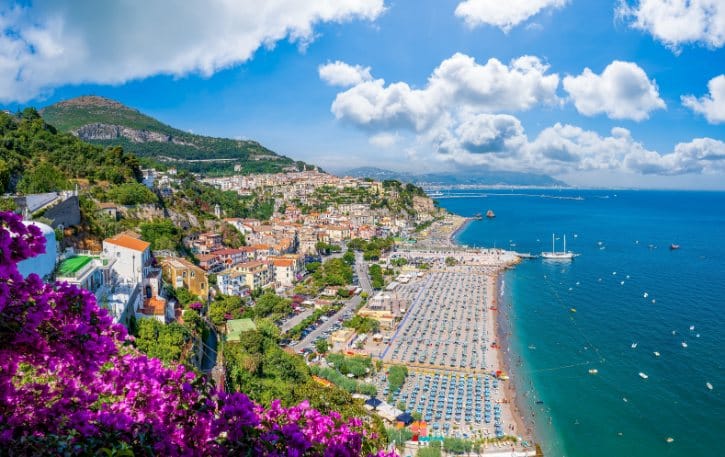
a. Arrive at the Coast’s Ceramic Capital
Vietri sul Mare is the eastern gateway to the Amalfi Coast, and its signature is ceramics. Potters have worked here since Roman times, and color spills across the entire town, from doorways to stairways.
b. Spot the Tiles Everywhere
The whole place works like an open-air gallery:
- Building facades and street signs covered in hand-painted majolica
- Public stairways and park walls set with bright mosaics
- The Church of San Giovanni Battista, its dome sheathed in glittering fish-scale tiles
c. See the Craft in Action
You can watch tradition being made by hand:
- Working studios where artisans throw and paint before your eyes
- The classic green donkey motif you will find on plates and tiles
- The striking Solimene factory, designed by Paolo Soleri in the early 1950s, its facade clad in thousands of terracotta vessel bottoms
d. Head Down to the Marina
Below the upper town, Marina di Vietri has a wide beach framed by two matching limestone sea stacks. Note there is no cable car down, just a ten-minute walk on stepped paths or a short ride on public transport.
e. Notice What Makes Vietri Stand Out
Nowhere else on the route wears its craft so openly. The sheer amount of colorful ceramic work gives the town a look all its own, and a fitting last stop before the journey ends in the city.
15. Salerno
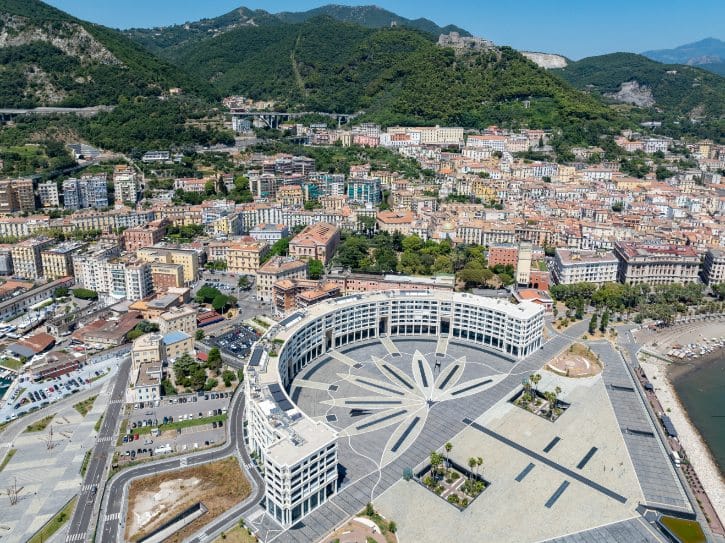
a. Finish in a Real City
Salerno is the natural end of the route, and a satisfying one. A lively provincial capital on its own gulf, it trades small-village scale for an open waterfront, a great cathedral, a hilltop castle, and the everyday buzz of city life.
b. Stroll the Seafront and Old Town
Two long walks capture the city at a glance:
- The Lungomare Trieste, a palm-lined promenade about two kilometers long
- Views west to the Amalfi cliffs and south toward the Cilento coast
- Via dei Mercanti, the narrow pedestrian spine of one of the south’s best-preserved medieval centers
c. Step Inside the Cathedral
The Cattedrale di San Matteo rewards a slow look:
- A courtyard ringed by 28 ancient Roman columns brought from Paestum
- Two 12th-century marble pulpits set with Byzantine mosaics
- A frescoed crypt holding the relics of Saint Matthew
d. Climb to the Castle
High on the hill sits the Castello di Arechi, expanded in the 8th century by a Lombard prince and later by others. From the ramparts you look out over the city, the harbor, and the whole gulf, a fitting final view back across the coast you have followed.
e. Remember Its Place in History
Salerno carries a legacy beyond its beaches:
- Home to the earliest medical school in medieval Europe
- A terraced botanical garden where a medieval physician grew healing herbs
- Local flavors like buffalo mozzarella and handmade seafood pasta
f. Reach a Satisfying Full Stop
From the ruins of Naples and Pompeii, around the peninsula, and along the cliffs and harbors of the Amalfi Coast, the journey settles here in a historic city on its own wide gulf. If you still have time, the Cilento region continues south, but Salerno is the perfect place to end.