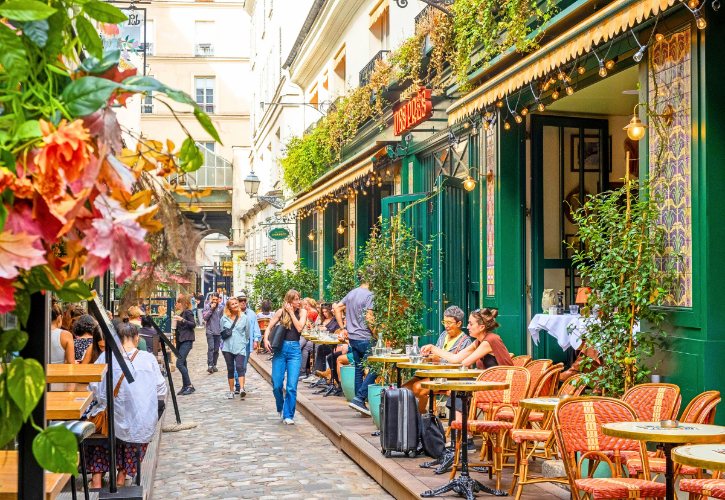
Some of the greatest sights in Paris sit so close together that you can enjoy them in one relaxed morning.
You start in the calm green of the Left Bank, drift north through elegant streets and literary cafés, then cross the Seine onto the island where the city began.
Each stop is just 1 to 5 minutes from the last, and the finish gives you two of the most breathtaking Gothic interiors in France. 😊
1. Jardin du Luxembourg
a. The Gentlest Way to Begin
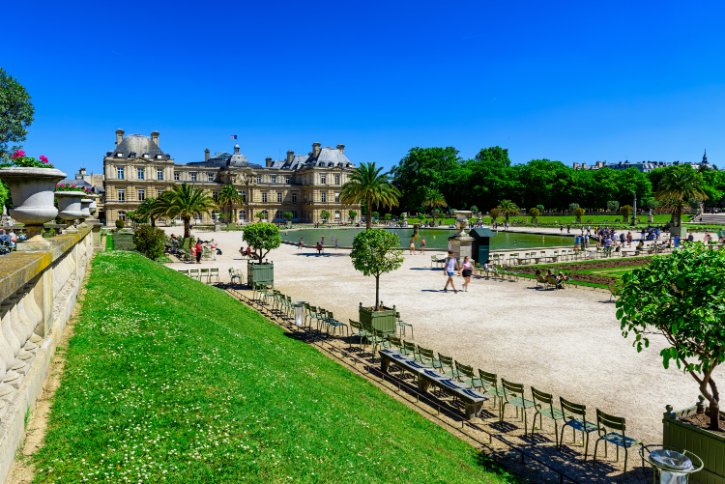
You could not ask for a calmer start. This garden sets an elegant, unhurried tone, and nothing here rushes you.
b. The Queen Who Built It
The garden was created in 1612 by Marie de’ Medici, widow of Henri IV. Tired of the gloomy Louvre, she asked architect Salomon de Brosse to build her a palace that recalled her native Florence, with terraces inspired by the Boboli Gardens. Since 1879 it has been cared for by the French Senate, which is why it stays so beautifully kept.
c. The Features Worth Slowing Down For
- The Grand Bassin. An eight-sided pool where children still sail little model boats on fine days.
- The best view. Look north across the water toward the palace. The morning light through the trees is the garden’s finest moment.
- The Fontaine Médicis. A shaded fountain with a dramatic bronze giant looming over two marble lovers.
- The Queens of France. Twenty marble statues of famous women ring the upper terrace.
- A small Statue of Liberty. A bronze version stands in the western lanes.
d. Small Details Most People Walk Past
- An orchard along the south edge trains over 500 heritage apple and pear varieties against neat frames.
- A beekeeping school from the 1850s still runs active hives beside it.
- An orangery shelters hundreds of citrus trees and palms through winter.
e. How to Soak It In
Grab one of the garden’s movable green chairs and simply sit for a while. Moving your own chair into the sun is part of the local ritual. When you are ready, leave on the north side and the quiet lanes soon lead you to a huge classical church.
2. Église Saint-Sulpice
a. More Than a Quick Look
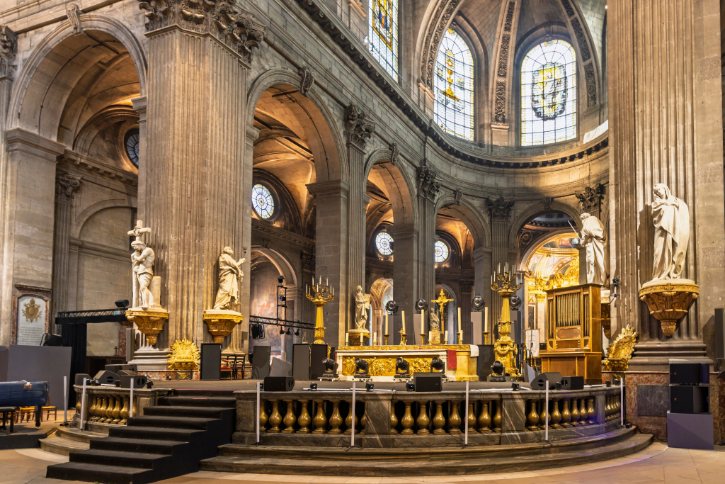
It is tempting to glance at the front and keep walking, but the inside holds real treasures. This is the second-largest church in Paris, behind only Notre-Dame, begun in 1646 over much older foundations.
b. Spot the Mismatched Towers
Here is a detail most people miss. The two towers do not match.
- The north tower was finished in the 1780s and carries statues of the Evangelists.
- The south tower was left about five meters shorter when the Revolution stopped work in 1789.
- That unfinished look is why the front seems slightly lopsided today.
c. The Delacroix Paintings to Find
Turn right as you enter, into the Chapelle des Saints-Anges. There you will see three late works by Eugène Delacroix, painted onto the plaster between 1849 and 1861.
- Jacob Wrestling with the Angel on the south wall.
- Heliodorus Driven from the Temple on the north wall.
- Saint Michael Defeating the Demon on the ceiling.
These are counted among his finest works, so give them a few quiet minutes.
d. The Famous Line on the Floor
A brass strip runs across the floor to a white marble obelisk. This is a real astronomical tool, not a mystery. A priest had it installed in 1743 to fix the date of Easter by tracking the sun. If you have read dramatic novels about a secret line here, enjoy them, but trust the simple truth.
e. Before You Step Out
- The grand organ, rebuilt in 1862, is one of the most celebrated in France.
- The fountain in the square carries four seated bishops, none of whom ever became a cardinal, which is the local joke behind its nickname.
Head north on Rue Bonaparte for something smaller and sweeter.
Read More: 10 Breathtaking Churches in Paris You Can’t Miss
3. Pierre Hermé
a. A Window Like a Jewelry Shop
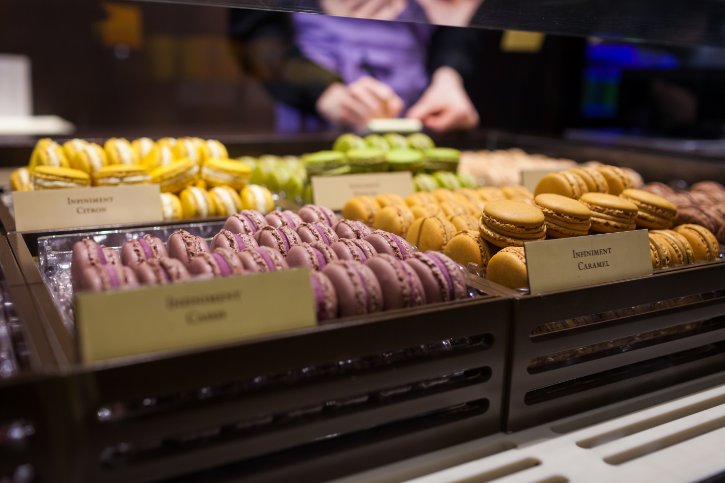
A short walk north brings you to a pastry window that looks more like a jeweler’s than a bakery, and that is exactly the idea. Pierre Hermé reshaped modern French pastry and was named World’s Best Pastry Chef in 2016.
b. Getting the Story Straight
You will hear this shop called many things, so here is the accurate version. Hermé opened his first boutique in Tokyo in 1998. The shop at 72 Rue Bonaparte opened in 2001, which makes it his first boutique in Paris and his flagship. So “first Paris boutique” and “flagship” are fair, but “first ever” is not.
c. The Creations to Try
- Ispahan. His most famous treat, built on rose, lychee, and raspberry, with the raspberry cutting through the sweetness. Sold all year as a macaron, a tart, and a croissant.
- Mogador. Milk chocolate lifted by passion fruit.
- Tarte Infiniment Vanille. A deep, layered vanilla tart.
- 2000 Feuilles. Crisp caramelized pastry with hazelnut cream.
d. What to Notice at the Counter
- Each item sits alone in a lit glass case, treated like a precious object.
- The macarons rest for a day or two before sale, so they turn tender inside while staying crisp outside.
- This is a proper Parisian treat, not a rushed snack, so enjoy it slowly.
Then step back onto the street, because Rue Bonaparte is a sight on its own.
4. Rue Bonaparte
a. A Street Worth Walking Slowly
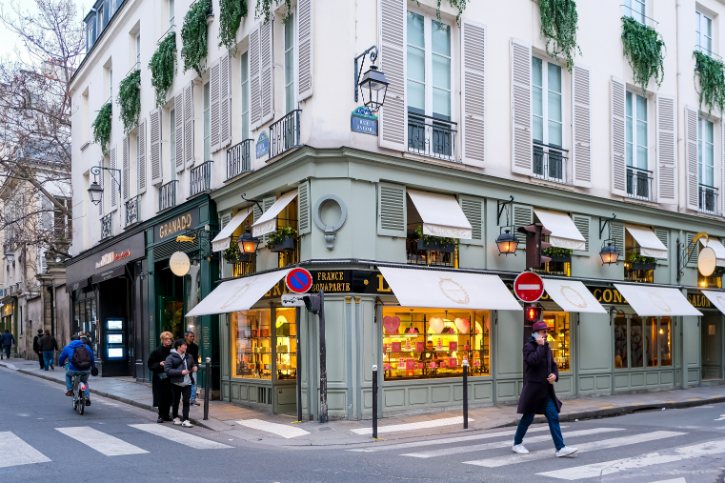
Do not think of this as just the road between stops. Walking it is part of the fun. It took its current shape in 1852, when three older roads were joined into one and named for Napoleon I. That is why it mixes mansions, old stone fronts, and 19th-century apartments.
b. Doorways and Numbers to Watch
- No. 70. A former dairy keeps its old painted glass panels of country scenes.
- No. 28. A tall 17th-century carriage arch with a carved wooden panel above it.
- No. 14. Near the river stands the École des Beaux-Arts, where artists from Degas to Monet once studied.
c. A Street of Writers and Thinkers
- No. 36 marks the home of philosopher Auguste Comte in the early 1820s.
- No. 42 is where Jean-Paul Sartre lived and wrote from 1945 to 1962. The building was bombed twice because he backed Algerian independence, which pushed him to move away.
d. As You Reach the Cafés
As the quiet street meets Boulevard Saint-Germain, the mood turns busy and the café terraces appear. Two of them are legends, and you get to pick.
5. Café de Flore or Les Deux Magots
a. Two Legends, Your Choice
Both cafés sit near the church square, and both shaped the thinking life of the neighborhood. You simply choose the one that fits your mood.
b. Café de Flore in Short
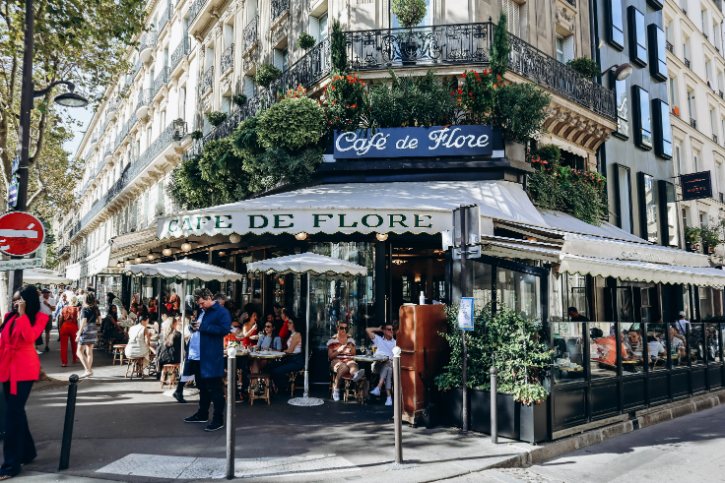
- Founded around 1887, named after a statue of the Roman goddess Flora.
- Became linked with the Surrealists in the 1910s and 1920s, when Apollinaire and his circle gathered here.
- During the Occupation, Sartre and Beauvoir worked here from morning to evening, partly for the warmth of its coal stove.
- Keeps the Art Deco look it has had since the 1930s, with red banquettes and mirrored walls.
- Still hosts a literary prize, the Prix de Flore, started in 1994.
c. Les Deux Magots in Short
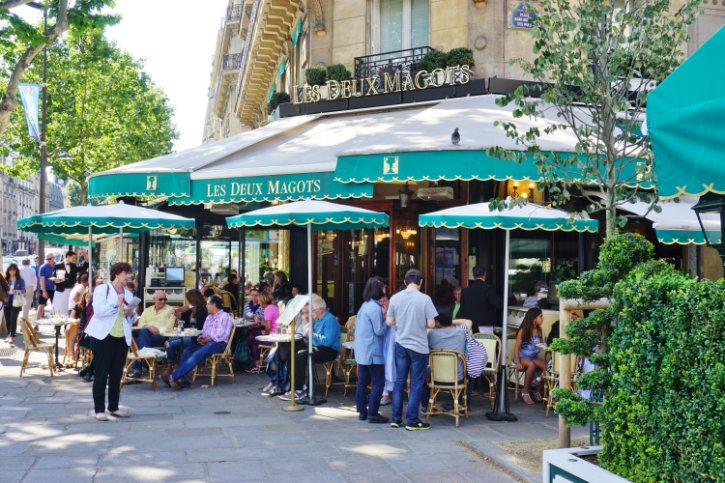
- Began in 1812 as a shop, became a café in 1885, and is named after two carved Chinese figures you can still see inside.
- Drew Symbolist poets like Verlaine and Rimbaud, and later Hemingway.
- Created its own literary prize in 1933.
- Feels more traditional and formal than the Flore.
d. The Truth About Sartre and Beauvoir
A common story says the pair split their days evenly between both. Beauvoir’s own memoirs tell it differently. The Flore was their warm, relaxed writing spot, while Les Deux Magots was for publisher meetings and evening gatherings.
e. How to Pick One
- Want the writing-room feel? Lean toward the Flore.
- Love the poets and the old-salon mood? Choose Les Deux Magots.
- Neither is better. They just carry slightly different histories.
Coffee done, cross the square to the oldest standing church tower in the city.
Read More: 10 Most Beautiful Café in Paris
6. Church of Saint-Germain-des-Prés
a. The Oldest Corner of the Area
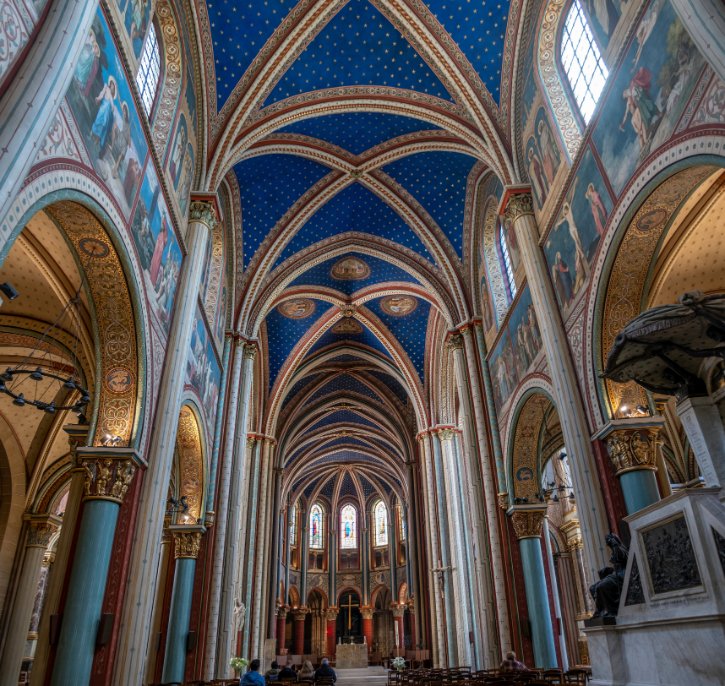
This church gives you something very different from Saint-Sulpice. It is layered, old, and quietly colorful. It is the main surviving church of a powerful medieval abbey, with roots going back to the 6th century, though most of what you see is far later. The abbey’s former Abbot’s Palace nearby also still stands, so this is not the only piece left.
b. Reading the Different Ages of Stone
The real pleasure is spotting which part belongs to which century.
- The bell tower, from around 1014, is the oldest standing church tower in Paris.
- The nave keeps its early 11th-century Romanesque piers, though its stone vaults came in the 1640s.
- The choir, from 1163, is Early Gothic, with some of the earliest flying buttresses in the region.
c. Color and Famous Tombs
- A major cleaning finished in 2020 brought back the bright 19th-century wall paintings and the blue ceiling scattered with gold stars.
- The philosopher René Descartes has a black marble tomb in a side chapel.
- A baroque tomb honors a Polish king who gave up his throne to become abbot here.
d. About That “Oldest Church” Claim
You will often hear this called the oldest church in Paris. It is best to say it carefully. The site was founded in the 6th century, but most of the surviving building is from the 11th century onward, and the clearly oldest part is the bell tower.
e. Stepping Back Outside
Leave the painted calm and return to the wide sidewalks of Boulevard Saint-Germain, where the scale of the city suddenly grows.
7. Boulevard Saint-Germain
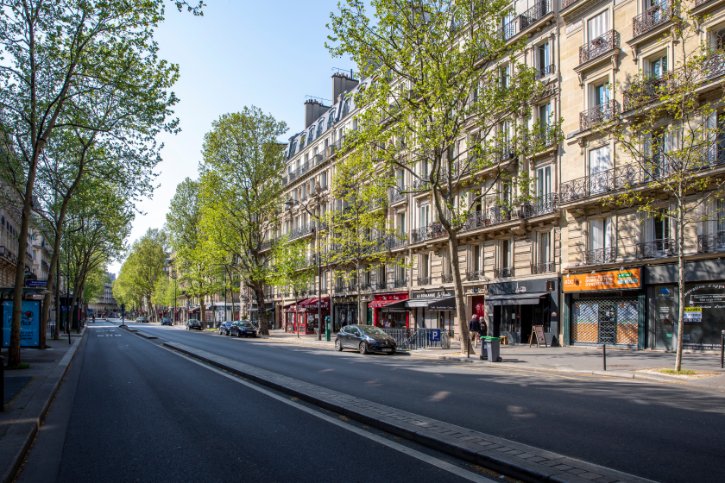
a. Stepping Into a Bigger Paris
After narrow lanes, this broad avenue feels like a different city. It was a major part of Baron Haussmann’s rebuilding of Paris, cut through old medieval streets between 1855 and 1877 and lined with wide sidewalks and rows of trees.
b. Look Up, Not Just Ahead
- The buildings follow the classic Haussmann rulebook, with matching floor heights and balcony lines from one plot to the next.
- At street level you pass cafés, bookshops, and clothing stores.
- Above the storefronts, hunt for carved keystones, leafy balcony brackets, and tall carriage gates.
c. Where Thinkers Are Remembered
Where Rue Bonaparte meets the boulevard, the space opens into Place Jean-Paul-Sartre-et-Simone-de-Beauvoir, named in 2000 to honor the area’s intellectual history. It is a small nod to all the ideas that once filled these café tables.
d. Turning Off the Avenue
The boulevard feels open and busy, a clear change from the quiet streets. Soon you turn onto something more intimate again, where the street narrows into an old market lane.
8. Rue de Buci
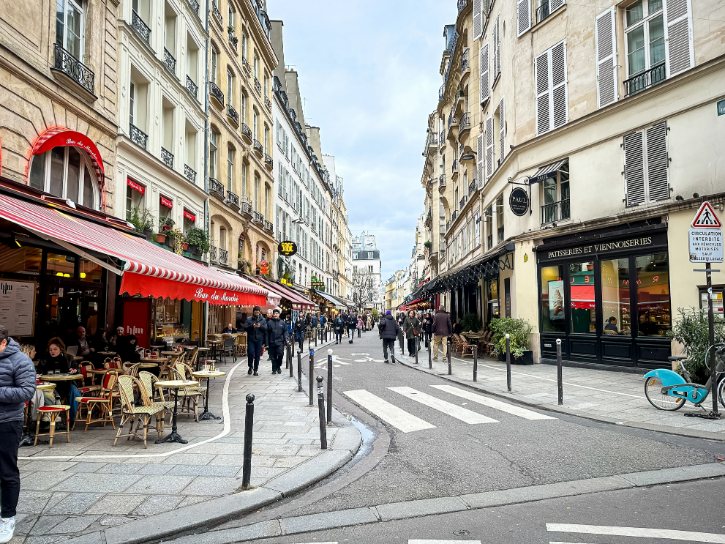
a. A Lively Old Market Lane
The scale shrinks here and the mood turns local. The street dates to the early 13th century and kept its winding shape while much of Paris was straightened. For centuries it was the main food market of the area.
b. Is It Still a Market?
Yes and no, so it helps to be accurate.
- The old open-air pushcart market has mostly given way to fixed shops.
- The street still revolves around food and outdoor dining.
- You will pass cheese shops, wine merchants, bakeries, and sidewalk flower displays that make great photos.
c. Lift Your Eyes Above the Shops
- No. 12 carries a carved five-pointed star marking an early Masonic meeting place from 1732.
- Nos. 26, 28, and 30 are protected historic buildings with old window shapes and iron railings.
- Nearby buildings once hosted Sartre, Beauvoir, and jazz musicians at the Hôtel La Louisiane.
d. The Change of Mood
This street feels livelier and more hands-on than the grand boulevard, full of food stalls and busy terraces. At its end, a passage opens into something that feels like stepping back in time.
9. Cour du Commerce Saint-André
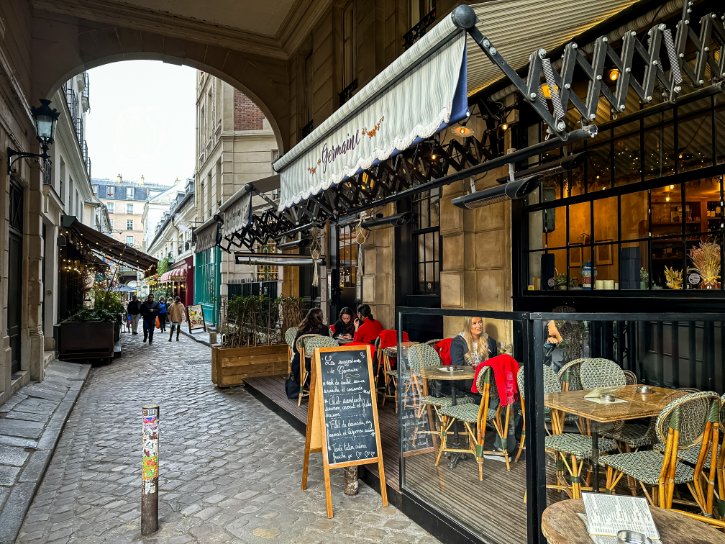
a. A Step Back in Time
Slip into this cobbled lane and the noise fades. It gives you one of the strongest doses of old Paris on the whole walk. It was opened in 1776, built right over the ditches of the medieval city wall.
b. Get the Description Right
You may hear it called a covered arcade. That is only partly true. It is mostly an open-air cobblestone lane, with a glass-and-iron roof only over the northern end. The uneven cobbles, stone steps, and wood-framed windows give it that time-worn feeling.
c. What to Look For
- No. 4. Inside a shop, you can see the lower stonework of a round tower from the 13th-century city wall.
- No. 8. Jean-Paul Marat printed his fiery newspaper here, and an old iron bell still sits on the roofline.
- No. 9. In early 1792, early guillotine prototypes were tested in a workshop here.
- Café Procope. Its blue-framed back door opens into the lane. Founded in 1686, it is often called the oldest café in Paris, a claim worth taking with some care.
d. Fact Versus Legend
Procope attracts many colorful stories, so here is the careful version. It opened in 1686 and is often called the oldest café in Paris, though it closed in the 1800s and reopened later, so the “always running” part of the claim does not quite hold.
Its back door opens right here, and over the years it drew both Enlightenment writers and Revolutionary figures. Treat the more dramatic tales as neighborhood lore. Before you leave, peek through the iron gate opposite Procope into the quiet Cour de Rohan.
10. Quai des Grands Augustins
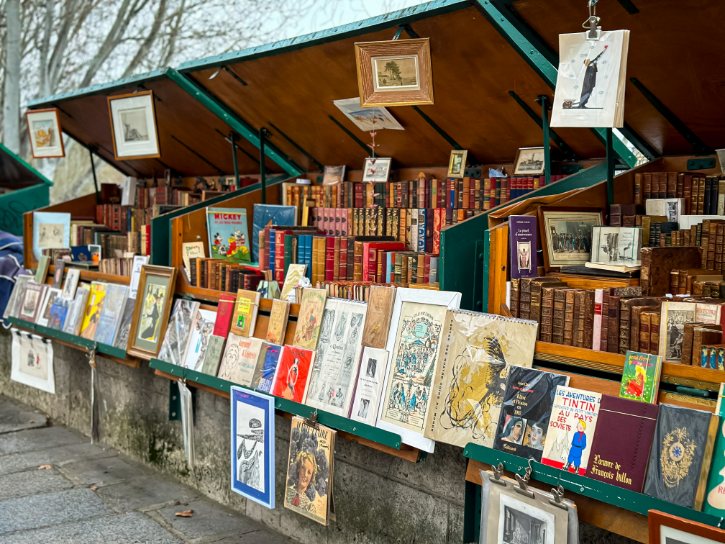
a. The River Opens Up
After all those narrow streets, the Seine suddenly spreads out in front of you. This change of scenery is one of the best moments of the walk. This is the oldest paved stone river quay in Paris, ordered back in 1313.
b. Along the Oldest Quay in Paris
- The dark green boxes on the parapet belong to the riverside booksellers, who have traded here since the 16th century.
- The city let them leave their boxes out overnight from 1891, and the standard green color and size were fixed in 1930.
- These stretches of riverbank are part of a UNESCO World Heritage listing.
- No. 51, the Lapérouse restaurant from 1766, keeps old private dining rooms with mirrors scratched by diamonds.
c. The View You Came For
Stand at the edge of the parapet and look across to the island. From here you can genuinely see:
- The round twin towers of the Conciergerie
- The slender spire of Sainte-Chapelle
- The arches of Pont Neuf just ahead
d. Heading to the Bridge
That view is your preview of everything to come. Follow the quay a short way downstream to reach the bridge itself.
11. Pont Neuf
a. A Crossing to Enjoy, Not Rush
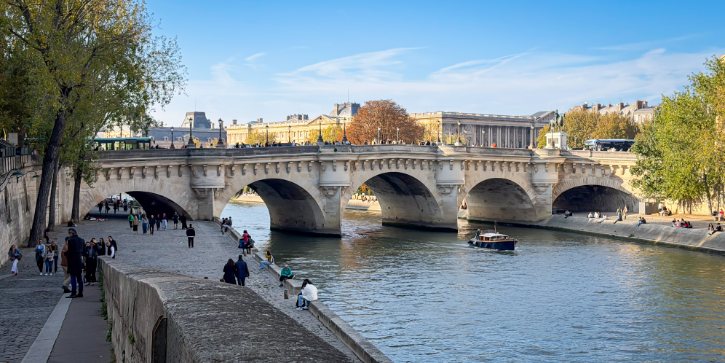
Crossing this bridge is an experience, not just a way over the river, so take your time. Henri III laid the first stone in 1578, and Henri IV opened the finished bridge in 1607.
b. The “New Bridge” That Is Really the Oldest
Despite its name, this is the oldest standing bridge across the Seine in Paris. The fair way to say it is simple. It is called the New Bridge, but it is the oldest one still standing.
c. Why It Changed Bridge Design
Older Paris bridges were crowded with houses that blocked views and caught fire. Pont Neuf broke the mold.
- No houses were built on it, so the crossing became an open promenade.
- It had the first raised stone sidewalks in the city.
- It added semicircular balconies over each pier as viewpoints.
d. Details to Spot as You Cross
- The arches. Twelve in total, split into sections of 7 and 5 where the bridge meets the island.
- The carved faces. Around 381 grinning stone masks line the edges, though the ones you see are all 19th-century copies.
- The statue of Henri IV. The first bronze king was melted for cannon during the Revolution, and the one here was remade in 1818.
Just across from the statue, two matching stone pavilions mark the way into a hidden triangle of calm.
12. Place Dauphine
a. A Quiet Triangle of Calm
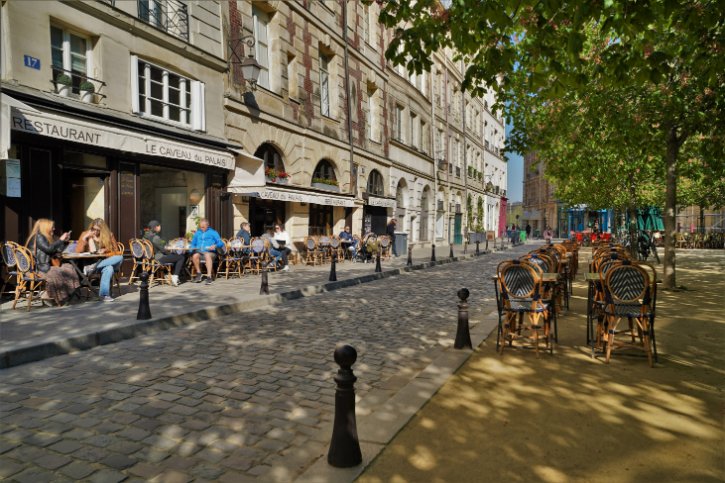
Step off the busy bridge into this square and the city seems to breathe out. It makes a lovely pause before the big monuments. Henri IV laid it out in 1607 and named it for his son, the Dauphin.
b. Second, Not First
Here is the accurate ranking. It was the second planned royal square in Paris, begun two years after the Place des Vosges. Its triangle shape was designed to fit the tapering tip of the island, opening through a single entrance toward Pont Neuf.
c. What Survives and What Changed
- The original plan called for 32 matching houses in red brick and pale stone.
- Owners later rebuilt and plastered over most of them.
- Only the two western pavilions, Nos. 1 and 2 facing Pont Neuf, still keep their 1607 fronts.
- The eastern row was torn down in 1874 to open the view toward the Palais de Justice.
d. The Square Today
- Mature chestnut trees shade a gravel center.
- Locals often play pétanque here in the afternoon.
- A few quiet bistro terraces ring the edges.
- For the best sense of its shape, look down its length from the Pont Neuf side.
Walk out through the open eastern side, then follow the quay around to reach the Conciergerie’s dark Gothic towers.
13. Conciergerie
a. A Palace and a Prison in One
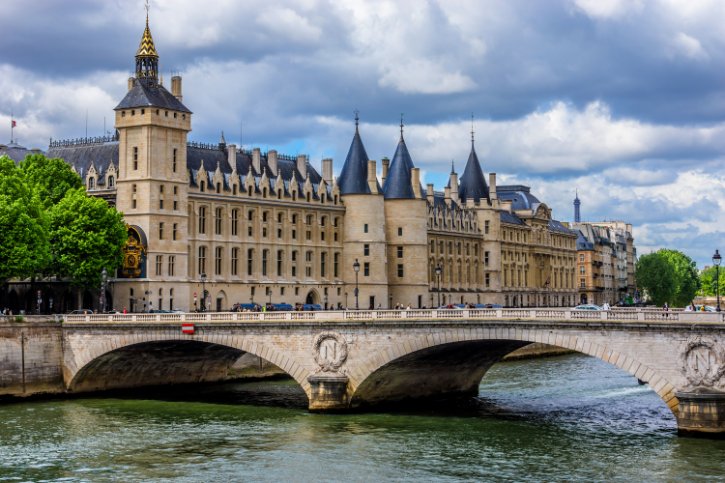
This building wears two very different stories at once, and keeping them apart makes the visit far richer. It is the main surviving part of the old royal palace, the seat of French kings from roughly the 10th to the 14th centuries, before it became a court and prison.
b. The Medieval Halls to See
- Salle des Gens d’Armes. A vast hall about 64 meters long, the largest surviving civil Gothic hall in Europe, once feeding thousands of palace staff.
- Salle des Gardes. A lower hall with carved stone capitals.
- The medieval kitchens. A Gothic workspace with four huge corner fireplaces for roasting whole animals.
c. The Clock Tower Outside
At the northeast corner stands the clock tower, which received Paris’s first public clock in 1370. One point of accuracy: the clock belongs to the wider palace complex rather than the prison itself, even though people often lump them together. A recent restoration brought back its blue, gold, and royal lilies.
d. Marie Antoinette and the Terror
During the Reign of Terror, this became the main prison for the Revolutionary Tribunal.
- Marie Antoinette was held here from August 1793 until her execution that October.
- Her cell was turned into a memorial chapel in 1816, so it is a later space, not the untouched original.
- You also see a reconstructed cell and the Women’s Courtyard.
e. Telling the Layers Apart
As you explore, try to sort what you see into genuine medieval stone, reconstructed prison displays, and later memorial additions. That mix is exactly what makes the island so layered. From here, step through toward a chapel made almost entirely of glass.
14. Sainte-Chapelle
a. Walking Into a Lantern of Glass
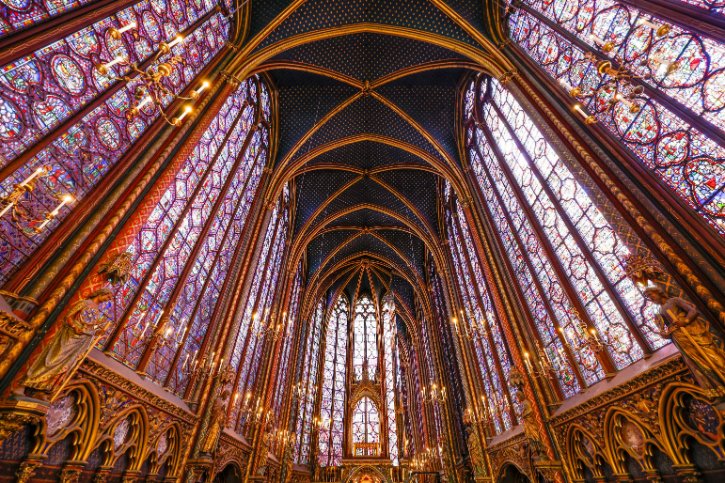
Nothing quite prepares you for this. After the heavy prison stone, the upper chapel feels like stepping inside a glowing lantern. King Louis IX built it in the 1240s to hold holy relics, above all the Crown of Thorns, and it was finished in just six years.
b. Why It Feels So Weightless
- Builders replaced heavy walls with slim buttresses and huge windows.
- Hidden iron bars run through the stone to hold everything together.
- The lower chapel is richly painted with gold lilies and small castles.
- The upper chapel soars about 20.5 meters, ringed by fifteen tall windows.
c. The Stained Glass to Study
- The windows cover more than 600 square meters and hold over a thousand small scenes.
- The story reads around the room, from Genesis through the life of Christ to the arrival of the relics.
- Around 70 to 75 percent of the main window glass is original 13th-century work, which makes it the most complete medieval set in Paris.
- The western rose window is later, added in the late 1400s in a swirling Flamboyant style.
d. A Few Honest Notes
- The relics were scattered during the Revolution, when the building served as a grain store.
- The spire was rebuilt in the 1850s during a major restoration.
- The glass was cleaned and protected again between 2008 and 2015.
e. One Thing to Remember
When you admire the chapel, keep in mind that it is mostly medieval glass inside a structure carefully repaired over the centuries. Step back into daylight and walk east. One last great monument waits.
Read More: Sainte-Chapelle in Paris: What Most Tourists Miss Inside This Famous Chapel
15. Notre-Dame Cathedral of Paris
a. A Powerful Place to Finish
This is the finish, and it is a strong one. After the jewel box of Sainte-Chapelle, Notre-Dame gives you scale and weight, and a story very much alive, since the cathedral reopened in December 2024 after a huge restoration. It was begun around 1163 and took roughly two centuries to complete.
b. Reading the Front of the Cathedral
Stand back in the square and read the front from the ground up.
- Three great carved doorways show the life of the Virgin, the Last Judgment, and older carvings reused from an earlier church.
- A band of 28 kings runs across the front. Revolutionaries beheaded them in 1793, wrongly thinking they were French kings.
- Twenty-one of the original heads were found in 1977 and now sit in a museum, so the façade statues today are 19th-century replacements.
c. The Spire and the 2019 Fire
The spire has its own layered story. It was designed in 1859 by Viollet-le-Duc, so it was never part of the original medieval cathedral.
- On April 15, 2019, a fire started in the medieval roof timbers and spread into the spire.
- The spire collapsed through the roof, bringing down some stone vaults.
- Firefighters saved the twin towers and the façade.
- The spire was rebuilt between 2023 and 2024 to closely match the 1859 design.
d. What Is Different Inside Now
The restoration genuinely changed how the interior feels, so this is worth knowing before you step in.
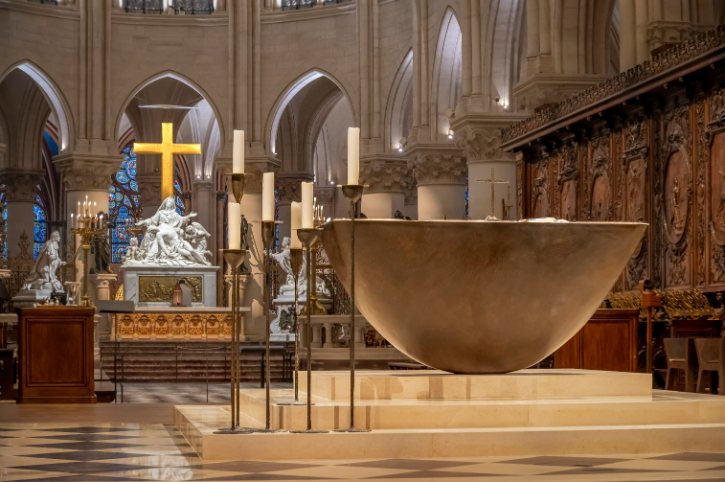
- The cleaned stone is far lighter and brighter than most visitors remember.
- The chapels, paintings, and carvings read more clearly now.
- The great organ, coated in lead dust after the fire, was fully cleaned and retuned.
- A handover ceremony took place on December 7, 2024, with public entry resuming the next day.
e. The New and the Very Old
A simple habit makes the whole cathedral click into place. As you look around, sort what you see into four ages.
- Genuinely medieval: much of the structure and the surviving rose windows.
- 19th-century work: the fantastical stone creatures on the balustrades, and the original spire design.
- Post-fire rebuild: the new roof and spire.
- Brand new: the dark bronze altar and furnishings, the oak chairs, and the new reliquary that holds the Crown of Thorns, which returned to the cathedral in December 2024.
f. Views Outside and a Fitting End
Some of the finest views are from the public spaces around the cathedral. From the forecourt you get the classic head-on view, and from the riverside you see the flying buttresses and the rebuilt spire. Look for the brass marker in the forecourt, Point Zéro, from which road distances across France are measured.
Now think back over where you started. A quiet royal garden, elegant streets, literary cafés, an old market lane, a hidden passage, and the open river.
Step by step, you moved from everyday Left Bank life into the medieval, royal, and sacred heart of Paris, all of it just a minute or two apart.
Stand on the forecourt for a moment before you go. You have crossed sixteen centuries of the city in a single easy morning, and the bright new stone of Notre-Dame is the perfect place to let that settle.