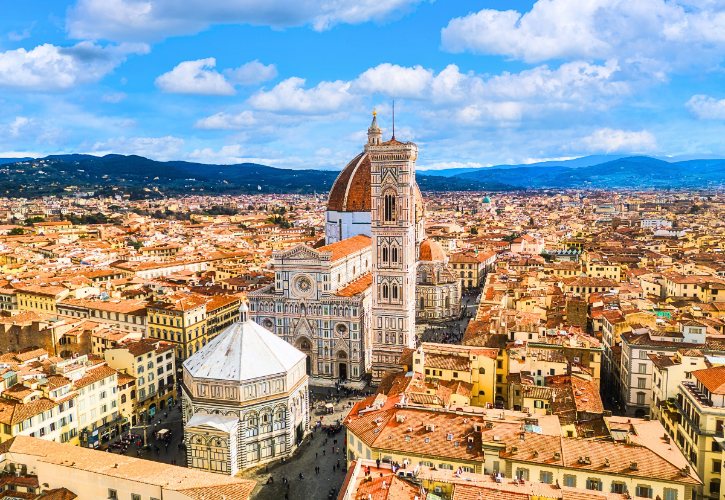
Florence rewards walkers like few cities on earth. Its greatest sights sit remarkably close together, so a single unhurried stroll carries you from towering cathedrals to hidden markets, from a river-spanning bridge to quiet neighborhood squares.
Each stop below flows into the next, never more than a few minutes apart. You do not need buses or plans, just comfortable shoes and a little curiosity. Here is what to see, and what to look for, at each one. 😊
1. Via dei Servi
a. The approach, not the monument
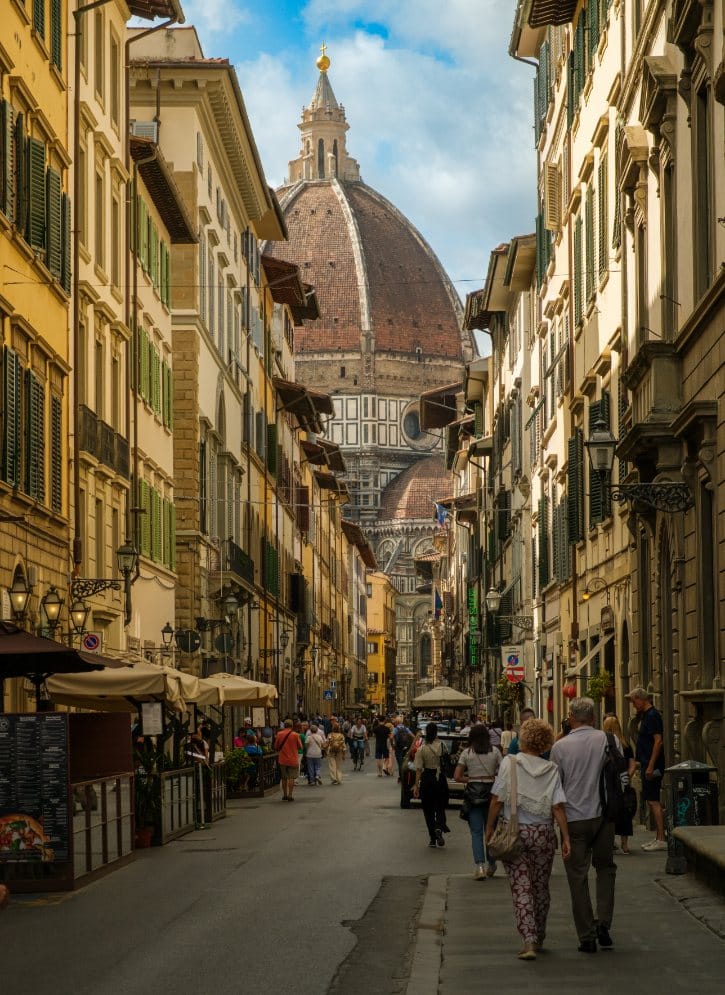
Via dei Servi is not a landmark to tick off. It is the perfect way to arrive at one. The street runs south from the calm Renaissance arcades of Piazza della Santissima Annunziata, laid out in the mid-1200s by the Servite Order to link their monastery with the city center.
Think of it as a runway to the cathedral. As you walk, Brunelleschi’s great terracotta dome slowly rises above the rooftops, growing and shifting between the buildings with every step. That slow reveal is the whole point of the street.
b. Where the view is best
The framing is strongest along the central stretch of the street:
- The section between Via degli Alfani and Via de’ Pucci, where old stone cornices frame the cathedral lantern.
- The way the dome seems to change shape as you move, never looking quite the same twice.
- The classic photo: the dome caught neatly between two rows of Renaissance stone.
c. Details most people walk past
This is a real working street of bakeries, workshops, and old family homes. A few small things reward a sharp eye:
- Palazzo Sforza Almeni at number 12, with window grilles resting on carved stone turtles and Mannerist frescoes inside by Vasari and Cristofano Gherardi.
- A bricked-up window at the corner of Via de’ Pucci, sealed by ducal order after a failed 1559 plot to assassinate Grand Duke Cosimo I from behind its shutters.
- Palazzo Budini Gattai, famous for a corner window that legend says must always be left open.
2. Piazza del Duomo
a. An ensemble, not a single building
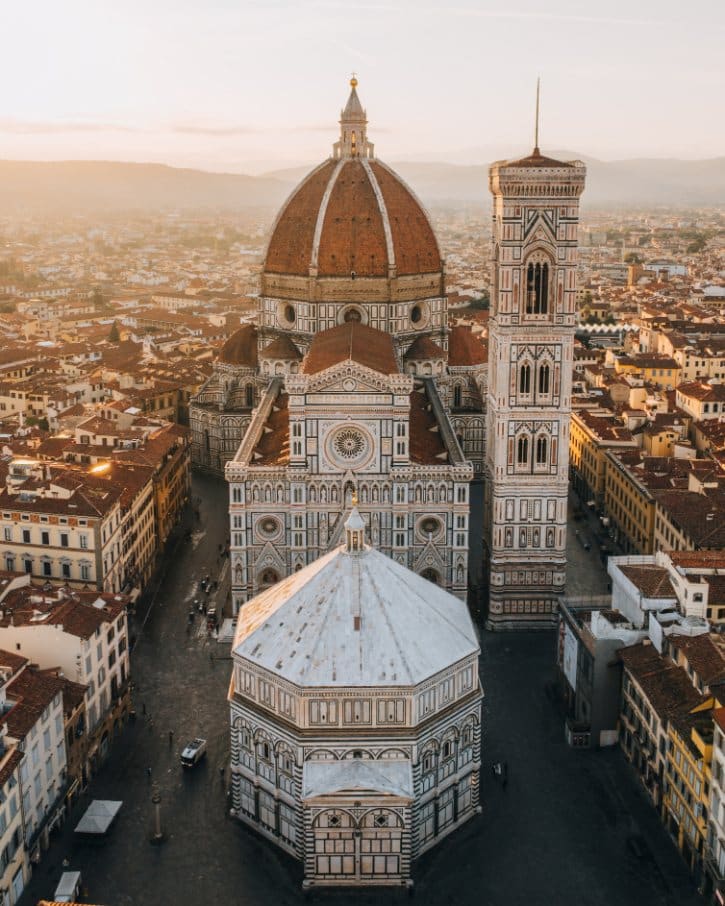
Piazza del Duomo is not just “where the cathedral is”. It is an extraordinary cluster of major buildings standing shoulder to shoulder, forming the religious and monumental heart of the city.
Do not view it from one spot and leave. Circle the whole complex and you travel through architectural history in a single loop, from Romanesque to Gothic to Renaissance.
b. The four great landmarks
The square holds three separate buildings, each a masterpiece in its own right, plus the dome that crowns the largest of them:
- The Cathedral of Santa Maria del Fiore, the vast church at the center of it all, begun in 1296.
- Brunelleschi’s dome, which crowns the cathedral rather than standing on its own, still the engineering marvel that defines the skyline.
- Giotto’s Campanile, the free-standing bell tower beside the cathedral.
- The octagonal Baptistery of San Giovanni, the oldest of the three buildings.
What ties them together is the colored marble: white from Carrara, green from Prato, and red from the Maremma, wrapping the cathedral, campanile, and baptistery so the whole square reads as one design.
c. Details worth a closer look
Circle the buildings slowly and you will spot things most visitors miss:
- The ornate front is far newer than it looks. The original medieval facade, begun by Arnolfo di Cambio and left unfinished, was dismantled in 1587. The Neo-Gothic front you see today was designed by Emilio De Fabris and built between 1876 and 1887.
- The dome (1418 to 1436) is still the largest unreinforced masonry cupola in the world, spanning 45.5 meters inside, built with a herringbone brick pattern and no scaffolding beneath it.
- On the Baptistery, Ghiberti’s gilded Gates of Paradise are museum-grade copies. The restored originals sit in the nearby Museo dell’Opera del Duomo.
- Giotto’s Campanile rises 84.7 meters, its lower panels carved with the arts, sciences, and planets.
Seen up close, right after that teasing view along Via dei Servi, the dome feels almost impossibly large.
3. Via dei Calzaiuoli
a. The city’s connecting spine
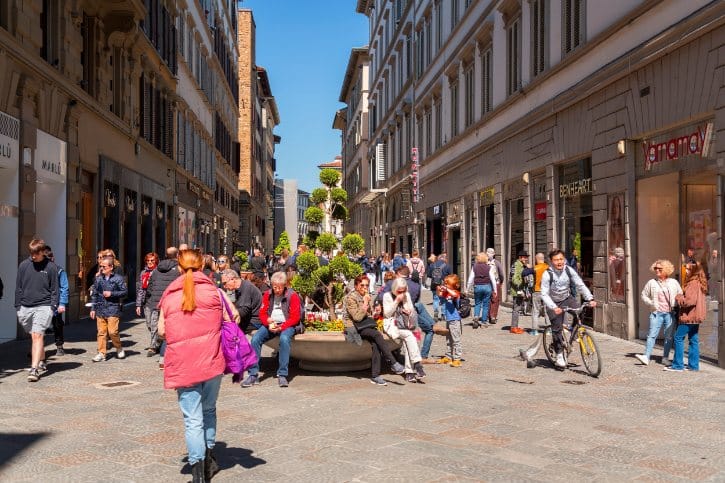
If Florence feels easy to explore, this street is a big reason why. Via dei Calzaiuoli runs about 400 meters and connects the religious heart at the Duomo with the civic heart at Piazza della Signoria.
It began as a tangle of narrow medieval lanes named for the guilds who worked here, then was widened to its present 14 meters between 1842 and 1844 under Grand Duke Leopold II, which is why it feels so open today.
One note: it is pedestrian, but not fully car-free. Early-morning delivery vans and small electric carts still pass through.
b. What lines the street
This is where Florence shops, strolls, and people-watches:
- Boutiques, cafes, and historic shopfronts run the full length of the street.
- Look south for a long view of the Torre d’Arnolfo rising over Palazzo Vecchio.
- In 1834 the street hosted the Bazar Buonaiuti, Florence’s very first covered shopping arcade.
c. Do not miss Orsanmichele
About halfway down stands the tall, rectangular bulk of Orsanmichele, one of the city’s most unusual buildings:
- It began in 1337 as a covered grain market, then was enclosed and turned into a guild church.
- Its exterior niches hold fourteen sculptures commissioned by the guilds, with names like Donatello, Ghiberti, and Verrocchio attached.
- The outdoor statues are copies. The restored originals are displayed upstairs in the Orsanmichele Museum, which reopened in January 2024.
4. Piazza della Repubblica
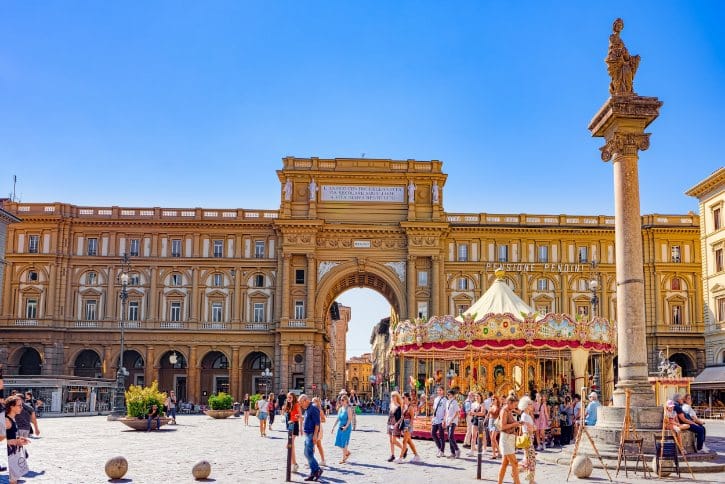
a. Roman roots underfoot
Piazza della Repubblica proves that Florence is not frozen in the Renaissance. Beneath its pavements lies the core of ancient Roman Florentia.
The Roman forum stood right here, at the crossroads of the city’s two main streets, laid out in the first century BCE.
The Colonna dell’Abbondanza on the eastern side still marks that ancient center. It was rebuilt using old granite shafts and once served as a pillory where cheats were tied up.
b. The square that replaced a neighborhood
Most of what you see is surprisingly modern:
- The redevelopment, known as the Risanamento, took place between 1885 and 1895, in the decades after Florence briefly served as capital of Italy from 1865 to 1871.
- Planners cleared away the old Mercato Vecchio, medieval tower houses, guild churches, and the historic Jewish Ghetto.
- In their place rose broad, Parisian-style avenues and a grand triumphal arch, the Arcone.
So the square carries an unusual weight. Much of its importance lies in what no longer stands here.
c. The historic cafes
The square is famous for its grand old cafes, once gathering places for writers and artists:
- Caffè Gilli, founded by a Swiss pastry family in 1733, with Belle Époque woodwork and Murano glass chandeliers.
- Caffè Giubbe Rosse, the meeting place of the Italian Futurists, where Marinetti and his circle launched their ideas.
- Caffè Paszkowski, another long-standing haunt of the city’s intellectuals.
A cheerful antique-style carousel turns at the center, softening all that imperial architecture. Notice how open it feels after the tight rush of Via dei Calzaiuoli.
5. Fontana del Porcellino
a. The market that hosts the boar
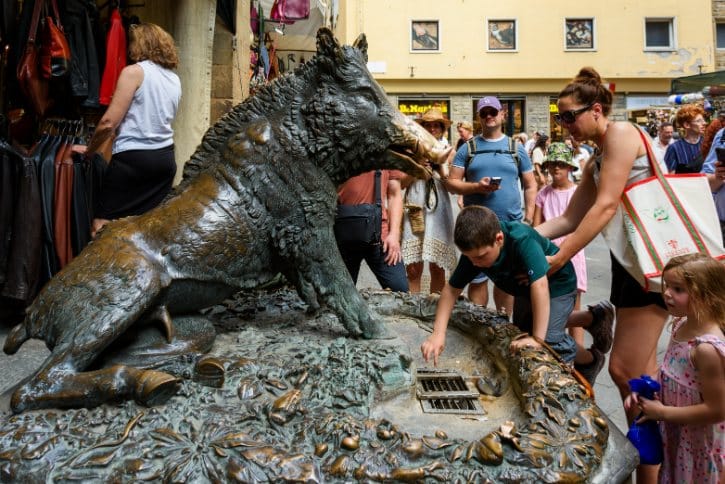
This little stop proves that memorable Florence moments do not always require giant monuments. The bronze fountain sits on the edge of the Loggia del Mercato Nuovo:
- It was built between 1547 and 1551 for Grand Duke Cosimo I.
- It was made for luxury trades like silk brocade and gold thread.
- It was called the “New Market” to set it apart from the older market that stood where Piazza della Repubblica is now.
- Its arcades still shelter stalls selling leather goods, scarves, and souvenirs.
b. The boar itself
A few facts are worth getting right:
- Despite the nickname meaning “little pig”, the sculpture is a life-sized wild boar.
- It was cast by court sculptor Pietro Tacca, working from an ancient marble boar given to the Medici.
- The one you see outdoors is a 1998 bronze copy.
- Tacca’s weathered original is preserved across the river in the Museo Stefano Bardini, and the ancient marble that inspired it is in the Uffizi.
c. The ritual, and the Scandal Stone
Touching the boar is a centuries-old tradition, documented as far back as 1766. Rub the snout, worn shiny by countless hands, and you are said to return to Florence. Place a coin on the tongue, and if it slips through the grate below, good luck is yours.
Before you leave, look down at the center of the loggia floor. There lies the Pietra dello Scandalo, a circular marble inlay where bankrupt merchants were once publicly punished before being banished from the city. It is an easy detail to walk straight over.
6. Piazza della Signoria and Palazzo Vecchio
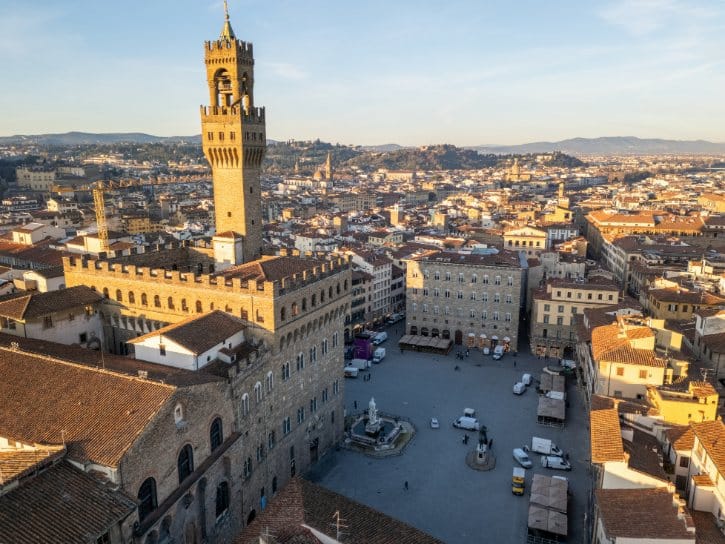
a. Florence’s civic stage
If the Duomo is the city’s religious heart, this square is its political one. This is where Florence governed itself, celebrated its triumphs, and at times settled its scores in public.
The open, L-shaped space took shape in the late 1200s, after a rival faction was defeated and their houses torn down to clear the ground. Today it works like an open-air theater of power.
b. Palazzo Vecchio
The great fortress dominating the square repays a close look:
- It was built between 1299 and 1314, with designs attributed to Arnolfo di Cambio.
- The off-center tower, the Torre d’Arnolfo, climbs 95 meters and reuses the base of an older tower.
- Out front stands a copy of Michelangelo’s David, on the exact spot where the original stood until 1873.
- Beside it looms Bandinelli’s muscular Hercules and Cacus.
c. The Loggia dei Lanzi
Just south of the palace, the Loggia dei Lanzi is an open-air sculpture gallery you can walk right into, free of charge. Two works steal the show:
- Cellini’s bronze Perseus with the Head of Medusa (1554).
- Giambologna’s swirling Rape of the Sabine Women (1583), carved from a single block of marble.
d. Small things people miss
The huge Fountain of Neptune, nicknamed “Il Biancone”, anchors one side. Near it, a round granite plaque set into the ground, its inscription lettered in bronze, marks the spot where the friar Girolamo Savonarola was hanged and burned in 1498. And notice the long wing of the Uffizi stretching from the square toward the river, a preview of the stop to come.
7. Via dei Neri
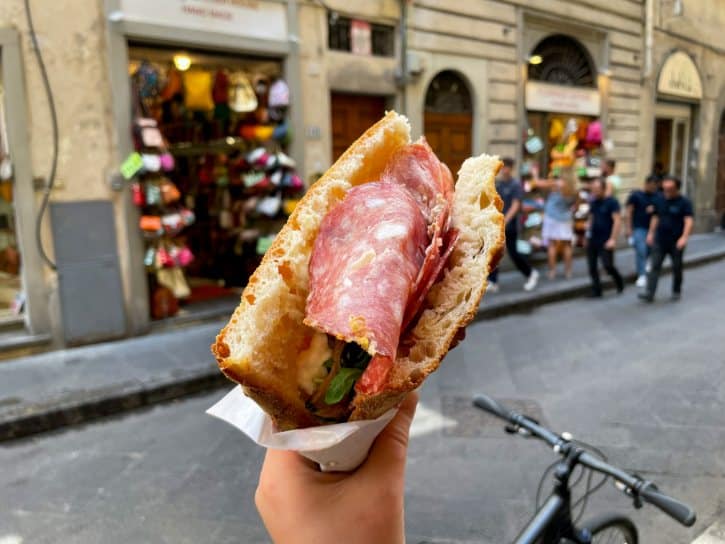
a. From politics to panini
After the grand scale of Piazza della Signoria, Via dei Neri feels wonderfully human. It is narrow and curving, lined with tall medieval houses, and it follows an old bank of the Arno.
Named for the aristocratic Neri family who once had towers here, the street today is all about food, and it makes a delicious change of pace between two heavyweight landmarks.
b. A food-lover’s lane
This is one of Florence’s great eating streets, packed with small, family-run shops selling:
- Schiacciata, the crusty, salt-flecked Tuscan flatbread, baked fresh and stuffed to order.
- Cured meats like prosciutto toscano, finocchiona, and wild boar sausage.
- Aged pecorino cheese, and spreads of truffle or artichoke.
- Wine shops, traditional bakeries, and artisan gelato for something sweet.
c. Enjoy it respectfully
Florence takes good care of its historic center, so a quick heads-up helps you fit in:
- Local rules across the old city discourage sitting on steps and in doorways or blocking the narrow lanes.
- Do not stop, sit, or linger to eat on the street, steps, or in doorways in the historic center. The easy, respectful option is to take a seat at a cafe or restaurant.
- Keep doorways and sidewalks clear.
For photos, slow down here. Warm light spills from bakery windows, and the tall stone walls make a lovely frame for the crowd moving through. It is atmosphere, not monuments, that makes the shots so good.
8. Piazzale degli Uffizi and the Uffizi Galleries
a. The courtyard before the ticket
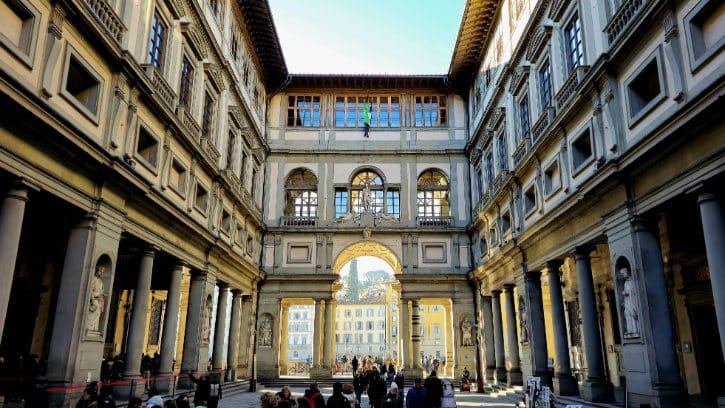
The Uffizi is really two experiences, and the first is free. Before any ticket, there is the courtyard itself, the long Piazzale degli Uffizi framed by twin colonnades of soft grey stone. Vasari designed it in 1560 for Cosimo I, originally to house the government offices, the “uffizi”, that give the place its name.
Walk its length toward the river, where an open loggia frames a view of the Arno and the hills of San Miniato. Between the columns stand statues of Tuscan greats, from Leonardo to Galileo to Dante. Even without a ticket, this space is worth your time.
b. Masterpieces to prioritize inside
The galleries upstairs hold one of the world’s finest collections. Do not try to see everything. Aim for a handful of works that show why it matters:
- Botticelli’s The Birth of Venus and Primavera, in Rooms 10 to 14, glowing with delicate tempera and gold.
- Michelangelo’s Doni Tondo, displayed in the Uffizi’s Michelangelo room, his only finished panel painting, still in its original carved frame.
- Leonardo da Vinci’s early Annunciation.
- Raphael’s tender Madonna of the Goldfinch.
- Caravaggio’s dramatic Bacchus and Medusa.
c. Views and the Vasari Corridor
From the upper corridor, large windows look straight down over Ponte Vecchio and the Arno, a preview of your next stop from above. The restored Vasari Corridor starts from its own entrance at Room D19, on the Uffizi’s first floor.
This private elevated passage reopened in December 2024 after a long restoration, and now runs as a one-way route high above the streets toward the Boboli Gardens.
9. Ponte Vecchio
a. A bridge that behaves like a street
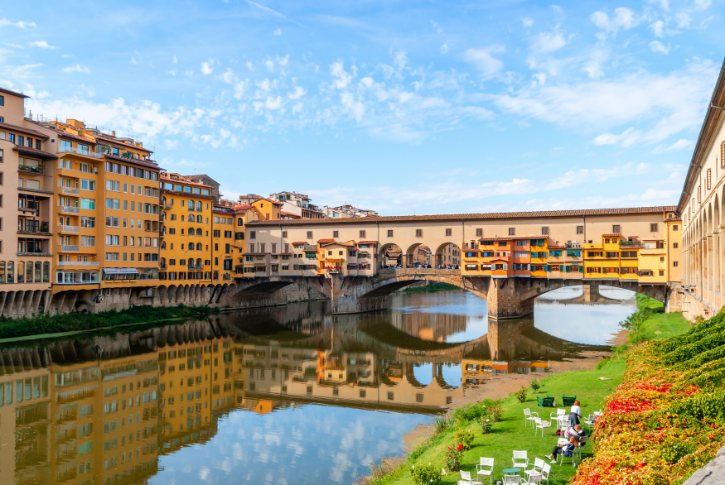
Ponte Vecchio does not feel like a bridge at all. It feels like a street that happens to cross a river, lined with shops and packed with people. It sits at the narrowest point of the Arno, where a Roman road once crossed.
After a devastating flood in 1333 swept away earlier crossings, it was rebuilt between 1339 and 1345 with wide, low stone arches, a clever design that let future floods pass more easily. The shops still hang out over the water on old timber and stone brackets.
b. From butchers to goldsmiths
The bridge has changed trades over the centuries:
- For a long time the shops belonged to butchers, fishmongers, and tanners, who dumped their waste straight into the river.
- In 1593, Grand Duke Ferdinando I expelled them, tired of the smell and noise.
- He replaced them with goldsmiths, jewelers, and silversmiths, whose glittering trade still fills the bridge today, behind historic wooden shutters.
c. Details and history to notice
Slow down and the bridge reveals its layers:
- Above the eastern shops runs the Vasari Corridor, built in 1565 so the grand dukes could walk privately between Palazzo Vecchio and Palazzo Pitti. At its far end it bends around a stubborn family’s tower they refused to let anyone tear down.
- Midway, the shops open into terraces. A bronze bust of the goldsmith Cellini stands on one side, with a lovely view downstream toward Ponte Santa Trinita.
- At the bridge’s northeast corner, where it meets Piazza del Pesce, a carved plaque bears lines from Dante’s Paradiso recalling the 1215 murder of Buondelmonte, which set off generations of civil strife between the city’s Guelph and Ghibelline factions.
- A marble tablet honors Gerhard Wolf, the German consul who helped save the bridge. In August 1944, retreating forces blew up every bridge in Florence except this one, destroying the buildings at each end instead to block the way. The bridge survived; the streets around it did not.
10. Palazzo Pitti
a. From republic to royal court
Cross the river and the mood changes. Palazzo Pitti marks the shift from Florence’s proud republic into the world of grand dukes and kings. It was begun around 1458 for the banker Luca Pitti, who wanted a home grand enough to outshine the Medici.
Ironically, the family ran out of money, and in 1549 they sold the unfinished palace to Eleonora di Toledo, wife of the Medici duke Cosimo I. It went on to house the Medici grand dukes, then the Habsburg-Lorraine rulers, and finally the kings of Savoy during Florence’s years as Italy’s capital.
b. The immense facade
The exterior alone announces its ambition:
- A horizontal front stretching more than 200 meters
- Rough, massive blocks of golden pietraforte stone, quarried from the hill right behind the palace.
- A grand courtyard added by Ammannati between 1560 and 1577, opening toward the Boboli Gardens.
c. Inside the Palatine Gallery
The heart of the palace is the Palatine Gallery, and it is unlike a modern museum:
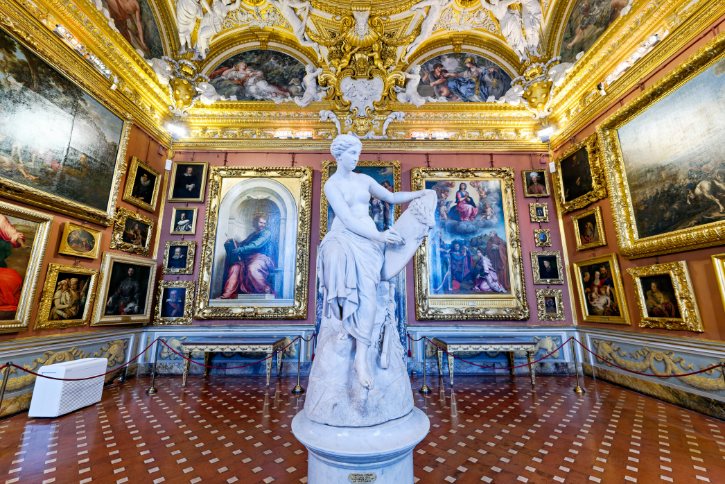
- Paintings are hung the old way, in dense, floor-to-ceiling arrangements across richly frescoed state rooms.
- It holds the world’s highest concentration of masterpieces by Raphael, alongside major works by Titian, Rubens, Artemisia Gentileschi, and Caravaggio.
- Nearby you can walk through the historic Royal Apartments, with their period ceilings, furnishings, and grand rooms.
One note: entry is now through the right-hand doorway, and visitors leave through the central portal onto the square. The palace also opens onto the vast Boboli Gardens behind it, which help you picture Pitti as a complete royal residence of house, art, and grounds together.
11. Piazza de’ Pitti
a. Room to see the whole palace
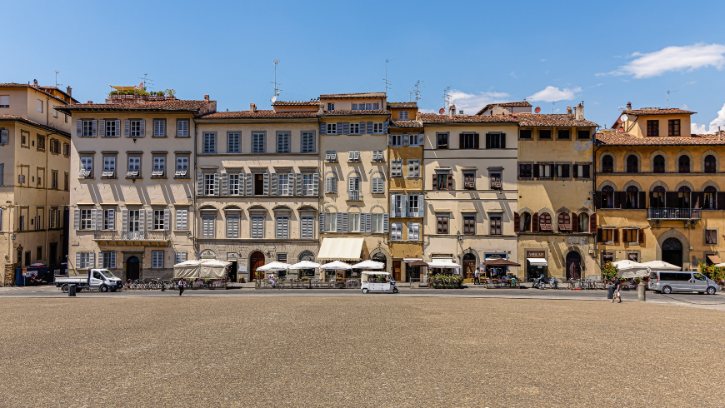
The palace and this square sit in the same spot, yet each deserves its own stop. The reason is simple: only from out here can you grasp the true size of the building.
Piazza de’ Pitti is a wide, gently sloping stone forecourt, cleared long ago as a viewing terrace for processions and parades. Step back into it, turn around, and the enormous facade finally reveals its full scale.
b. The stone up close
From the square, the palace’s walls tell their own story:
- The rough, cyclopean pietraforte blocks, some several meters long, give the palace the look of a carved cliff.
- This is a sharp contrast with the smooth, colorful marble you saw earlier at the Duomo. Same city, completely different mood.
- Look for carved stone lion heads beneath the windows.
- Notice old iron rings once used to tie up horses.
c. A square to sit in
Today the piazza is a relaxed, pedestrian space and a real part of neighborhood life. Students and travelers sit right on the sloping stones to read, sketch, or catch the afternoon sun on the golden facade.
The old courtiers’ houses around the edges, including Palazzo Guicciardini, now hold cafes, bookshops, and small jewelry workshops, a first taste of the Oltrarno’s craft tradition.
For the best photo, head to the lower northwest corner and frame upward across the slope, setting a few small figures against those giant blocks to show the scale.
12. Piazza Santo Spirito
a. Florence as a neighborhood
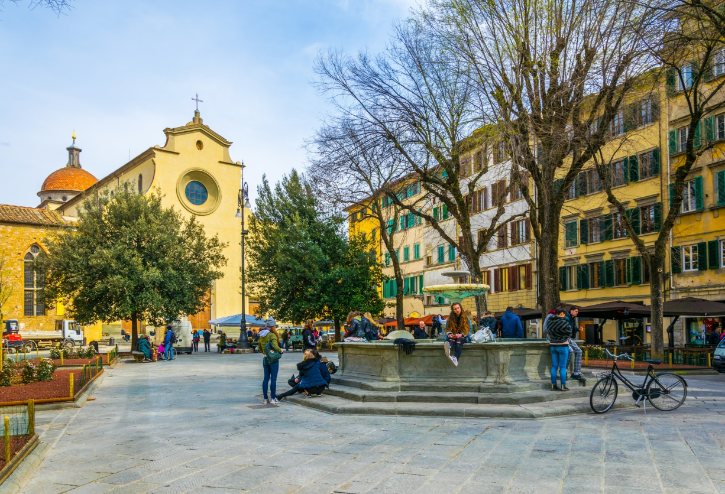
The walk ends not with another blockbuster, but with Florence as people actually live it. Piazza Santo Spirito is the beating heart of the Oltrarno, a genuine neighborhood square.
The area grew up around an Augustinian religious community that settled here in the mid-1200s, drawing craftspeople and families around it. That spirit lives on in the workshops nearby, where you will still find wood carving, restoration, metalwork, and paper marbling.
b. A plain church with a beautiful secret
At the head of the square stands the Basilica di Santo Spirito, one of the great works of the Renaissance:
- It was Brunelleschi’s final church design, commissioned in 1444.
- Inside, it is all calm proportion and harmony, with slender grey stone columns and thirty-eight small chapels curving around the edges.
- The exterior is almost blank, a plain plastered wall that gives no hint of the elegance within.
- In the sacristy hides a delicate wooden crucifix carved by a teenage Michelangelo around 1492, a gift to the friars for letting him study anatomy.
c. A cultural detail to seek out
Right beside the church, at number 30, is an easy-to-miss gem: the Cenacolo di Santo Spirito, home to the Fondazione Salvatore Romano. Set in the old monastery dining hall, it holds a large, weathered fresco by Andrea Orcagna and a fine collection of early stone sculpture. It keeps limited hours, generally open on Mondays, Saturdays, and Sundays, so check before you go.
d. The living square
More than anything, this is a place to linger. Its rhythm changes through the day:
- In the mornings, small fruit and vegetable stalls gather around the central stone fountain.
- Through the year, the square hosts craft and farming fairs. The best known, La Fierucola, generally takes place on the third Sunday of the month, with a break in August, so check the date if a market matters to you.
- As evening falls, the cafes and trattorias fill and the square settles into its easy, local mood.
And that is the real magic of Florence. In one short, unbroken stroll, you have moved from a towering cathedral to a river of goldsmiths to a quiet neighborhood square, through layer after layer of the city. Few places let you feel their whole story so easily, and all of it on foot.