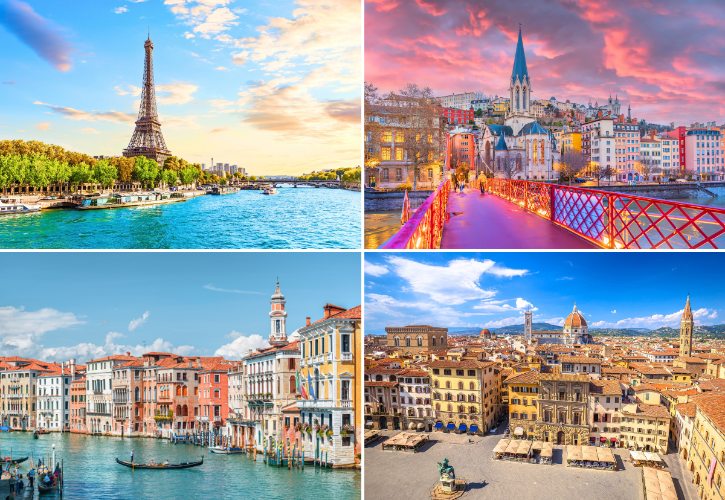
Flying from Paris to Rome takes about two hours, and you would miss everything in between.
Take the train instead, and the trip becomes the adventure. You start among grand Parisian boulevards, climb through the Savoy Alps, then roll down through northern Italy’s art cities and the hills of Tuscany.
The scenery, food, and architecture change with every stop. Here is why the slow way south is the better way to go. 😊
1. Paris, France
a. Why Visit Here
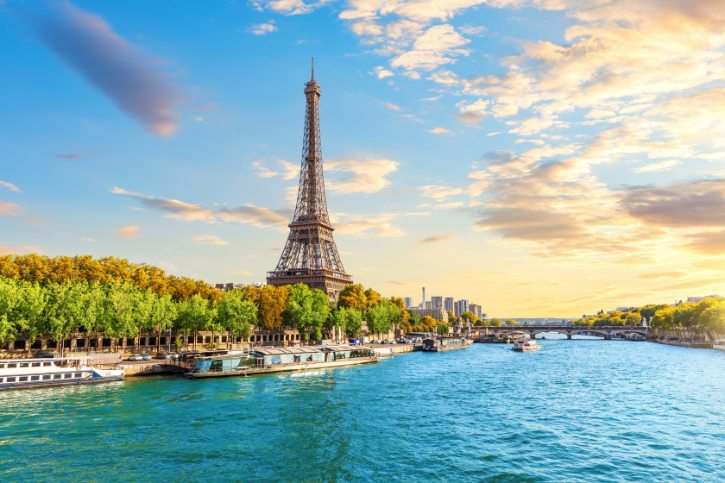
Paris is not just where your journey begins. It sets the tone for everything that follows.
The city is built on a grand scale, with wide tree-lined boulevards, cream stone façades, and long views along the Seine. Seeing it first gives you a clear point of comparison, because nothing later on the route looks quite like it.
b. Best Spots to Visit
- Louvre and Tuileries Garden: The world’s most complete collection of Western art, beside elegant riverside gardens.
- Notre-Dame de Paris and Île de la Cité: The Gothic cathedral on the historic island at the heart of the city.
- The Marais: Medieval streets, the arcaded Place des Vosges, art galleries, and the lively Jewish quarter.
- Montmartre and Sacré-Cœur: Winding village lanes on the city’s highest hill, with a sweeping view from the basilica terrace.
A quick tip. Pick one great museum per day so you do not burn out.
c. Best Nearby Places and Day Trips
The Palace and Estate of Versailles is the day trip to prioritize.
- Wander the lavish State Apartments and the mirrored Hall of Mirrors.
- Stroll the vast formal gardens, fountains, and tree-lined avenues.
- Explore the quieter Grand Trianon, Petit Trianon, and the Queen’s Hamlet.
Versailles fills a full day on its own, so there is no need to add a second big outing here.
d. How Long to Stay
- Minimum: 3 nights. Two full days for the central monuments, the Louvre, Île de la Cité, the Marais, and Montmartre.
- Comfortable: 4 nights. The extra day fits in Versailles without rushing, plus slow dinners and evening walks along the Seine.
e. How to Get to the Next Stop by Train
- From: Paris Gare de Lyon
- To: Lyon Part-Dieu
- Service: TGV INOUI or Frecciarossa (high-speed)
- Type: Direct
- Journey time: About 1 hour 56 minutes
Read More: The Best 3-Day Paris Itinerary Guide
2. Lyon, France
a. Why Visit Here
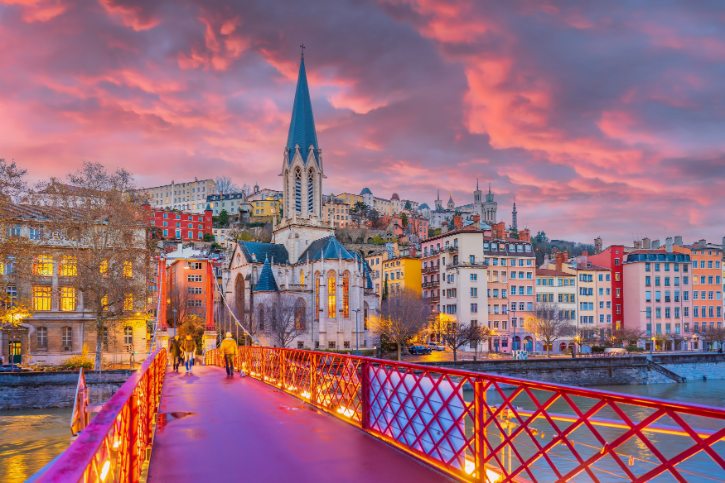
Lyon sits where the Rhône and Saône rivers meet, and it feels completely different from Paris.
It began as Roman Lugdunum, then grew rich on silk. Its signature feature is the traboule, a network of covered passageways cutting through private courtyards. Lyon is also the food capital of France, and its cozy bouchons serve hearty local classics.
b. Best Spots to Visit
- Fourvière Hill and Lugdunum: Two excavated Roman theaters, a Roman museum, and a hilltop basilica with wide views.
- Vieux Lyon and the traboules: One of the largest Renaissance quarters outside Italy, laced with hidden passageways.
- Presqu’île District: The lively center between the rivers, anchored by the huge Place Bellecour.
- Les Halles de Lyon Paul Bocuse: A covered food market packed with cheese, charcuterie, and oyster bars.
Here is the fun part. In Lyon, sightseeing and eating are the same activity, so book at least one dinner in a real bouchon.
c. Best Nearby Places and Day Trips
- Vienne (best choice): A Roman and medieval town with a well-preserved ancient temple, a huge hillside theater, and an archaeological garden.
- Beaujolais (alternative): Rolling vineyards famous for Gamay wine, though they are hard to explore without a car.
For a train-based trip, Vienne is the clear winner. It is packed with history and easy to reach.
d. How Long to Stay
- Minimum: 2 nights. About a day and a half for Fourvière, Vieux Lyon, the Presqu’île, and one proper bouchon dinner.
- Comfortable: 3 nights. Adds a relaxed half-day in Roman Vienne without cutting into your time in central Lyon.
e. How to Get to the Next Stop by Train
- From: Lyon Part-Dieu
- To: Chambéry – Challes-les-Eaux
- Service: TER (regional train)
- Type: Direct
- Journey time: About 1 hour 25 minutes
Read More: 15 Best Spots to Visit in Lyon
3. Chambéry, France
a. Why Visit Here
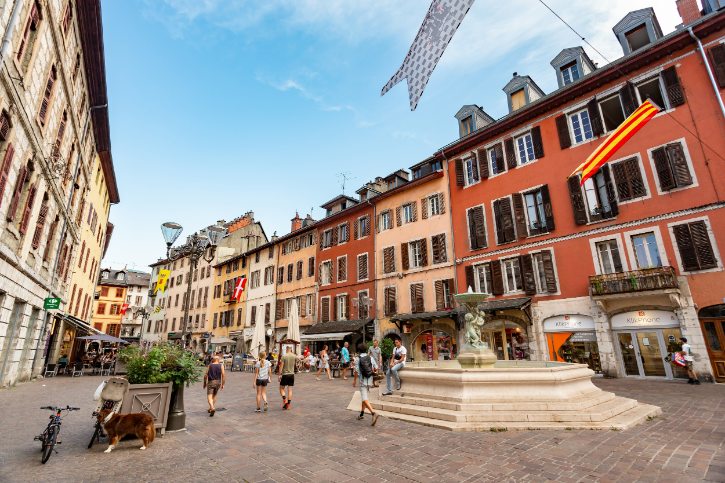
Chambéry is the quiet hinge between France and Italy, and it earns its place on this route.
It was the capital of the Duchy of Savoy for centuries, so the town feels happily caught between two countries, with Italian-style painted façades and vaulted medieval lanes framed by limestone cliffs. Best of all, the station is a flat 6-minute walk from the old center.
b. Best Spots to Visit
- Fontaine des Éléphants: The town’s beloved landmark, with four life-sized stone elephants.
- Château des Ducs de Savoie and Sainte-Chapelle: A large medieval fortress and a chapel richly painted inside.
- Cathedral of Saint-François-de-Sales: Home to the largest trompe-l’œil mural painting in Europe.
- Historic alleys and passageways: Covered lanes and spiral staircase towers throughout the old core.
- Musée Savoisien: A restored convent museum covering Savoyard folk culture and history.
For a short stay, focus on the château and a slow wander through the medieval lanes.
c. Best Nearby Places and Day Trips
- Aix-les-Bains and Lac du Bourget (best choice): France’s largest natural lake, with floral promenades, seasonal boats to the Abbaye d’Hautecombe, and historic thermal parks.
- Annecy (optional): A pretty canal-lined town, but it lies north and pulls you the wrong way before you head east into Italy.
Annecy works only as an optional extra, not a replacement for Chambéry.
d. How Long to Stay
- Minimum: 1 night. Enough for the old center, the Elephant Fountain, the château, and a Savoyard fondue dinner.
- Comfortable: 2 nights. Adds a relaxed half-day at Lac du Bourget.
Chambéry is a stopover by design, so one night works well if time is tight.
e. How to Get to the Next Stop by Train
- From: Chambéry – Challes-les-Eaux
- To: Torino Porta Susa
- Service: TGV INOUI or Frecciarossa (high-speed)
- Type: Direct
- Journey time: About 2 hours 30 minutes
4. Turin, Italy
a. Why Visit Here
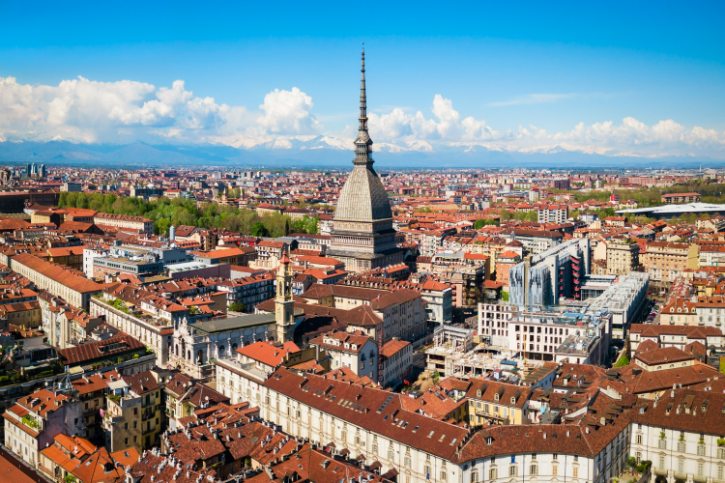
Turin is your first taste of Italy, and it is a grand one.
As the former capital of the House of Savoy, the city has a stately baroque look, with straight boulevards, elegant squares, and long covered arcades. The snowy Alps sit on the horizon, and unlike fast-moving Milan up next, Turin feels calm and refined.
b. Best Spots to Visit
- Piazza Castello and the Royal Museums: The core of Savoy power, joining the Royal Palace, the Royal Armory, and a fine art gallery.
- Museo Egizio: One of the world’s great Egyptian collections, second only to Cairo.
- Mole Antonelliana and Cinema Museum: The city’s soaring brick spire, with a glass lift rising to a panoramic platform.
- Piazza Vittorio Veneto and Monte dei Cappuccini: A vast riverside square and a hilltop view of Turin against the Alps.
- Historic cafés: Old wood-paneled institutions serving bicerin, a warm blend of espresso, chocolate, and cream.
Aim for a mix of royal history, one great museum, a lift-top view, and a café stop.
c. Best Nearby Places and Day Trips
- Reggia di Venaria Reale (best choice): A huge royal hunting estate with a soaring Great Gallery, an ornate chapel, and vast formal gardens.
- Basilica di Superga (shorter option): A hilltop baroque basilica with the Savoy royal crypt and wide views over the plain.
Short on time? Superga is a quick half-day. Have a spare day? Venaria is the grander experience.
d. How Long to Stay
- Minimum: 2 nights. One full day for the Egyptian Museum, the Royal Museums, and the cafés, plus an arrival evening on Piazza Castello.
- Comfortable: 3 nights. Needed to give a half-day to the palace of Venaria Reale.
e. How to Get to the Next Stop by Train
- From: Torino Porta Susa or Torino Porta Nuova
- To: Milano Centrale
- Service: Frecciarossa or Italo (high-speed)
- Type: Direct
- Journey time: About 1 hour
5. Milan, Italy
a. Why Visit Here
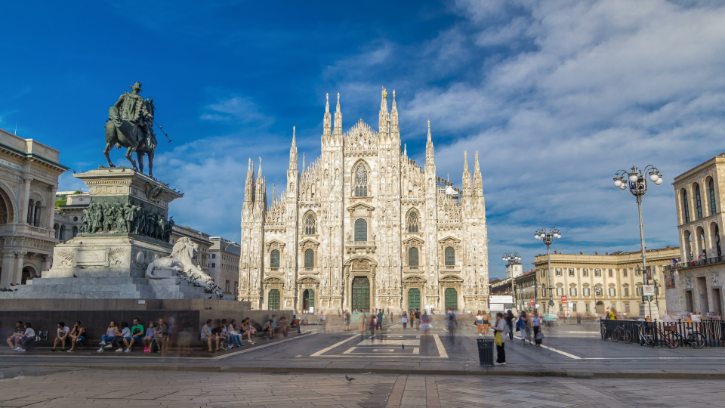
Milan is more than fashion and shopping. Look a little closer and you find real depth.
As Italy’s business and design capital, it mixes modern energy with a stunning Gothic cathedral, quiet Renaissance cloisters, and a canal network shaped in part by Leonardo da Vinci. It gives the journey a jolt of big-city buzz between elegant Turin and Roman Verona.
b. Best Spots to Visit
- Duomo di Milano and terraces: One of the world’s largest Gothic cathedrals, with rooftop terraces among the spires.
- Galleria Vittorio Emanuele II: A beautiful glass-and-iron arcade linking the Duomo to La Scala.
- Pinacoteca di Brera: Milan’s top painting gallery, with works by Caravaggio and Raphael.
- The Last Supper: Leonardo da Vinci’s masterpiece in the refectory of Santa Maria delle Grazie.
- Castello Sforzesco and Parco Sempione: A grand brick fortress with city museums and a large park.
- Navigli and Darsena: The historic canal district, best at aperitivo hour.
c. Best Nearby Places and Day Trips
- Lake Como (for scenery): Stroll Varenna’s lakeshore, visit villa gardens, and ferry across to charming Bellagio.
- Bergamo (for history): A walled upper town of medieval streets, reached by a scenic funicular.
Choose Lake Como for mountain and lake views, or Bergamo for an easier, shorter outing.
d. How Long to Stay
- Minimum: 2 nights. One full day for the Duomo, the Galleria, Brera, The Last Supper, and an evening on the Navigli.
- Comfortable: 3 nights. Needed for a full-day trip to Lake Como or Bergamo.
e. How to Get to the Next Stop by Train
- From: Milano Centrale
- To: Verona Porta Nuova
- Service: Frecciarossa or Italo (high-speed)
- Type: Direct
- Journey time: About 1 hour 13 minutes
Read More: The Best Milan Route to See the City’s Top Sights in One Day
6. Verona, Italy
a. Why Visit Here
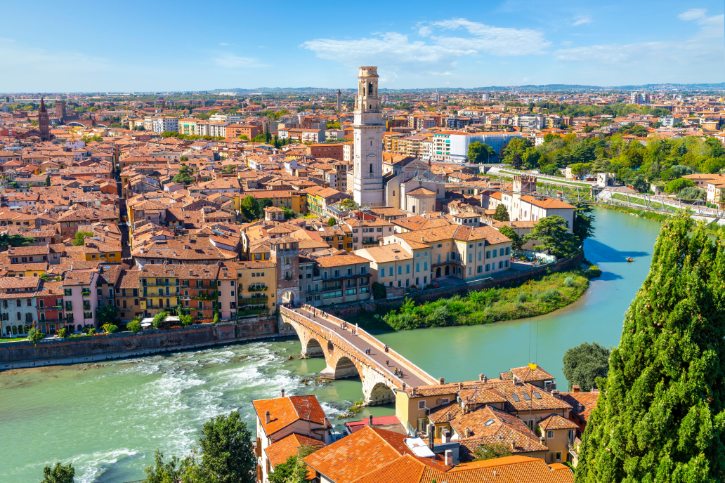
Verona is famous for Romeo and Juliet, but that is the least interesting thing about it.
The city curves along a dramatic bend of the River Adige and layers together Roman, medieval, and Renaissance history. The compact center is calm and easy to walk, paved with rosy local limestone, making it a lovely stop between big Milan and watery Venice.
b. Best Spots to Visit
- Verona Arena: An ancient Roman amphitheater, older than the Colosseum, right on the main square.
- Piazza delle Erbe and Piazza dei Signori: The old market square and an elegant piazza with a monument to Dante.
- Scaliger Tombs: Ornate Gothic funerary monuments of the city’s ruling family.
- Castelvecchio and Ponte Scaligero: A red-brick fortress and its fortified bridge over the river.
- Ponte Pietra and Roman Theatre: An ancient stone bridge leading to a hillside theater with rooftop views.
- Juliet’s House: A famous balcony and statue, best treated as a quick, fun stop.
c. Best Nearby Places and Day Trips
Lake Garda is the easy, rewarding excursion, and Italy’s largest lake.
- Explore the castle town of Sirmione on its narrow peninsula.
- Visit the lakeside Scaligero Castle and the Roman ruins of the Grotte di Catullo.
- Relax on the promenades of small resort towns like Peschiera del Garda.
d. How Long to Stay
- Minimum: 1 night. Plenty for the old center, Ponte Pietra, the Arena, and a relaxed dinner, spread over your arrival afternoon and the next morning.
- Comfortable: 2 nights. Adds an unhurried morning at Castelvecchio and an afternoon at Lake Garda.
e. How to Get to the Next Stop by Train
- From: Verona Porta Nuova
- To: Venezia Santa Lucia
- Service: Frecciarossa or Italo (high-speed)
- Type: Direct
- Journey time: About 1 hour 12 minutes
Make sure your ticket says Venezia Santa Lucia, right inside the historic city, not Venezia Mestre on the mainland.
7. Venice, Italy
a. Why Visit Here
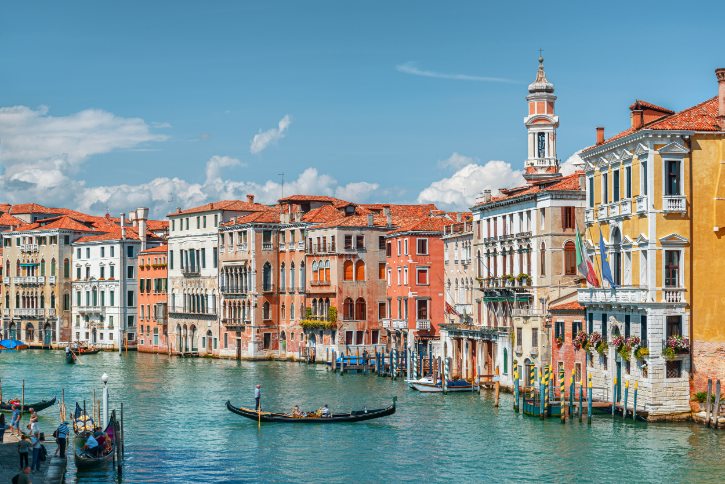
Arriving in Venice by train is one of the great entrances in travel.
You cross a long railway bridge over the lagoon, then walk out of the station straight into a city with no cars at all, only canals, footpaths, and boats. It is a place of Gothic and Byzantine palaces and glittering water, and nowhere else on this route feels remotely like it.
b. Best Spots to Visit
- Mark’s Square and Basilica: The heart of old Venice, famous for its Byzantine domes and glittering gold mosaics.
- Doge’s Palace: The Gothic seat of Venice’s rulers, linked to the old prisons by the Bridge of Sighs.
- Rialto Bridge and Market: The classic crossing over the Grand Canal, liveliest in the early morning.
- Dorsoduro District: A calm, artistic area with top galleries and the striking Salute church.
- Cannaregio District: A real residential quarter with the historic Jewish Ghetto and local wine bars.
Dorsoduro leans toward galleries and grand views, while Cannaregio is all everyday Venetian life.
c. Best Nearby Places and Day Trips
The lagoon islands make a perfect day out, each with its own character.
- Murano: Centuries of glassblowing, with furnaces you can still watch.
- Burano: Brightly painted fishermen’s cottages and delicate lacework.
- Torcello: A quiet, marshy island with an ancient cathedral full of Byzantine mosaics.
d. How Long to Stay
- Minimum: 2 nights. Essential so you can experience Venice early and late, once the day-trippers have gone.
- Comfortable: 3 nights. One day for San Marco and Dorsoduro, one for Cannaregio and the lagoon islands, plus time to wander.
e. How to Get to the Next Stop by Train
- From: Venezia Santa Lucia
- To: Bologna Centrale
- Service: Frecciarossa or Italo (high-speed)
- Type: Direct
- Journey time: About 1 hour 28 minutes
Read More: The Perfect Venice Walking Route for Seeing the Best Sights in One Day
8. Bologna, Italy
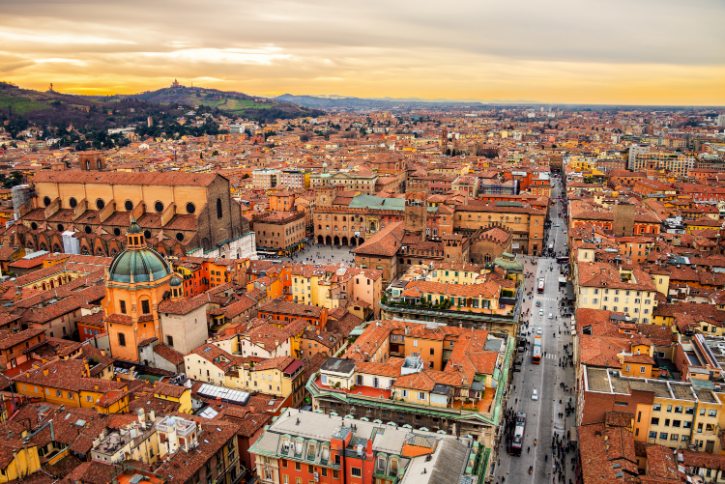
a. Why Visit Here
Bologna is often skipped by travelers rushing between Venice and Florence. That is their loss, and your gain.
This is a warm, red-brick city of grand squares, the world’s oldest university, buzzing food markets, and miles of covered walkways, or porticoes. Its nickname is La Grassa, “The Fat One”, and the food lives up to it. Between watery Venice and marble Florence, Bologna feels earthier and more lived-in.
b. Best Spots to Visit
- Piazza Maggiore and San Petronio: The grand main square, framed by a huge Gothic church.
- The Quadrilatero: A dense old market district packed with delis, fishmongers, and pasta makers.
- Archiginnasio and Anatomical Theatre: The old university seat, with a beautifully carved wooden lecture hall.
- Porticoes of San Luca: The world’s longest covered walkway, climbing to a hilltop sanctuary.
- The Two Towers: Bologna’s medieval symbol, though the towers are currently closed to climbing.
For a rooftop view, head to the Clock Tower on Piazza Maggiore, which faces the Two Towers.
c. Best Nearby Places and Day Trips
Ravenna is the rewarding cultural excursion, famous for some of the finest early Christian art in the world.
- Marvel at the shimmering Byzantine mosaics in the Basilica di San Vitale.
- See the tiny, star-studded ceiling of the Mausoleum of Galla Placidia.
- Visit the mosaic-lined Basilica of Sant’Apollinare Nuovo.
One honest note. Ravenna lies east, while Florence is south, so this trip means a bit of backtracking.
d. How Long to Stay
- Minimum: 2 nights. One full day for the porticoes, the Quadrilatero, the university, and an evening dinner under the arcades.
- Comfortable: 3 nights. Needed for a full day among the mosaics of Ravenna.
Do not judge Bologna by its monument count. Its magic is in the food and the lively evenings.
e. How to Get to the Next Stop by Train
- From: Bologna Centrale
- To: Firenze Santa Maria Novella
- Service: Frecciarossa or Italo (high-speed)
- Type: Direct
- Journey time: About 38 minutes
This short hop feels like an intercity subway, and it shows how easy the whole route can be.
9. Florence, Italy
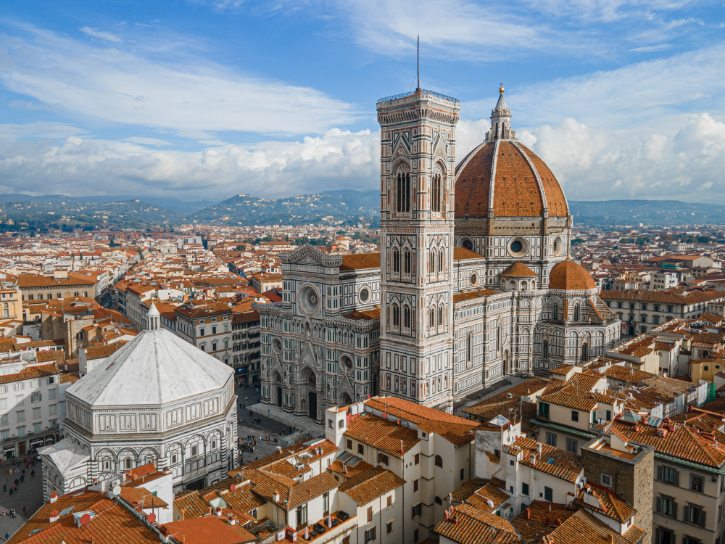
a. Why Visit Here
Florence is the artistic peak of the whole journey, and it deserves real time near the end.
Cradled by Tuscan hills along the Arno, this compact city holds an incredible concentration of Renaissance art and architecture.
The look shifts from Bologna’s brick to gleaming Tuscan marble, with a famous domed cathedral, world-class museums, and hillside viewpoints. Between earthy Bologna and imperial Rome, Florence is all beauty and craft.
b. Best Spots to Visit
- Piazza del Duomo complex: Brunelleschi’s soaring dome, Giotto’s bell tower, and the Baptistery.
- Piazza della Signoria and Palazzo Vecchio: An open-air gallery of Renaissance statues at the city’s civic heart.
- Uffizi Gallery: The greatest collection of Italian Renaissance painting anywhere.
- Ponte Vecchio and the Oltrarno: The famous jeweler-lined bridge leading into an artsy, workshop-filled quarter.
- Piazzale Michelangelo: The classic hilltop terrace with a full panorama of the city and the dome.
Trust me, time your visit to Piazzale Michelangelo for golden hour.
c. Best Nearby Places and Day Trips
- Fiesole (half-day): An ancient hilltop town with a Roman theater and wide views over the Arno valley.
- Arezzo (full-day): A handsome Tuscan hill town known for celebrated Renaissance frescoes, a sloping medieval square, and a Medici fortress.
Both are lovely, and Arezzo sits right on the line toward Rome, so it keeps you moving in the right direction.
d. How Long to Stay
- Minimum: 3 nights. Needed for the Duomo complex, the Uffizi, the Oltrarno, and the viewpoints without museum fatigue.
- Comfortable: 4 nights. Ideal for adding Fiesole or Arezzo, plus slow Tuscan dinners.
e. How to Get to the Next Stop by Train
- From: Firenze Santa Maria Novella
- To: Roma Termini
- Service: Frecciarossa or Italo (high-speed)
- Type: Direct
- Journey time: About 1 hour 55 minutes
Book a train ending at Roma Termini, right in the center, rather than Roma Tiburtina out in the suburbs.
Read More: The Perfect Florence Walking Route to Explore the City’s Best Sights in One Day
10. Rome, Italy
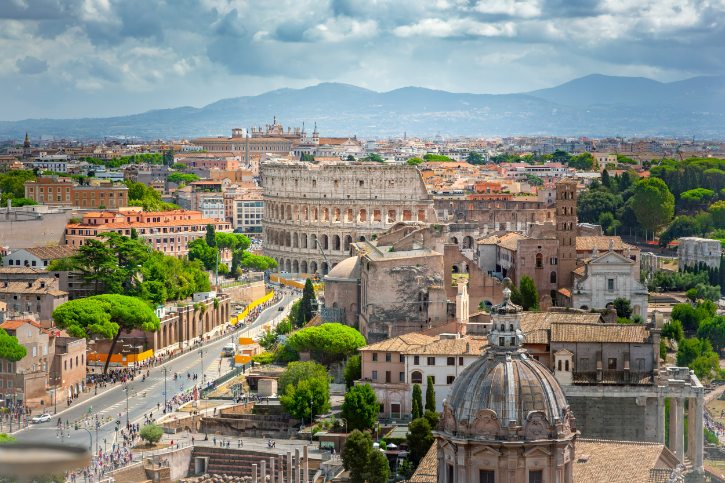
a. Why Visit Here
Rome is the grand finale, and it earns that title.
Here the whole journey comes together, with ancient ruins, early Christian churches, Renaissance palaces, and dramatic baroque fountains stacked layer upon layer. Where Florence is refined and compact, Rome is vast, raw, and endlessly deep, completing a story that began on the banks of the Seine.
b. Best Spots to Visit
- Ancient Rome: The Colosseum, the Roman Forum, and Palatine Hill, best explored together as one epic walk.
- Historic center circuit: A stroll linking the Pantheon, Piazza Navona, the Trevi Fountain, and the Spanish Steps.
- Vatican Museums and Sistine Chapel: An overwhelming art collection ending at Michelangelo’s painted ceiling.
- Peter’s Basilica and Square: The vast church and its sweeping colonnaded square, separate from the museums.
- Trastevere: A charming old quarter of cobbled lanes and classic Roman trattorias, best in the evening.
c. Best Nearby Places and Day Trips
Ostia Antica is the standout excursion, the remarkably preserved harbor city of ancient Rome.
- Walk complete ancient streets lined with shops, taverns, and apartment blocks.
- Explore old bathhouses and a Roman theater set among umbrella pines.
- Enjoy a Pompeii-like experience without the long journey south.
Rome itself already deserves several days, so there is no need for a longer list of day trips.
d. How Long to Stay
- Minimum: 3 nights. One full day for Ancient Rome and the historic center, and one for the Vatican and Trastevere.
- Comfortable: 4 to 5 nights. Lets you enjoy the galleries slowly, explore more neighborhoods, and add a half-day at Ostia Antica.
Split the big areas across separate days, and build in time for queues. Rome is not a city to rush.
Read More:
- The Perfect One-Day Colosseum Walking Route and Nearby Sights
- The Best Walking Route Around Trevi Fountain and Nearby Attractions
e. The Perfect Ending
The journey ends the moment you step off the train at Roma Termini, right in the center of the Eternal City. No airport transfers, no boarding gates, just Rome itself waiting outside the doors.
You have traveled from Paris to Rome and watched Europe change around you the whole way, through French boulevards, alpine valleys, Italian art cities, and Tuscan hills. Arriving this way, in the heart of Rome, is the best possible finish to the trip. That is something a flight could never give you.
Read More: 17 Best Things to Do in Rome