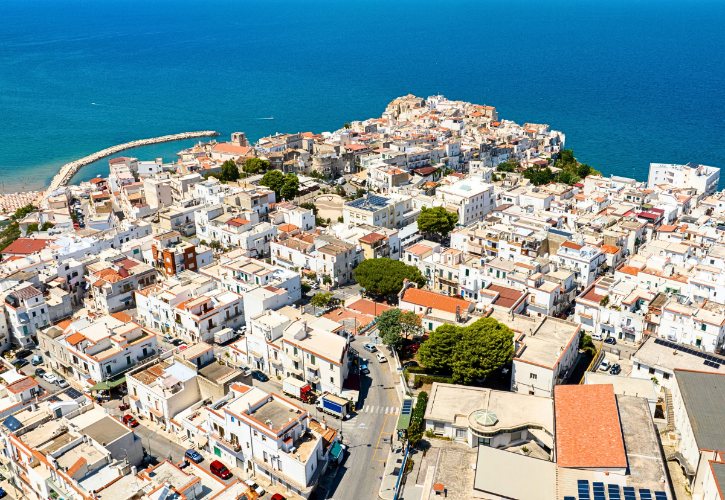
Santorini has a look you know instantly. White houses above deep blue water, sun-bleached lanes, and views that stop you in your tracks.
Here’s the thing. You can feel echoes of that same beauty all over Italy, just wearing a different, homegrown character. Some places share the colours. Others share the cliffs, the coves, or the slow harbour calm.
None of them is a copy, and that’s the joy of it. Ten Italian spots, ten reasons to skip the crowds and fall for something real. 😊
1. Panarea, Sicily
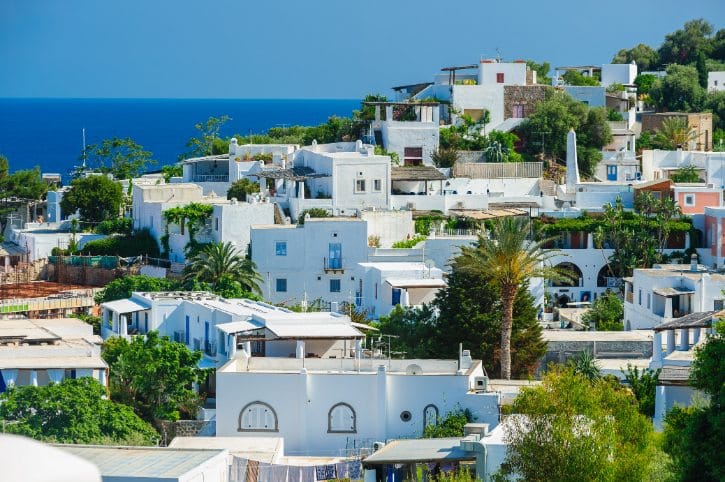
The smallest and most polished island in the volcanic Aeolian chain, Panarea feels like a whitewashed daydream floating north of Sicily.
a. The Greek-island echo
- A crisp white-and-blue palette, pale house fronts against deep cobalt sea.
- A genuine volcanic island setting.
- Car-free lanes, best explored on foot or by small electric cart.
- Vividly coloured rocky coves along an arid, sun-baked coast.
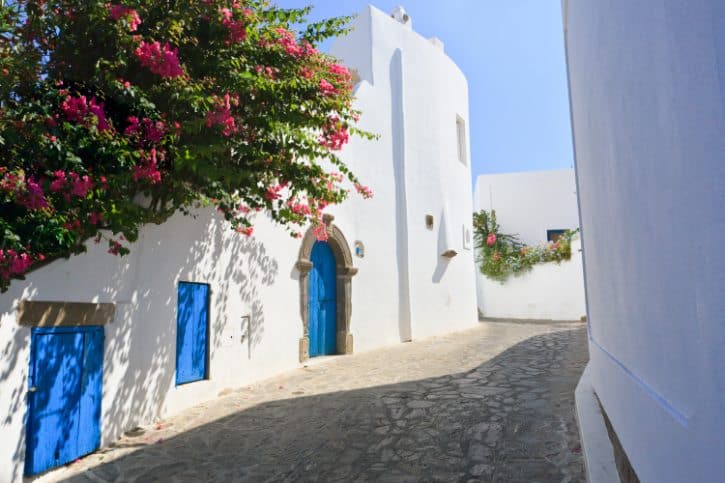
b. Wandering San Pietro
The main village is intimate and easy on the eyes. White facades, simple geometric shapes, bougainvillea over the walls, and shaded terraces line the narrow stone paths.
Take a boat around the island and you’ll see it from a whole new angle, the white village glowing above the water with uninhabited rocks scattered nearby.
c. Two coves to remember
- Cala degli Zimmari: the island’s only true sandy beach.
- Cala Junco: an amphitheatre-shaped bay of deep turquoise water, framed by prehistoric basaltic rock. Above it sits a Bronze Age village at Capo Milazzese, a nice echo of Santorini’s own ancient site.
d. The Aeolian side of its character
Panarea is proudly its own place, defined by:
- Local caper cultivation.
- Offshore islets like Basiluzzo and Spinazzola, home to Europe’s only dwarf palm colony.
- Underwater fumaroles at Calcara beach that actually warm the sea.
2. Sperlonga, Lazio
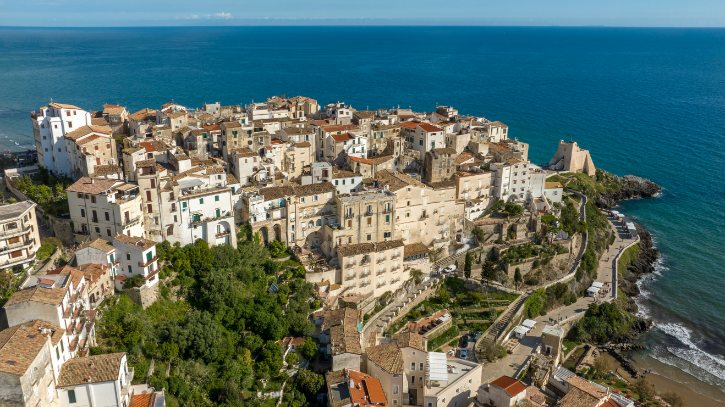
Halfway between Rome and Naples, this white medieval village crowns a rocky promontory pushing straight into the Tyrrhenian Sea.
a. The Greek-island echo
Walking Sperlonga is all about surprise. You don’t get one big open view. Instead, the blue keeps flashing at you through arches, between white houses, and at the bottom of steep stairways.
That rhythm of glaring white walls, cool shadowed alleys, and sudden bursts of sea is what feels genuinely Greek.
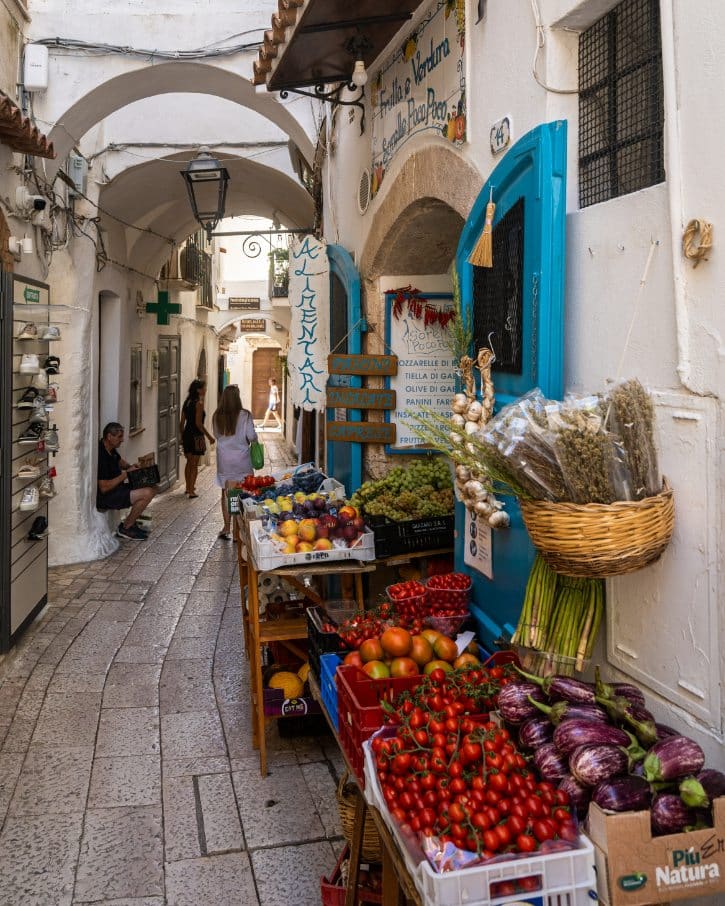
b. Through the white streets
- Whitewashed houses packed tight along narrow alleys.
- Arches, vaults, and stone staircases dropping toward the water.
- Ancient watchtowers woven into the old fabric.
- Long stretches of pale, fine sand waiting below.
c. The view from Torre Truglia
Torre Truglia stands at the very tip of the promontory. Climb up and you’ll look back at the whole white village tumbling down the hillside against the sea and sky. It’s the shot you came for.
d. A deep Roman story
Just outside town lies the Villa of Tiberius, a spectacular 1st-century Roman complex. Its natural sea cave once held colossal marble sculptures of Odysseus, carved by the same artists behind the famous Laocoön group. It’s a layer of history no Greek island can offer.
3. Ostuni, Puglia
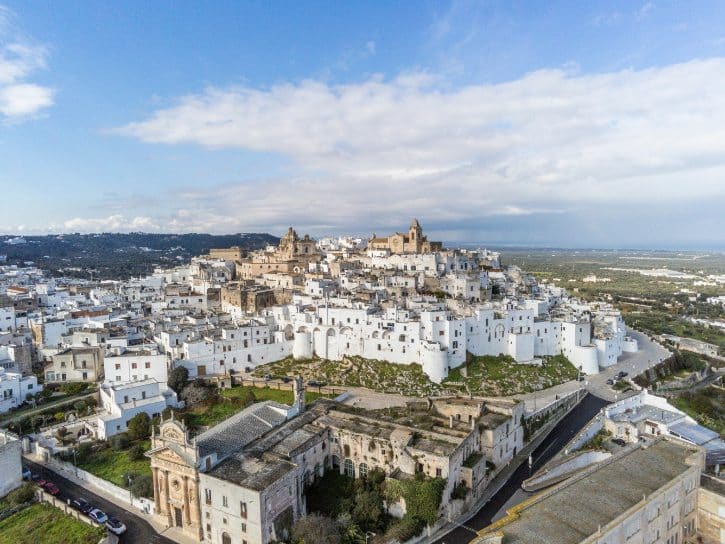
Known across Italy as La Città Bianca, the White City, Ostuni is the entry here that’s all about architecture rather than a seafront.
a. The Greek-island echo
This is arguably the most convincing white-town match on the Italian mainland. Its medieval core, La Terra, is a bright, close-packed maze:
- Densely stacked whitewashed houses.
- Steep stairways and blind alleys.
- Flying arches built to confuse invaders.
- A blinding white hilltop silhouette rising from three hills.
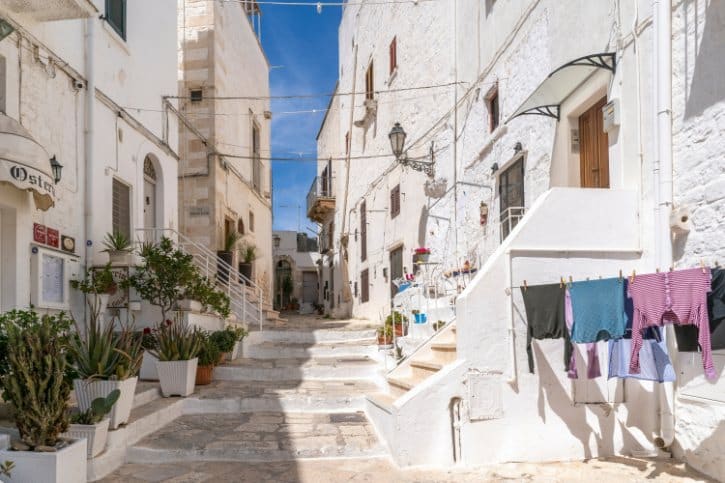
b. Why it’s so white
There’s a real reason behind the colour. The heavy lime wash became strict practice during the plague of 1656, since the lime worked as a natural disinfectant and its bright surface reflected the fierce summer sun.
The result is a town that seems to glow from the inside out.
c. Two ways to take it in
- From outside: the approach roads reveal the full white silhouette against the sky.
- From inside: the lanes and archways surround you in dazzling lime-washed walls.
- Look for the Late Gothic Cathedral with its Venetian-influenced rose window.
- Rest in Piazza della Libertà, softened with Baroque touches.
d. A sea of olives, not water
One thing to know upfront. Ostuni does not sit on the coast. It stands about eight kilometres inland, gazing over a vast plain of ancient olive groves. If you want a swim, the nearest sand is at Marina di Ostuni or Lido Morelli, a short trip away.
4. Peschici, Puglia
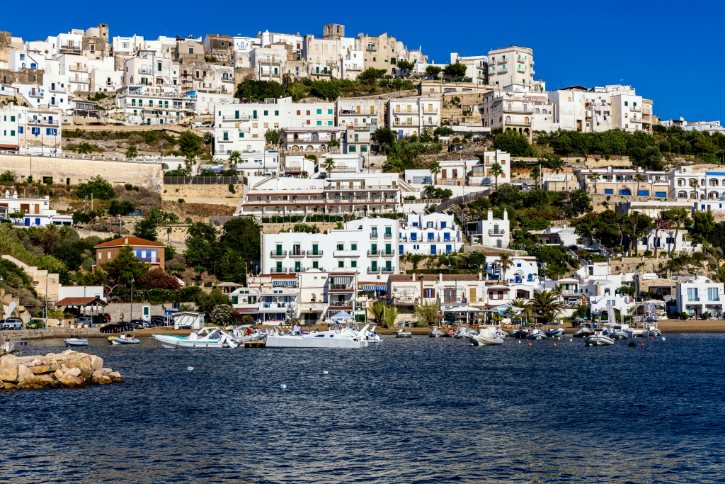
On the northern Gargano coast, Peschici clings to a limestone cliff that drops more than 90 metres straight into the Adriatic. It’s dramatic from every angle.
a. The Greek-island echo
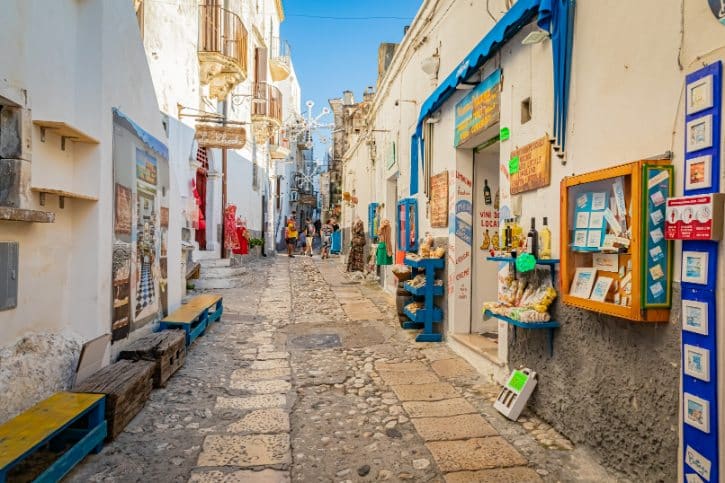
- White buildings stacked up a sheer cliff face.
- Narrow, twisting alleys and steep stone stairs.
- Small squares ending in sea-facing terraces.
- Wide, elevated views over the blue Adriatic.
b. The rooftops that fool the eye
Here’s the detail that pushes Peschici toward the Greek look. Many of its cubic, block-like houses are topped with unusual domed roofs, originally built to catch rainwater.
Those rounded shapes happen to echo the Aegean, even though this is a purely local Gargano style. A happy coincidence, not a copy.
c. Where to look
- View the town from the harbour or beach at sunset, when the pale walls catch the light.
- Climb toward the castle area for the best coastal panoramas.
- Watch for trabucchi, the old wooden fishing platforms along the shore.
d. Green forest, golden sand
Peschici is backed by the lush Umbra Forest and edged by long, gently sloping sandy beaches. That soft, green setting is a world away from Santorini’s steep volcanic drop-offs, and it gives the town a relaxed, summery feel.
5. Levanzo, Sicily
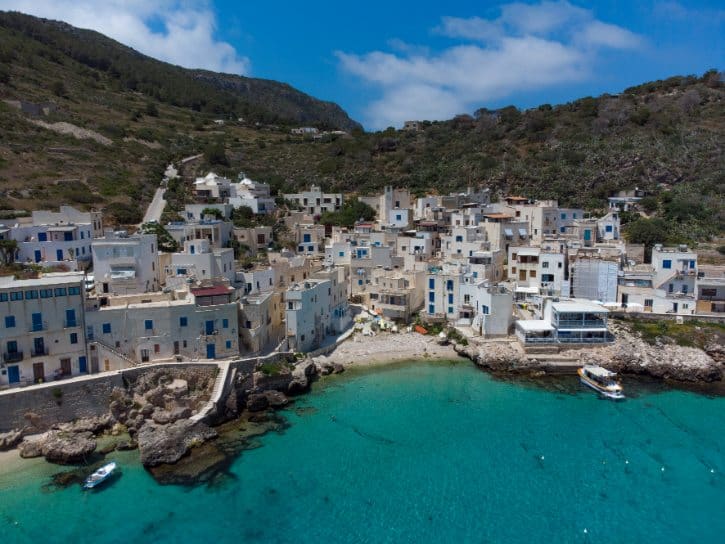
The smallest and most unspoiled of the Egadi Islands, Levanzo is a true miniature, barely six square kilometres, with no cars and no crowds of concrete.
a. The Greek-island echo
Forget grand cliffside towns. Levanzo’s charm is pure colour and calm:
- White harbour houses with blue and green shutters.
- Glass-clear turquoise water.
- Wooden fishing boats that seem to float on air.
- A slow, foot-only pace against arid rock.
b. The one perfect scene
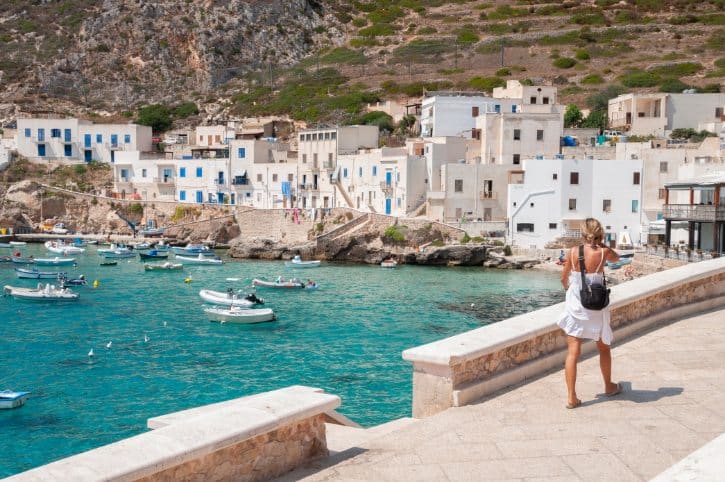
The island’s whole identity fits into Cala Dogana, a tiny harbour ringed by whitewashed houses. Village, boats, and turquoise water all sit together in a single frame. It’s the idealised Greek-island postcard, shrunk to human size.
c. Coves worth the walk
- Cala Minnola: tucked in a fragrant pine grove, with a Roman shipwreck resting in its clear depths.
- Cala Faraglione: named for the tall sea stack offshore, and a dreamy spot at sunset.
- Grotta del Genovese: a sea cave holding rare prehistoric art.
6. Polignano a Mare, Puglia
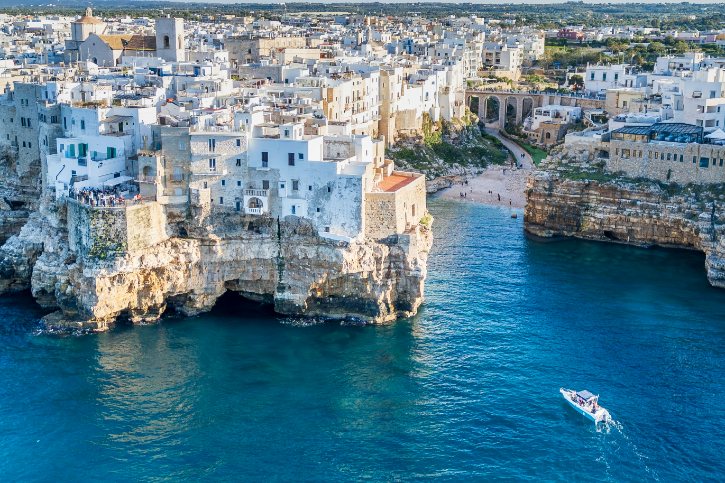
If any Italian town rivals Santorini for sheer drama, it’s Polignano a Mare, perched on the edge of a honeycombed limestone cliff south of Bari.
a. The Greek-island echo
The likeness here is all about the thrilling drop:
- Pale buildings pressed to the very edge of 27-metre cliffs.
- Turquoise and emerald water
- Balconate, panoramic stone terraces with vertigo-inducing views straight down.
- Sea caves gaping beneath the town.
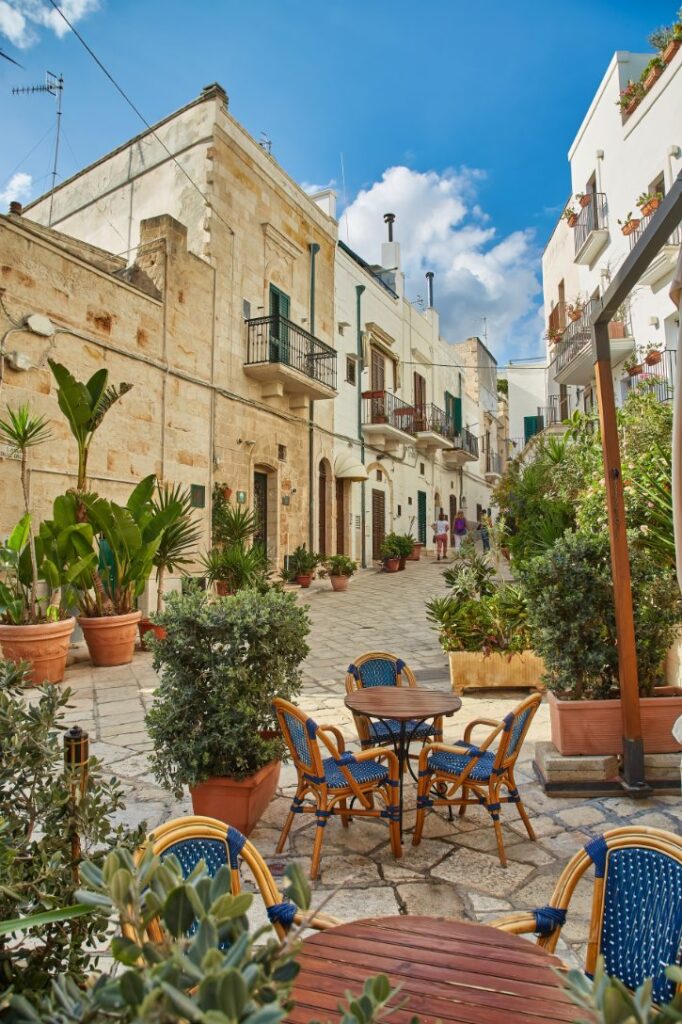
b. The heart-stopping cove
Lama Monachile, also called Cala Porto, is the visual climax. It’s a deep, narrow river gorge cut into the cliffs, ending in a small white pebble beach washed by bright water. A Roman-era bridge crosses right over it, and it’s one of the best places to stand and stare.
c. Three ways to feel the drama
- From the Roman bridge, looking down into the cove.
- From the balconate terraces, feeling the cliffs fall away beneath you.
- From the water, by boat or kayak, gazing up at the pale city above the sea caves.
Trust me, that last one is where the scale finally hits you.
d. Old-town wanders
Step through Arco Marchesale, the historic gateway, into a warren of stone-paved streets and sea-facing corners. Below your feet runs a network of caves, including the famous Grotta Palazzese. It’s medieval, Apulian, and full of character.
7. Rodi Garganico, Puglia
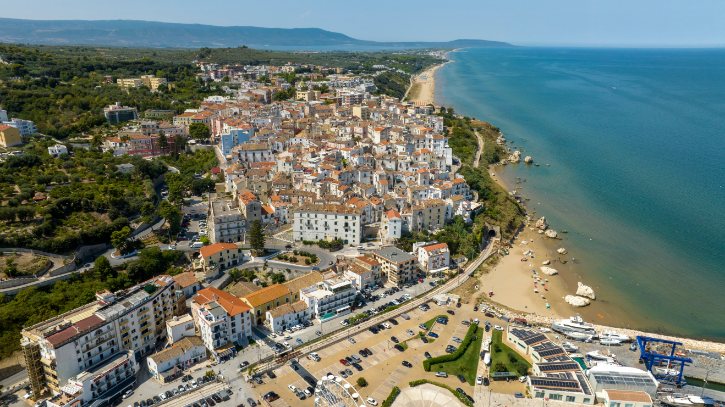
A quieter, greener take on the white-village look, Rodi Garganico spills down a rocky headland on the northern Gargano coast.
a. The Greek-island echo
From the harbour below, Rodi reads as a dense, pale settlement stacked above bright blue water:
- White and pastel houses massed on the hillside.
- Steep pedestrian lanes and stairways.
- Small squares that open onto sweeping coastal views.
- The distant Tremiti Islands floating on the horizon.
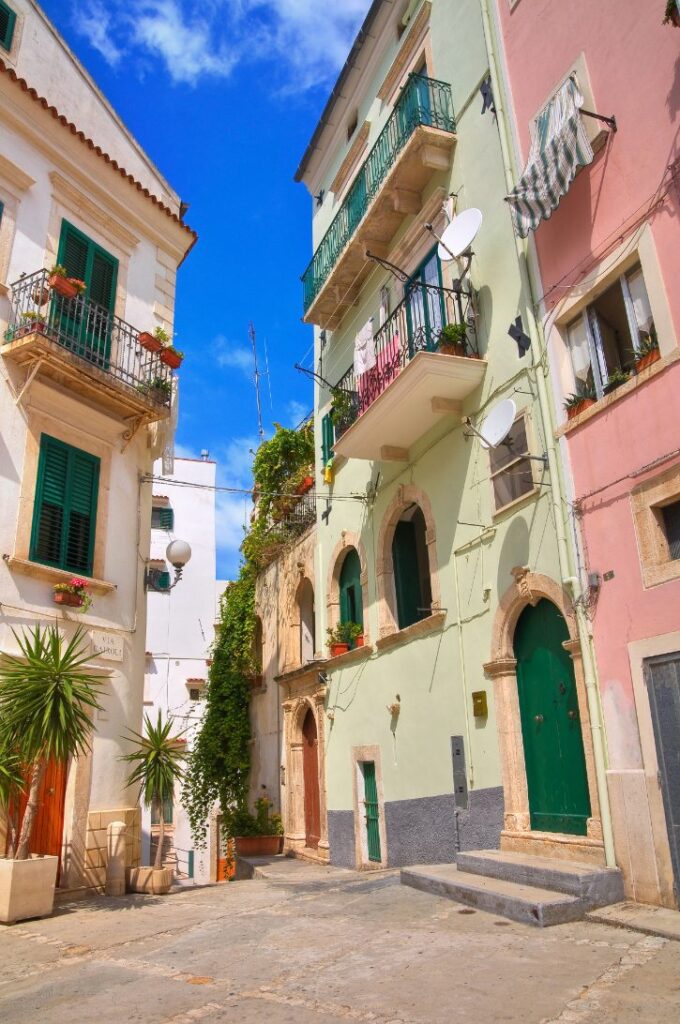
b. Down through the old town
The historic centre is a vertical little maze of old lanes, arches, and stairways, with churches and sea-facing corners tucked throughout. Let the steps lead you down toward the marina and the open beaches. Half the fun is not quite knowing where you’ll come out.
c. The scent of citrus
Here’s what really sets Rodi apart. It sits at the centre of the Oasi Agrumaria, a special microclimate where historic lemon and orange groves grow right down to the shoreline. That fragrant, green landscape is the opposite of Santorini’s dry volcanic slopes, and it’s the town’s true signature.
d. A coast full of character
- Long sandy beaches on both sides of town.
- White cliffs and turquoise stretches of sea.
- Historic coastal watchtowers.
- Traditional trabucchi, the old Adriatic fishing platforms.
8. Marettimo, Sicily
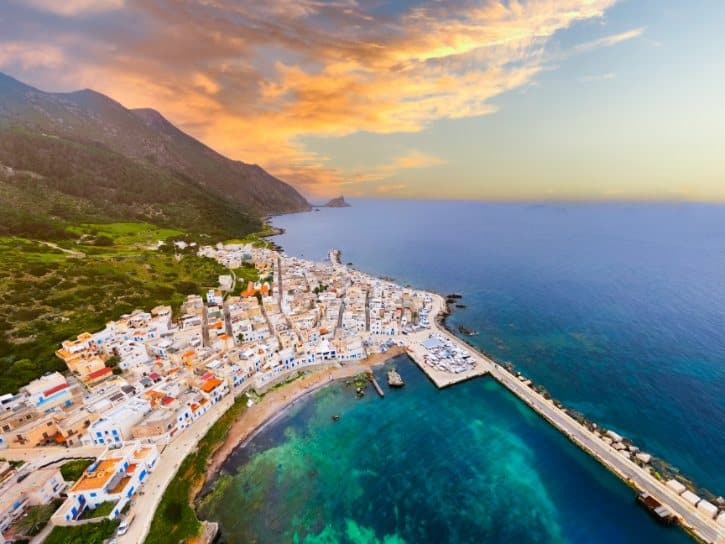
The wildest of the Egadi Islands, Marettimo pairs a lime-white harbour with soaring mountains and an end-of-the-world hush.
a. The Greek-island echo
The feeling hits the moment you reach the waterfront:
- Stark white, lime-plastered houses packed along the harbour.
- Deep blue and turquoise water.
- Dramatic coastal cliffs.
- A remote, untouched atmosphere.
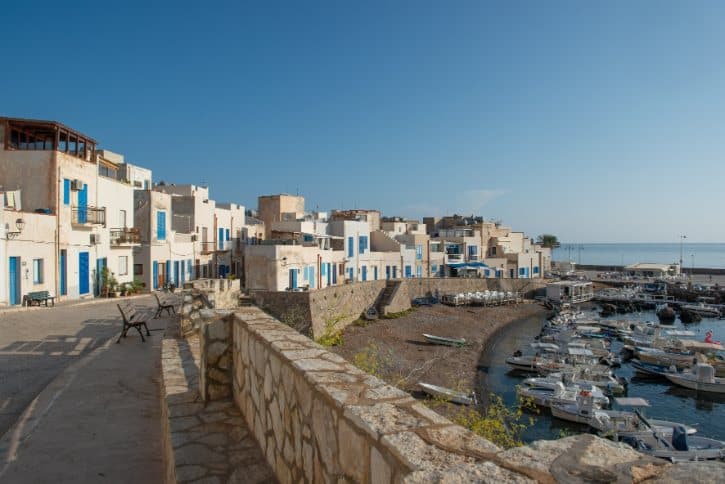
b. A mountain island
Behind that white harbour rise jagged limestone peaks, green and flowering in spring. It’s rugged, quiet, and beautifully wild, a very different backdrop from Santorini’s arid volcanic slopes. This is a place to breathe deeply and slow right down.
c. The best of it is on the water
Much of Marettimo’s beauty hides along its coast:
- Around 400 sea caves carved into the cliffs.
- Hidden coves and rock formations you can only reach by sea.
- A restored Norman fortress, Castello di Punta Troia, on a sea-girt headland.
- Ancient trails climbing to peaks like Pizzo Falcone.
d. Two perspectives to chase
The ideal visit is a two-part one. Hike the old mule tracks for vast views over the archipelago, then take to the water for the raw sea caves and cliffs you simply can’t see from land.
9. Monopoli, Puglia
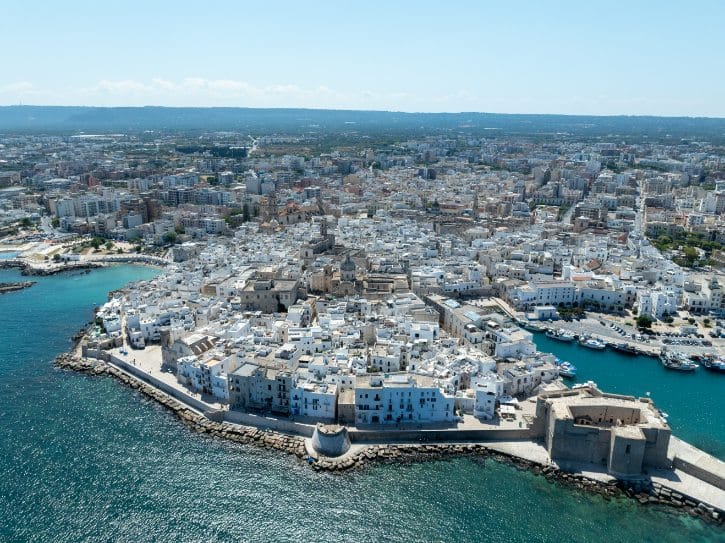
A gentler version of the look, Monopoli lays its white old town flat against the sea, tucked behind thick medieval seawalls between Ostuni and Polignano.
a. The Greek-island echo
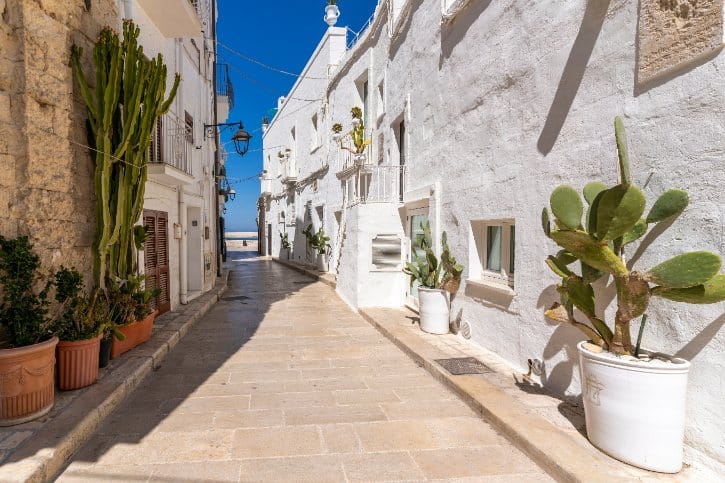
Here the resemblance is a mood, felt at street level rather than from a great height. You’ll wander:
- Immaculate whitewashed lanes paved in smooth, light stone.
- Bright, sun-drenched squares that open up unexpectedly.
- Sudden glimpses of the blue Adriatic between white walls.
b. A harbour full of colour
The old harbour, Porto Antico, is lined with traditional blue and red gozzi fishing boats, and it feels like a working slice of everyday Italian life. Guarding it all is Castello Carlo V, a sturdy 16th-century fortress, with Baroque church facades adding drama nearby.
c. The beach by the walls
Cala Porta Vecchia is a small sandy cove right outside the ancient walls. You can float in clear, shallow water with the pale stone fortifications and the cathedral bell tower rising behind you. It’s the town’s white-and-blue moment in one tidy scene.
d. A walk that ties it together
- Start along the fortified seawalls.
- Pass the historic harbour and its fishing boats.
- Duck into the shaded white lanes of the old core.
- Finish with a swim at Cala Porta Vecchia.
10. San Vito Lo Capo, Sicily
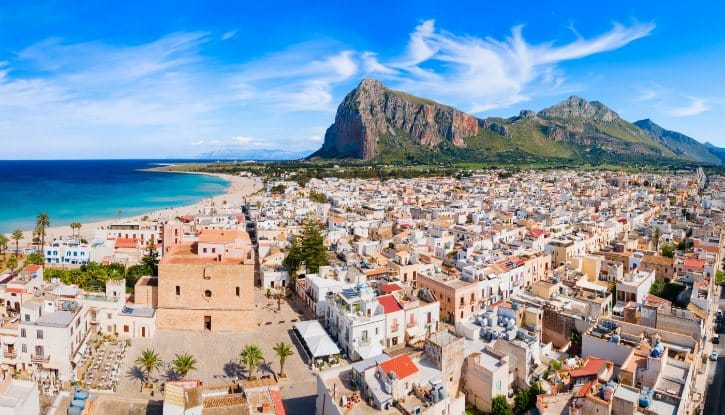
We finish on the sand. San Vito Lo Capo is a beach town on a remote northwestern Sicilian peninsula, watched over by the flat-topped mountain Monte Monaco.
a. The Greek-island echo
Take in the whole scene at once and the feeling is unmistakable:
- Blindingly pale, fine sand.
- Shallow, intensely turquoise water.
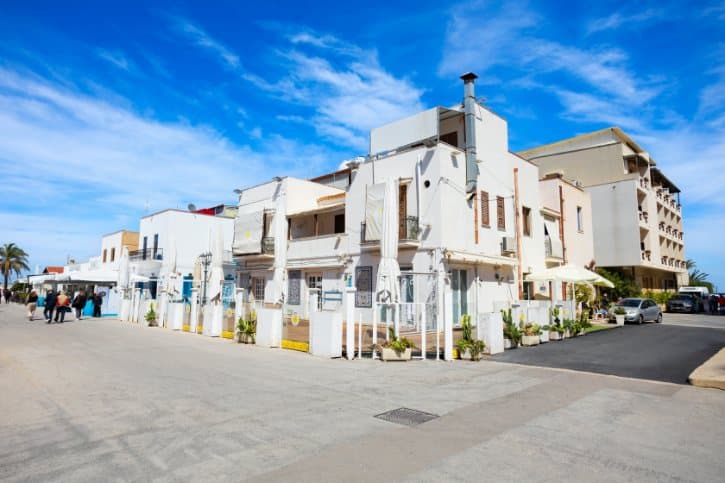
- Low-rise white and pastel houses.
- Bougainvillea, jasmine, and hibiscus
b. The beach and the village
The main beach is the star, a long crescent of soft sand meeting clear water, with the mountain rising sheer behind it. The village itself is easygoing and low-slung, full of flowers and relaxed Mediterranean lanes. It’s the kind of place where you lose track of the afternoon.
Every autumn the town celebrates its Arab-Sicilian roots at the lively Cous Cous Fest.
c. Where the coast turns wild
If you want cliffs and coves instead of soft sand, the drama is just outside town:
- Macari and Baia Santa Margherita, for rockier coves.
- The Zingaro Nature Reserve, with coastal trails, limestone cliffs, and beautifully clear water.