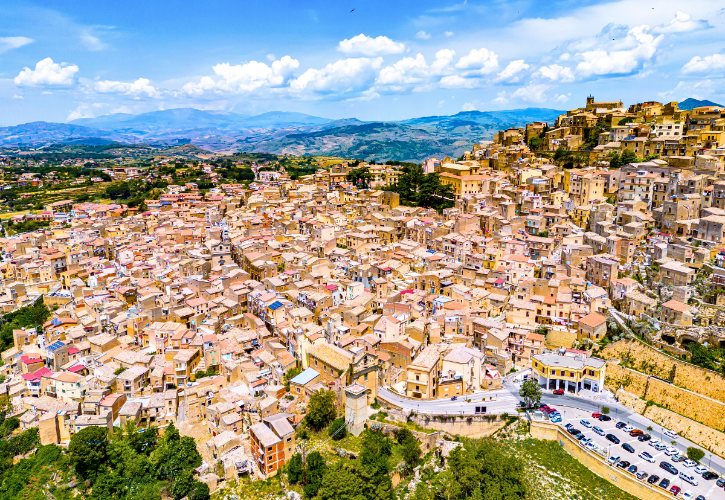
Sicily can feel like several very different worlds packed into one island. In a short stretch you move from ancient Greek stone to glowing Baroque towns, from sea-level coves to windy mountain villages, from tidy squares to streets carved into bare rock.
The magic is in the walking. Slow down and notice the stairways, the paving, and the sudden gaps that open toward the sea, and each layer of history quietly reveals itself under your feet. 😊
1. Taormina, Isola Bella and Castelmola
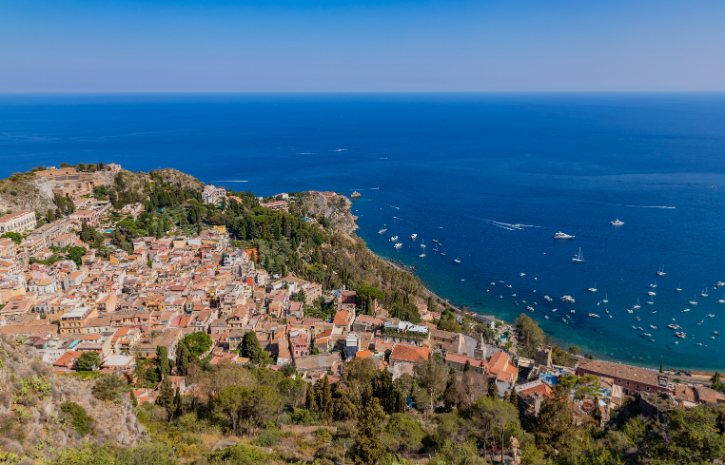
a. Three worlds at three heights
Think of these three places as one landscape seen from three heights, not three separate sights. Isola Bella sits right at the water, Taormina on a shelf about 200 meters up, and Castelmola higher still near 530 meters. Mount Etna quietly frames all three.
b. Walking Taormina
Start at Porta Messina and follow Corso Umberto, the traffic-free main street. The side lanes are where the real character hides.
- Old palaces line the Corso, but the surprises sit in the alleys leading off it
- On one side, lanes climb into steep staircases toward the cliffs
- On the other, covered passages open onto terraces hanging over the sea
- Piazza IX Aprile is a checkerboard balcony with clear views to the coast and Etna
c. Teatro Antico: Greek bones, Roman face
The ancient theatre is where architecture and landscape stop feeling separate. Just know it is not purely Greek.
- The Greeks founded it in the 3rd century BC and carved the seating bowl into the hillside
- What stands today is mostly a Roman rebuild from the 2nd century AD, when it became an arena
- The gap in the stage wall frames the coast and Etna’s summit like a window
- At about 109 meters across, it is the second-largest classical theatre in Sicily
d. Isola Bella, a reset at sea level
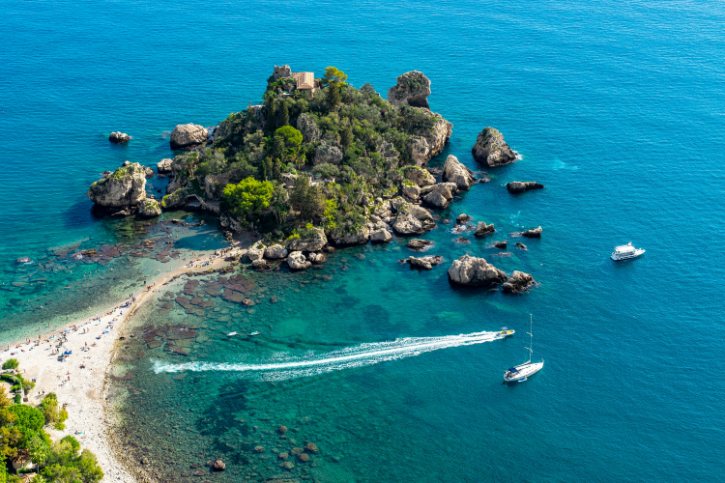
After all that stone, Isola Bella feels like another planet. It is a small garden islet linked to the beach by a strip of sand that the tide can cover, so the crossing changes through the day.
An English noblewoman once turned the bare rock into an eclectic garden of pavilions and terraces woven into the stone. After severe winter storms damaged its paths and walls, the islet closed for a full restoration and has since reopened, with visitor numbers now capped to protect its fragile coast and the rare lizard that lives only here.
e. Castelmola above it all
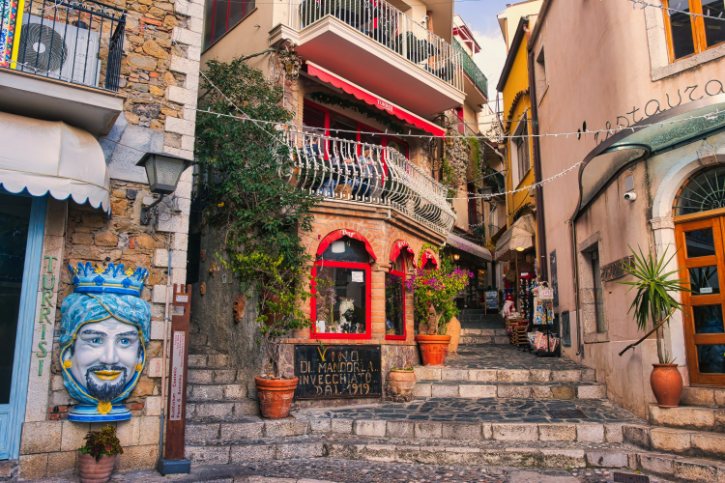
Castelmola is far more than “the view above Taormina”. It is a medieval village on a sharp peak, worth wandering in its own right.
- Enter at Piazza Sant’Antonino, paved in white limestone and dark pebbles
- Alleys often run under two meters wide, lined with stone houses and iron balconies
- Only outer walls, a gateway, and cistern bases survive of the old castle
- From the top you look straight down on the ancient theatre, the bay, and the sea
- A rougher trail toward Monte Veneretta climbs higher for wide views over Etna’s flank
f. Getting the most from it
You will not link all three in one easy loop, so take them as three separate experiences. Save your legs for wandering Castelmola on foot, and let the views do the rest.
2. Ortigia Island
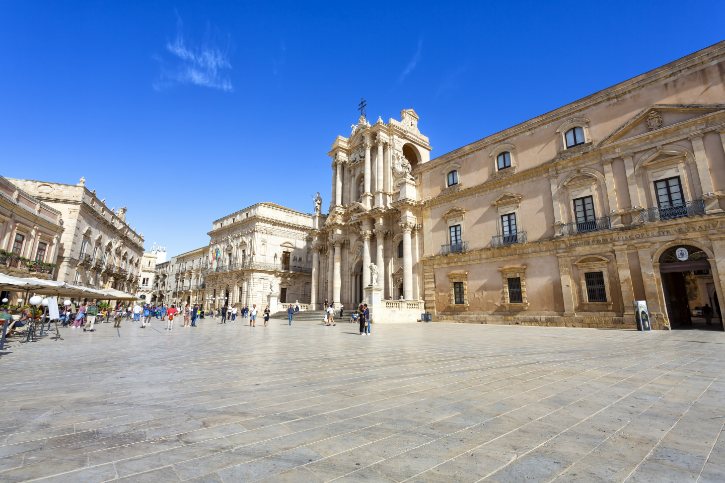
a. Centuries in one square kilometer
Ortigia is the ancient heart of Syracuse, a small offshore island joined to the mainland by a bridge. It forms the core of a UNESCO World Heritage property, and its beauty comes from how tightly its history is packed. Greek foundations, medieval defenses, and Baroque palaces all share the same few streets.
b. A walking line across the island
Follow a natural route from the entrance to the sea-facing tip:
- Temple of Apollo, just past the bridge
- The market streets and Piazza Archimede with its dramatic fountain
- Piazza Duomo, the visual high point
- Fonte Aretusa, a spring beside the sea
- Castello Maniace at the fortified point
c. The Temple of Apollo
It is easy to walk straight past this ruin, but it matters more than it looks.
- It dates to the early 6th century BC and is the oldest surviving Doric stone temple in the western Greek world
- Its columns stand unusually close together, from an early, experimental phase of building in stone
- Over the centuries it became a church, then a mosque, then a church again, then barracks
- You view it from the surrounding railings rather than walking inside
d. Piazza Duomo, the great palimpsest
A narrow alley suddenly releases you into a wide, curving square paved in pale limestone that glows in the sun. The cathedral here is built right around an ancient Greek temple, so old columns still stand embedded in its walls, wrapped in a later Baroque front.
One honest note: the famous Caravaggio painting once shown nearby was moved back to the Syracuse mainland, so you now need to cross the bridges to find it.
e. Fonte Aretusa, water and myth
From the square, a short descent brings you to a freshwater spring right beside the sea. It is a lovely change of pace.
- The spring rises through the limestone next to salt water
- It grows a thicket of papyrus, one of only two places in Europe where it grows wild
- Greek myth ties the spring to a nymph turned to water to escape a river god
f. Castello Maniace at the tip
The southern point feels like a true island fortress.
- A near-perfect square with four round corner towers, built under the emperor Frederick II in the 13th century
- Inside, a vaulted stone hall survives, its ribs springing from slender carved columns
- The outer battlements look straight across the harbor entrance
3. Cefalù and La Rocca
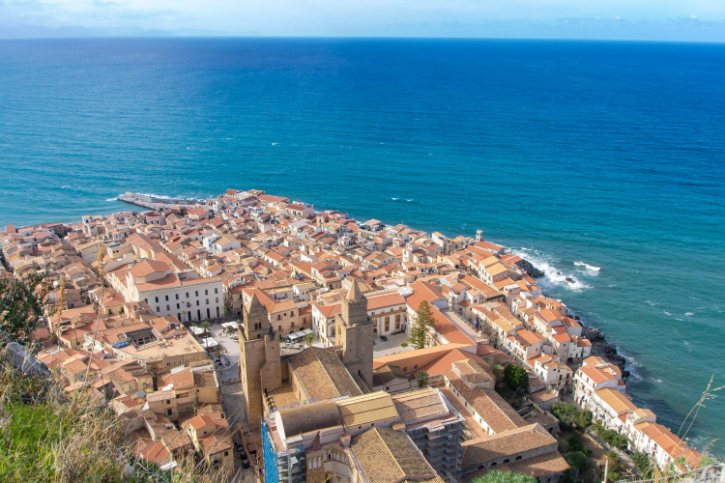
a. A silhouette in three parts
Approaching Cefalù, you meet a famous outline: a red-tiled town on a narrow coastal shelf, the twin towers of its Norman cathedral at the center, and the sheer crag of La Rocca rising behind. As part of a UNESCO Arab-Norman property, the town reads across three levels, and that vertical stack feels very different from Taormina or Ortigia.
b. From the water up
Begin at the old sea gate and work inland and uphill.
- The Gothic gate frames the fishing harbor and breaking waves
- A curved staircase leads down into a medieval washhouse, where a stream flows through stone basins under wide arches
- Narrow alleys, low vaulted passages, and carved-stone balconies fill the streets between
c. The cathedral, more than two towers
The Cathedral of Cefalù rewards a proper look, not just a photo of the towers.
- Founded in 1131 by the Norman king Roger II
- Its apse holds some of the best-preserved 12th-century mosaics anywhere
- The great Christ Pantocrator gazes down from the semidome, Gospel open in his hands
- A Norman cloister on the north side carries columns carved with beasts and acrobats
d. La Rocca, a climb not just a view
The pace changes completely on the crag above. It is a landscape and an archaeological site in one, reached by a stepped stone trail through old defensive walls.
- Partway up sits the Tempio di Diana, built of massive polygonal blocks laid without mortar
- It is a 5th- to 4th-century BC structure raised over a much older prehistoric water shrine
- Its exact original purpose is still debated, so take confident single explanations with a little caution
e. What the climb shows you
The ascent is the point, not just the summit.
- The town’s street grid opens out below you as you rise
- The cathedral’s towers begin to look like a stone ship among the rooftops
- The coast stretches away to the east from the top
It is real effort, with uneven ground, steady elevation, and long stretches of little shade, so wear proper shoes and pick a cooler hour.
f. Three levels, one town
Cefalù makes most sense seen from all three heights: the shoreline, the town and cathedral, and the mountain. Seeing the same place from the water, its streets, and high above tells you far more than any single beach afternoon.
4. Ragusa Ibla
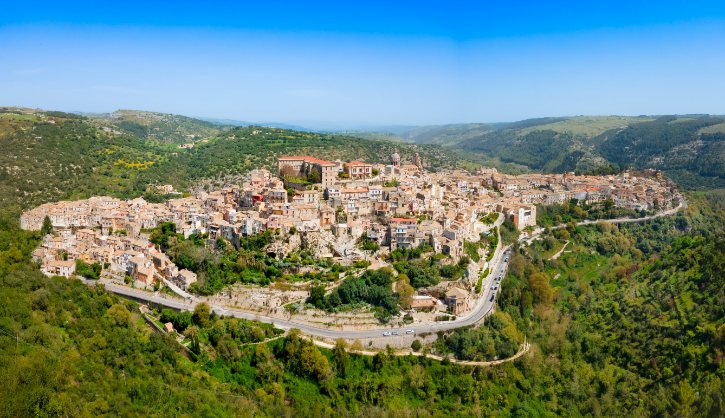
a. The vertical counterpart to Noto
Ragusa Ibla is the steep, tumbling opposite of flat, planned Noto, though both belong to the UNESCO Late Baroque Towns of the Val di Noto. After the great earthquake of 1693, Ragusa split in two: an orderly upper town on the plateau, and Ibla, rebuilt over its dense medieval plan on a lower ridge. The result is all twisting streets, domes, and viewpoints.
b. The approach from above
The best way in is on foot from the upper town, down the stepped path by the church of Santa Maria delle Scale.
- The 1693 quake sheared the church in half: one side rebuilt in Baroque, the other still Catalan Gothic
- The terrace beside it gives your first great view over Ibla packed into the gorge
- The descent runs down roughly 300 stone steps through switchbacks
c. Details on the descent
Slow down for the close-up carvings as you drop into town.
- Palazzo Cosentini, with corner balconies on brackets shaped as grotesque faces and masks
- Santa Maria dell’Itria, its bell tower capped with vivid blue-and-yellow tiles
- Balconies, portals, and tiled towers worth catching if you look up
d. The Duomo arrives slowly
Continue east and the ground levels before easing down into Piazza Duomo. The great Duomo di San Giorgio reveals itself gradually, which is exactly how its architect planned it. Set at an angle atop a wide flight of steps, its convex, tiered front rises into a bell tower and a tall dome, framed by the palaces around the square.
e. Ending at Giardino Ibleo
Do not turn back at the cathedral. Keep going to the gardens at the tip of the ridge.
- Shaded by palms, pines, and cypress avenues
- Home to three historic churches, one with an eye-catching tiled tower
- Ending at balustrades above a deep valley, with cave dwellings cut into the far walls
f. Walk it downhill
The practical secret is direction. Walking down from the upper town lets Ibla unfold beneath you.
- The route is stairs, gradients, and old paving, so it is demanding on the knees
- Side streets reward spontaneous detours, and many best details sit just off the main line
5. Erice and Castello di Venere
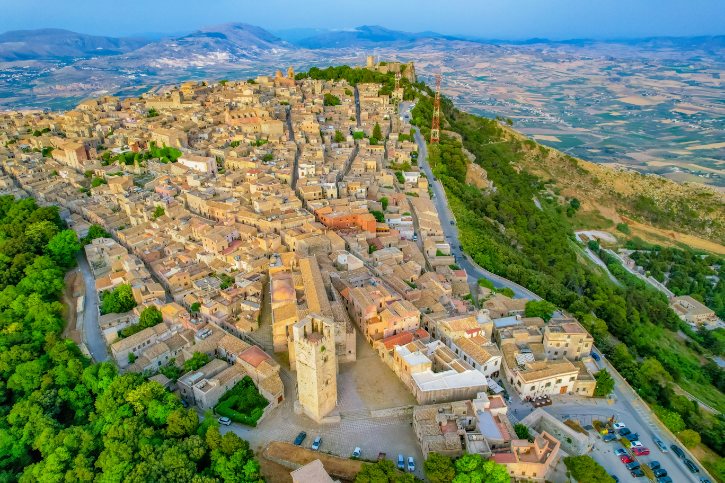
a. Stone, altitude, wind and cloud
Erice feels elemental. It stands about 750 meters up on an isolated peak above the sea, often wrapped in a cool, dense fog the locals name la bava. Its center is paved in grey cobblestones and ringed by ancient walls. After the warm Baroque towns of the southeast, its cold stone and huge drop toward the coast feel like another country.
b. Through the gate into town
Enter through Porta Trapani and take the streets slowly. The enclosed lanes make the panoramic reveal at the end far more dramatic.
- At the gate’s base, look for the massive ancient foundation blocks under later medieval stone
- Just inside stands the Real Duomo of 1314, with a detached bell tower that began as a watchtower
- Deeper in, you pass quiet convent walls, pebble courtyards, and old pastry shops
c. Castello di Venere’s deep story
At the far edge of the rock stands the Castello di Venere, and its history runs deeper than the walls suggest.
- The spur was a famous ancient sanctuary for over a thousand years, sacred to a fertility goddess
- Sailors once used the fires burning here as a navigation beacon
- The Normans later cleared the temple and built their fortress on the bedrock, reusing ancient stone
- After a long closure for restoration and cliff-edge work, it has reopened to the public
Keep the line between evidence and legend clear here. The Norman building and the reused ancient material are documented; the older cult stories are tradition layered on top.
d. The Balio gardens and the view
Just before the castle, pine-shaded gardens change the mood again. On clear days the terraces open onto:
- The salt pans and curving lagoon around Trapani
- The Egadi Islands resting on the western horizon
- The coastal plain far below
A small eclectic tower nearby, once a private retreat, now serves as a cultural space. Remember that fog and cloud can erase these views entirely, so a clear day is a gift.
e. Underfoot and overhead
Erice rewards a slow eye and careful feet.
- Watch the geometric cobblestone patterns underfoot, which turn slick in fog or rain
- Medieval walls and towers appear suddenly at the ends of lanes
- Castle masonry reuses ancient fragments, so look closely at the stone
- Gaps between buildings keep opening toward the plain far below
6. Noto
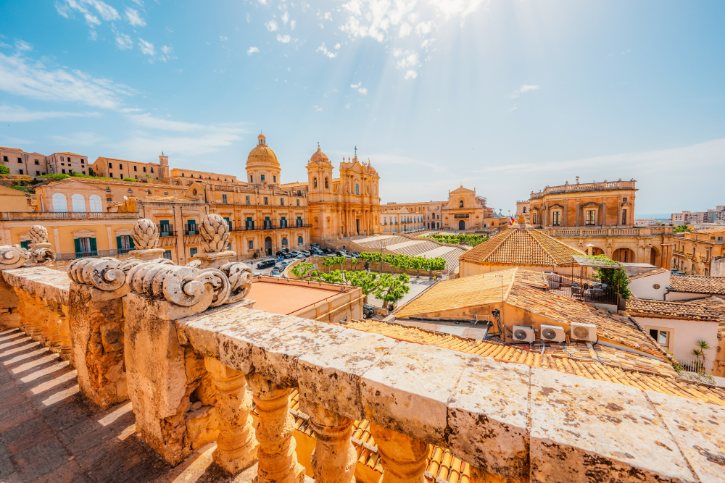
a. Composition and light
Noto is about design and light. After the 1693 earthquake destroyed the old town, it was rebuilt from scratch nearby on a unified Baroque plan, with wide streets angled to catch the sun. Compared with tumbling Ragusa Ibla, Noto feels ordered and ceremonial, a stage set in warm limestone.
b. From Porta Reale down the Corso
Begin at the arch of Porta Reale and walk west along Corso Vittorio Emanuele, the spine that strings together three grand squares.
- San Francesco all’Immacolata, raised on a wide terrace with a sweeping double stair
- Santa Chiara, with an oval interior ringed by twelve columns
- Palazzo Ducezio, the town hall, with a long arcaded portico
- Noto Cathedral, rising above a monumental flight of 39 steps
c. The stone itself
Noto’s local limestone is soft enough to carve into fine detail, and iron in the stone makes it shift color through the day.
- Pale cream at midday
- Deep amber and burnt apricot in late afternoon
- A fiery rose glow at sunset
d. The cathedral’s dramatic recent past
Do not read the cathedral as simply an old building. In 1996 its dome, right nave, and piers suddenly collapsed, partly from weak original masonry. Rather than rebuild in concrete, restorers hand-carved new blocks in local stone and paired them with modern seismic engineering, and it reopened in 2007. Much of what you see is a careful recreation.
e. Via Nicolaci up close
Turn uphill onto Via Nicolaci for the details that make Noto stick in your memory.
- Palazzo Nicolaci Villadorata carries six balconies on extraordinary carved brackets
- Look up to find grimacing masks, winged horses, mermaids, lions, and turbaned figures
- Once a year the street is carpeted in pictures made from flower petals, a seasonal festival rather than a fixed feature
f. Walk the same street twice
The most rewarding trick in Noto costs nothing but time.
- Once at midday, when high sun throws the carving into sharp relief
- Once at sunset, when the stone glows deep gold and rose
The same facades genuinely look like different buildings.
7. Scicli
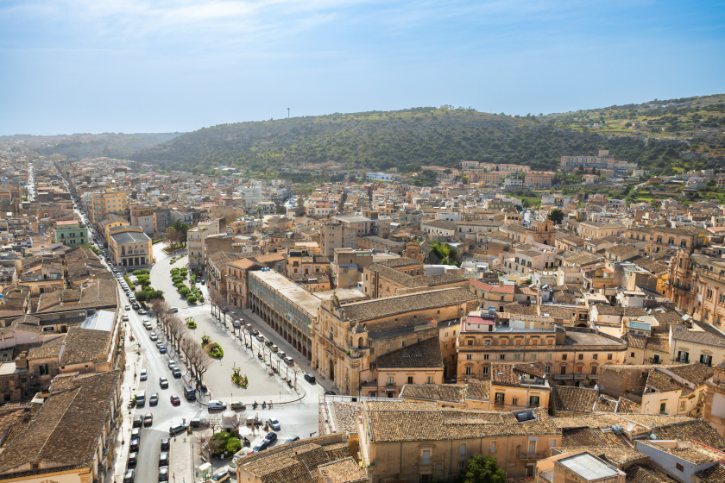
a. Where rock meets Baroque
Scicli sits where three steep limestone canyons meet, and that terrain shapes everything. The medieval town clung to a high ridge, while the Baroque rebuild after 1693 spread down onto the valley floor. The result is a place where polished stone facades and bare rock cliffs constantly appear together.
b. Via Mormino Penna
Begin on Via Francesco Mormino Penna, Scicli’s polished public face and part of the official UNESCO area.
- An almost unbroken run of 18th-century palaces and churches on smooth, light paving
- Palazzo Spadaro, its facade gently curving to follow the old street line
- Churches with convex fronts and rich interiors along the way
c. Palazzo Beneventano up close
Turn toward the hill and you reach this corner palace, the close-up stop.
- Two crowned Moorish heads, carved with vivid detail
- Snarling beasts and figures sticking out their tongues
- A relief of Saint Joseph over the corner
d. Into the San Bartolomeo ravine
Move through the wide, triangular Piazza Italia, then follow the street as it narrows into a limestone gorge. At its head rises the pale Baroque front of the Church of San Bartolomeo, set against dark bare cliffs. The contrast between open square and tight rocky setting is the heart of Scicli.
e. The old hillside above
For real depth, look up to the ridge.
- San Matteo hill, crowned by the roofless shell of the former Mother Church
- The Chiafura caves, cut into the cliffs and lived in until the late 1950s
- From the plateau you can see how the town sits in the basin below the cliffs
f. What to notice
Scicli’s signature is the meeting of stone and rock.
- Warm carved limestone beside dark cave openings
- Sheer cliffs framing churches
- Narrow streets opening onto ravines and elevated ruins
Its UNESCO status covers specific streets and monuments rather than the whole town, though the hillside sites are still worth exploring.
8. Modica
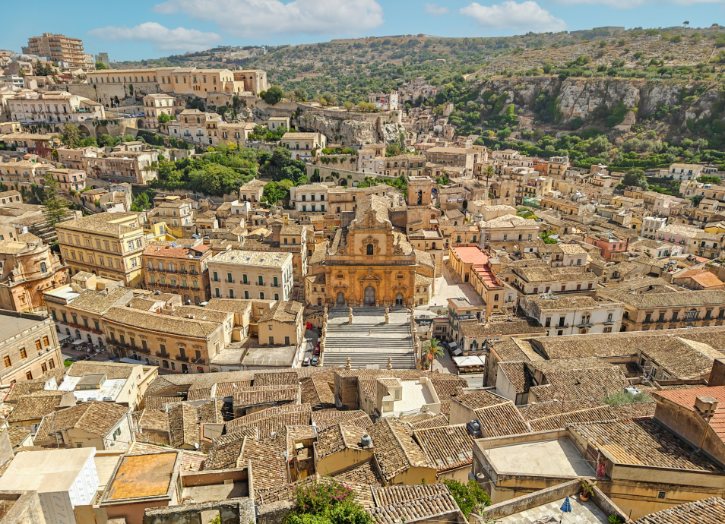
a. A town read vertically
Modica is a city to read from bottom to top. It grew inside a deep limestone canyon, stacking houses and churches up the walls. The lower spine, Modica Bassa, follows a covered riverbed, while Modica Alta climbs the slopes above. Changing height, not a single square, defines the experience.
b. Starting in Modica Bassa
Begin along Corso Umberto, the lower town’s main street, anchored by the Church of San Pietro.
- A broad staircase lined with life-sized stone statues of the Twelve Apostles
- A balanced two-tier facade crowned by a statue of Saint Peter
- A three-aisled interior with inlaid marble and old frescoes
c. The climb is the experience
The real Modica is the climb from Bassa up to Alta on zigzagging staircases and alleys.
- Expect roughly 250 stepped terraces in total, with houses built into the living rock
- Pause often and turn around; the views back over the stacked town are the reward
- The full climb is demanding, so plan turnaround points if you need them
d. The Duomo di San Giorgio
The climb delivers you to the Duomo di San Giorgio, one of the masterpieces of Sicilian Baroque.
- A soaring convex, three-tiered front reaching about 62 meters
- A grand staircase winding up through terraced gardens
- Inside, look down for a solar meridian line where a noon sunbeam tracks the date across the floor
Step counts vary between sources, so treat any single figure loosely.
e. Why the color works
Modica’s palette is more than “golden stone”. The buildings use the same canyon limestone as the slopes, so architecture and bare rock share one continuous material. That is why the town reads as a single carved mass rather than buildings dropped on a hill.
f. The castle on the skyline
Above the cathedral, the Castello dei Conti sits on a rocky spur.
- It keeps fragments of medieval walls and a deep rock-cut prison pit
- Its 18th-century clock tower perches over the cliff as a skyline marker
- Think of it as something to see from the terraces below rather than a big interior visit
g. One sweet pause
Modica has a stop all its own: Modica chocolate, made by a cold-working method from the Spanish era.
- Worked at low heat, so the sugar never fully melts, giving a grainy, crumbly texture
- No cocoa butter or lecithin is added
- It holds a protected European origin status, but it is not on any UNESCO heritage list, whatever some marketing suggests
9. Calascibetta
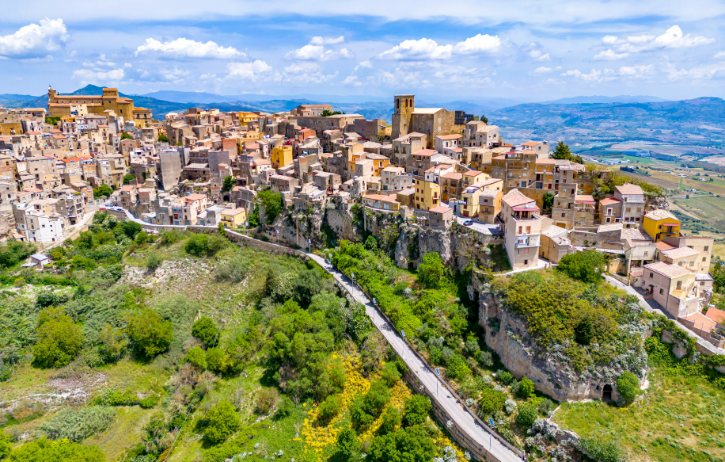
a. Height and silence
Calascibetta trades polished monuments for something quieter: height, weathered stone, and deep history. It sits around 690 meters up in central Sicily, facing the town of Enna across a valley. Far from the coast and the crowds, it preserves layers running from prehistoric tombs to a medieval Jewish quarter and a royal chapel.
b. Climbing the muntata
Start at the large lower square, then climb into the upper town along a steep corridor known locally as the muntata, meaning the ascent.
- The houses are simple and unadorned, built from local grey stone
- Narrow external stair steps break up the walls
- You pass an old church with 14th-century foundations that now serves an Orthodox congregation
c. Via Giudea and the rock-cut prisons
Midway up, a detour along Via Giudea leads into the old Jewish quarter.
- A community of Jewish merchants and craftsmen lived here until the forced expulsion of 1492
- Nearby, caves cut into the limestone were first prehistoric dwellings, then medieval prison cells
- Look into the dark openings for beam sockets, ledges, and rings once used to hold chains
d. The royal chapel and the view
The climb peaks at the Mother Church, which holds the rare title of Royal Palatine Chapel, granted in 1340. It stands on the ruins of an earlier Arab fortress, and glass floor panels inside reveal the foundations below. Step to the nearby viewpoint for a sweeping panorama: Enna on its high plateau, and the rolling farmland of the interior shifting from green to gold across the seasons.
e. Countryside sites, seen separately
Two important sites sit outside the town and work best as separate trips, not casual stops.
- A hillside necropolis north of town, with hundreds of Iron Age rock-cut tombs
- A Byzantine valley settlement northeast, with rock-cut dwellings and chapels reached by a guided path
f. What makes it different
The through-line here is geology shaping human life. Local rock formed the houses, the cave prisons, the burial sites, and the hilltop chapel, so the whole place feels carved from one continuous stone.
10. Gagliano Castelferrato
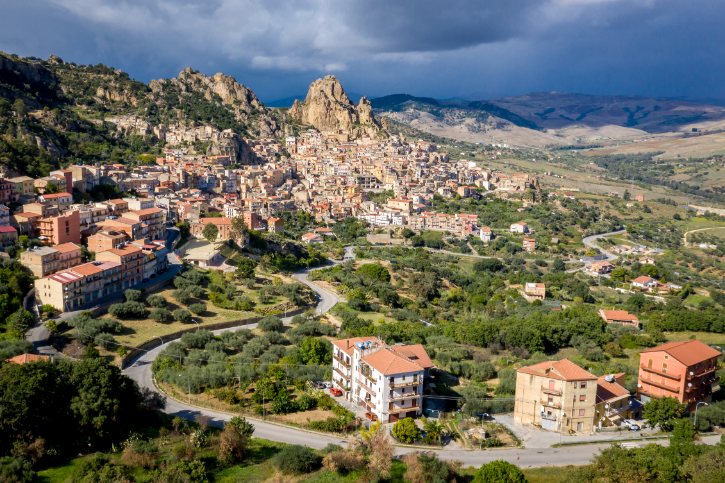
a. La Rocca is the destination
At Gagliano Castelferrato, the landscape itself is the sight. The village sits at the foot of a massive limestone monolith called La Rocca, with its houses built directly against the sheer cliff. This is not the usual hill town where a castle sits calmly above the houses. Here the fortress was carved straight into the living rock.
b. Start from below
Begin from the lower streets, where you can take in the full scale of the rock before any climbing.
- The houses step up the slope in tiers, framed by the vertical cliff
- Cliff faces, masonry, and cave-like cavities mark where the old fortress met the rock
- Let the documented rock-cut structures tell the story rather than guessing from appearances
c. The church against the rock
The key composition unfolds in front of the Chiesa Madre (San Cataldo), a 14th-century church with a classical stone bell tower. Stand in the square and look up: the tower is outlined directly against the grey wall of La Rocca behind it, a memorable image of human building set against raw geology. This is one of the best public viewpoints in town.
d. Look into the rock
The fortress relied on carving chambers, stairs, and tunnels out of the cliff rather than building free-standing walls.
- Porta Falsa is a narrow arch cut through the rock, once a hidden rear escape gate
- Deeper features include a long excavated gallery and deep rock-cut cisterns
- Some of this you can view from town, and some requires entering the castle area
e. Rocca della Malazita
Looking across from the castle approaches, you can pick out a second crag tied to a local legend. Together the twin rocks create the jagged skyline that defines the town, so it is worth noticing as part of the wider landscape.
f. Be careful about access
This is the section to treat with caution. The lower streets and the path up to Porta Falsa are open to walk, but the climb to the very summit crosses steep, unfenced ledges with severe drops.
- Access to the highest chambers is sometimes restricted for safety, so do not assume the summit is open
- Base your visit on the lower quarters, the church framed against the cliff, and the path up to Porta Falsa