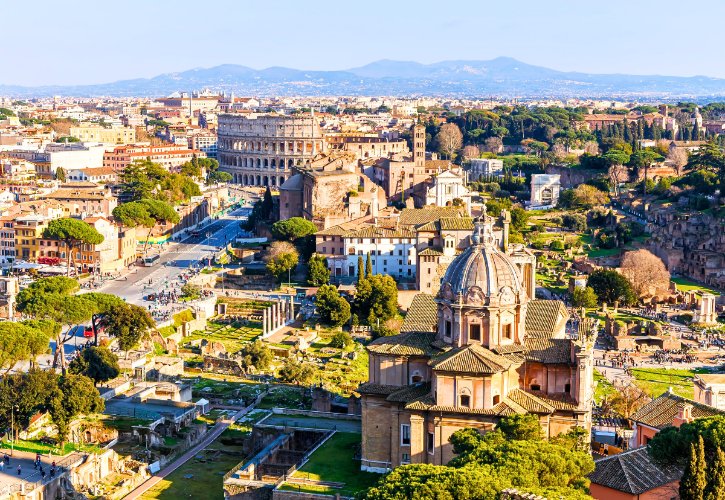
Few places on earth pack this much history into so little space. Around the Colosseum, you can walk a compact loop where each stop sits less than a five minute walk from the last.
Ancient amphitheatres, ruined forums, Renaissance squares, national monuments, museums, and old theatres sit almost shoulder to shoulder here.
You can travel through wildly different centuries of Rome without ever going far. The real trick is knowing what deserves a closer look at each stop. Let’s walk it together. 😊
1. Colosseum
a. The basics
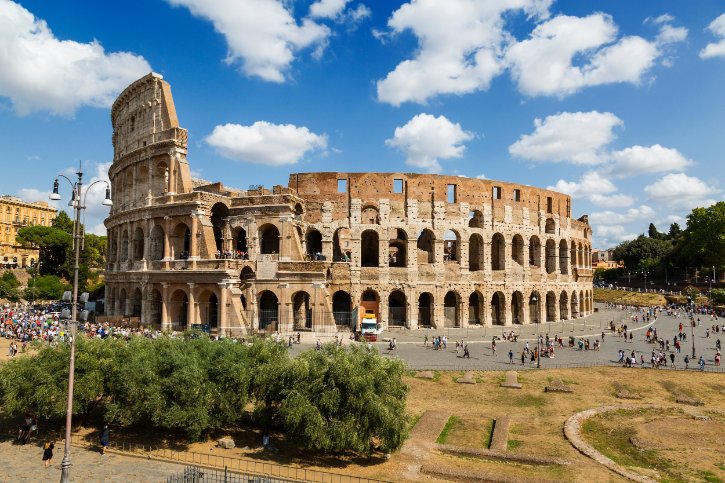
This was really the Flavian Amphitheatre. Emperor Vespasian began it around 70 to 72 CE, his son Titus opened it in 80 CE with a hundred days of games, and Domitian finished it. It held 50,000 to 65,000 spectators. The name “Colosseum” came later, from the giant bronze Colossus of Nero that once stood nearby.
b. A machine built to move crowds
- 80 entrance arches, 76 of which were numbered for ticket holders with matching Roman numerals above them, while the four grand axial gates were unnumbered for dignitaries. Numerals XXIII through LIV are still readable on the surviving north facade.
- Vaulted corridors and separate stairways led each group straight to its seats.
- Seating by rank: senators lowest, then equestrians, then citizens, with women and the poor highest.
- The whole building could empty in fifteen to twenty minutes through its wide vomitoria without the classes mixing, though entering and filling the venue took considerably longer due to ticket verification at the gates.
c. The arena and the world beneath it
- The wooden floor was about 83 by 48 meters, covered in sand to soak up blood.
- Below sat the hypogeum, a two-level maze holding animals, prisoners, gladiators, and scenery.
- A system of wooden lifts and trapdoors raised cages straight into the arena.
d. What you see underground now
- The Criptoportico dei Gladiatori reopened in 2023, the passage that once linked the arena to the gladiator school, the Ludus Magnus.
- Look for holographic gladiators on the original brick floor, real bronze armor from Pompeii, amber helmets, and the gravestones of actual fighters.
e. Life after the games
Earthquakes, especially one in 1349, brought down much of the southern ring. Medieval Rome moved in, and the Frangipane family turned it into a fortress. During the Renaissance it became a stone quarry for other buildings. In 1749, Pope Benedict XIV consecrated it as a shrine, which finally stopped the stone robbing.
f. Color and views up top
- A panoramic lift (added 2023) reaches the upper levels, with views to the Temple of Venus and Roma, the Oppian Hill, and the Arch of Constantine.
- The Passage of Commodus still holds painted plaster and stucco reliefs, proof the bare stone once glowed with color.
2. Arch of Constantine
a. Purpose and date
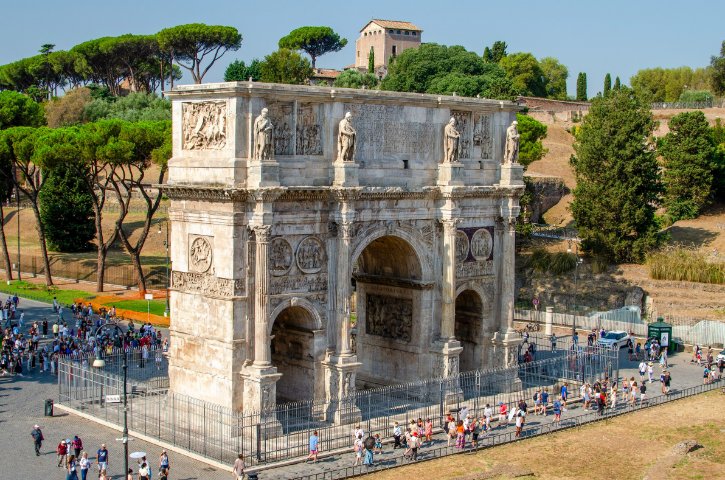
The Arch of Constantine is the largest surviving triumphal arch from antiquity and the best preserved of the three ancient arches remaining in Rome. The Senate dedicated it in 315 CE to celebrate Constantine’s victory over Maxentius at the Battle of Milvian Bridge in 312 CE. Its inscription credits “divine inspiration”, a phrase left vague to please both Christians and pagans.
b. Built from older monuments
- Much of it is secondhand, a practice called spolia.
- Reused pieces came from Trajan, Hadrian, and Marcus Aurelius.
- Along with its famous horizontal narrative frieze, several other original carvings belong to Constantine’s own time, including the column pedestal reliefs, arch spandrels, and side roundels depicting the Sun and Moon.
c. Why the recycling matters
Constantine had won power by beating a fellow Roman, so he needed to look legitimate. Borrowing images from Rome’s most respected emperors placed him in that golden lineage. His designers even recut the older faces to show Constantine himself.
d. Spotting the styles
- The Hadrianic roundels show natural bodies and real depth.
- The Constantinian frieze below shows stiff, blocky figures facing forward in rows.
- That shift points straight toward medieval and Byzantine art.
e. The overlooked Meta Sudans
- Beside the arch is a low ring of brick foundations, the Meta Sudans, a cone-shaped fountain.
- Its name meant “sweating turning-post”, since water trickled down its surface.
- Demolished in 1936 for a parade road, only its foundation ring survives.
3. Roman Forum & Palatine Hill
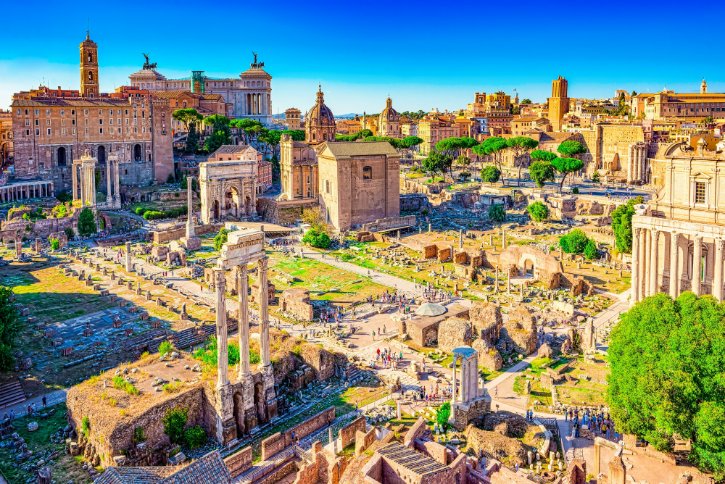
One ticket covers both the Roman Forum and the Palatine Hill, and they sit inside the same enclosed area, so it makes sense to see them as a single, longer stop. Start down in the Forum, then climb up onto the hill.
a. The Forum was the city’s living heart
The Roman Forum was the political, legal, religious, and commercial center of ancient Rome. It began as a swampy valley, drained in the 6th century BCE by the great stone channel called the Cloaca Maxima, which cleared the way for public life to grow.
b. Read the Forum by function
- Government: the Curia Iulia (senate house) and the Rostra (speaker’s platform).
- Law: the Basilica Iulia and Basilica of Maxentius.
- Trade and money: the Temple of Saturn, which held the treasury.
- Religion: the Temple of Vesta and the House of the Vestal Virgins.
- Ceremony: the paved Via Sacra, used for triumphal parades.
c. Curia Iulia
- Begun by Julius Caesar in 44 BCE and finished by Augustus.
- It survived because it became a church in 630 CE.
- Inside, notice the late 3rd-century CE Diocletianic marble floor and the stepped tiers where senators once sat. The bronze doors are replicas (the originals are at St. John Lateran).
d. Basilica of Maxentius
Begun by Maxentius around 306–308 CE and completed by Constantine around 312–313 CE, this was the Forum’s giant. Its central hall stretched 80 by 25 meters and rose about 35 meters. The three huge surviving arches later inspired Renaissance architects like Bramante and Michelangelo at St. Peter’s Basilica.
e. Arch of Titus
- Built around 81 CE at the high point of the Via Sacra.
- The south panel shows soldiers carrying the golden Menorah taken from Jerusalem.
- The north panel shows Titus in a four-horse chariot crowned by Victory.
- The carving is so deep the procession seems to sweep past you, unlike the flat Arch of Constantine.
f. Why the Imperial Forums appeared
By the 1st century BCE, this old valley was too small for Rome’s growing business and courts. So Julius Caesar bought nearby land and built a new forum in 46 BCE, starting centuries of expansion into the Imperial Forums.
g. Climbing up to the Palatine
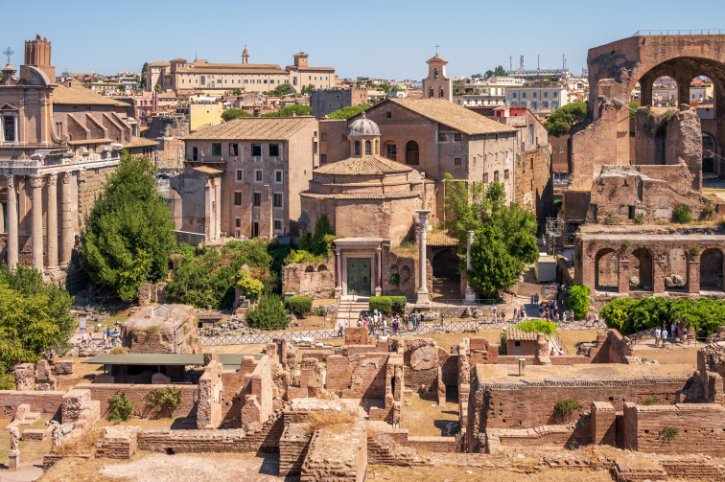
From the Forum you climb straight onto the Palatine Hill, which stacks many eras in one place. People lived here as far back as the 8th century BCE, matching the legend that Romulus founded Rome on this spot.
During the Republic it was a wealthy neighborhood, and with Augustus it became the seat of imperial power. Fittingly, the hill’s Latin name, Palatium, is the root of the word “palace” across Europe: Italian palazzo, French palais, Spanish palacio.
h. The imperial palaces
- Augustus and Livia built a fairly modest residence with a temple.
- Tiberius began the first true palace, the Domus Tiberiana, which reopened in 2023 after nearly fifty years.
- Nero added hidden underground passages, like the 130-meter Cryptoporticus with its surviving stucco.
- Domitian built the vast complex that set the template for all later palaces, with the public Domus Flavia and the private Domus Augustana.
- The so-called Palatine Stadium may actually have been a garden or riding arena, so hold that name loosely.
i. The Renaissance gardens
The Palatine is not only ancient. In the mid-16th century, Cardinal Alessandro Farnese built the Farnese Gardens right over the ruins, with terraces, twin aviary pavilions, and shaded groves of holm oaks and cypress. They are among Europe’s earliest botanical gardens.
j. The viewpoints and access
- Looking north, you gaze over the Roman Forum with the Vittoriano beyond.
- Looking south, the view drops into the Circus Maximus.
- Looking east, the Colosseum frames the skyline.
- Access to the most sensitive interiors, like the House of Augustus and House of Livia, is timed or restricted, so plan around what is open when you visit.
4. Via dei Fori Imperiali
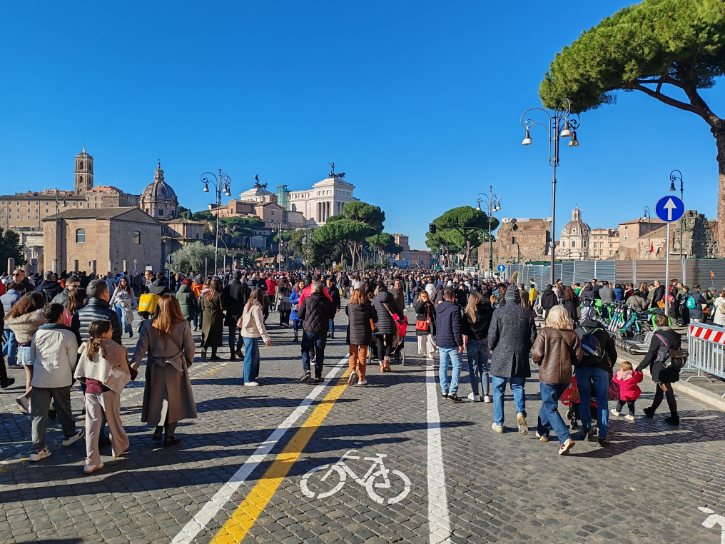
a. A street with its own story
The straight avenue of Via dei Fori Imperiali is not ancient. It was built under Mussolini and opened in 1932, first called Via dell’Impero. Its purpose was political: a clean line of sight between the regime’s headquarters and the Colosseum, and a stage for huge parades.
b. Ruins against modern planning
- Building it meant leveling an entire neighborhood, the Quartiere Alessandrino.
- More than 5,500 residents were displaced.
- Around 300,000 cubic meters of earth were removed.
- The road cut through the Imperial Forums, burying much of them.
c. What “the Imperial Forums” means
- Not one plaza, but a series of squares built over 160 years.
- Forum of Caesar (46 BCE), Forum of Augustus (2 BCE), Forum of Peace (75 CE), Forum of Nerva (97 CE), and Forum of Trajan (112 CE).
d. What you can see walking
- The ancient pavements lie three to six meters below street level.
- Look down for the curved apses of Augustus’s forum.
- Spot the standing columns of the Temple of Venus Genetrix and the tall stone firewall that once shielded the forum from the crowded Subura district.
e. Rome digging up Rome
On the wall of the Basilica of Maxentius, look for four marble maps installed in 1934. They chart Rome’s growth into an empire, a clear example of how archaeology was used for modern political messaging. It helps to keep the documented history separate from that spin.
5. Trajan’s Forum
a. The engineering behind it
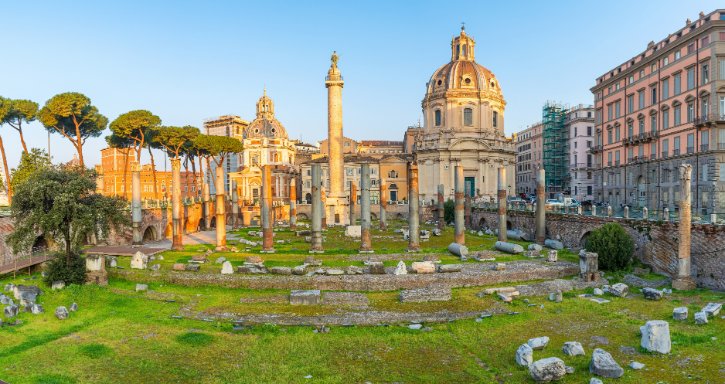
Trajan’s Forum opened in 112 CE, designed by Apollodorus of Damascus and funded by the Dacian Wars. To build it, workers carved away a whole ridge of land and dug down to bedrock, creating a level terrace of roughly 300 by 185 meters.
b. How the piazza was laid out
- You entered from the south through a marble arch topped by a six-horse chariot.
- An open marble plaza was framed by golden columned porticoes.
- A huge bronze equestrian statue of Trajan stood at the center.
- The Basilica Ulpia, the largest Rome ever built, closed off the far end.
c. Trajan’s Column
- Stands about 38 meters tall with its base.
- A carved frieze winds up 23 times, running roughly 190 meters with around 2,500 figures.
- The subject is the Dacian Wars, with Trajan appearing about sixty times.
- From the ground you can still trace the lower coils, like the army crossing the Danube on a bridge of boats.
d. The column as a tomb
The base held a burial chamber for the golden urns of Trajan and his wife Plotina. The original statue of Trajan on top vanished, and in 1587 Pope Sixtus V replaced it with a statue of Saint Peter, which still stands there today.
e. Basilica Ulpia in its own right
- About 170 by 60 meters, with five aisles and gray granite columns.
- It housed law courts and the ceremony for freeing enslaved people.
- Upper galleries let spectators watch legal cases below.
f. The lost color and luxury
- The pale ruins once glowed with colored marble.
- Picture purple-veined stone, golden yellow marble, red porphyry, and white pavements, and the whole complex transforms.
6. Monument to Victor Emmanuel II (Vittoriano)
a. From ancient empire to modern Italy
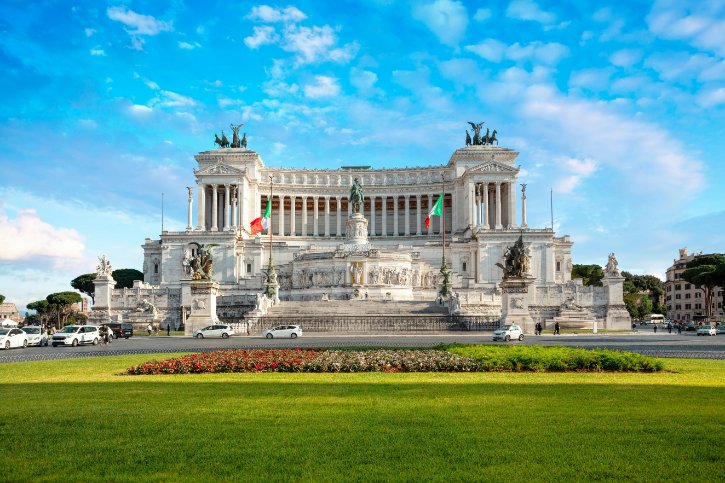
The Vittoriano, also called the Altar of the Fatherland, honors Victor Emmanuel II, the king who unified Italy. Designed by Giuseppe Sacconi and inaugurated in 1911, its gleaming white marble was meant as a grand secular forum for the new nation.
b. More than a memorial to one king
- In 1921, the Tomb of the Unknown Soldier was added.
- That turned a royal memorial into a national shrine.
- Through the 20th century it took on deep patriotic meaning.
c. The story of the Unknown Soldier
A grieving mother, Maria Bergamas, whose own son died without a known grave, chose one unidentified soldier from among eleven to represent all the missing of World War I. He was buried beneath the statue of the Goddess Roma and is still guarded around the clock.
d. The exterior program
- Two fountains represent Italy’s two seas, the Adriatic and the Tyrrhenian.
- The towering Goddess Roma sits against a gilded mosaic.
- Friezes of Labor and Patriotism run behind the tomb.
- The bronze equestrian statue of the king was cast from melted military cannons.
e. The upper architecture
- The Sommoportico is a colonnade of sixteen Corinthian columns.
- It is flanked by sections dedicated to the nation’s Unity and Liberty.
- Each is crowned by a bronze chariot driven by a winged Victory.
f. The view and the guard
- Glass elevators reach the rooftop terrace.
- Looking south, you see Via dei Fori Imperiali, the Imperial Forums, the Palatine, and the Colosseum.
- A military honor guard keeps constant watch at the tomb below.
7. Piazza del Campidoglio
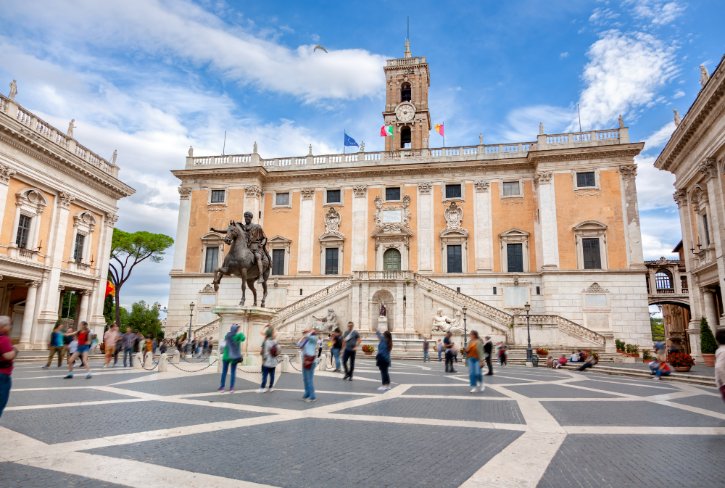
a. A square designed as one composition
Piazza del Campidoglio sits on the Capitoline Hill. In 1536, with Emperor Charles V arriving, Pope Paul III was embarrassed that this civic center was a muddy slope, so he asked Michelangelo to redesign it into a unified public space.
b. The Cordonata
- You climb a wide ramp-staircase with shallow steps.
- It was gentle enough to ride a horse up.
- The low approach hides the square until you reach the top, a staged reveal.
c. The Egyptian lions
- At the base sit two black basalt Egyptian lions.
- They came from an ancient sanctuary of Isis and Serapis.
- Once turned into fountains, they spouted wine during civic celebrations.
d. The equestrian statue as the pivot
At the center stands the bronze Marcus Aurelius statue, moved here in 1538 with a pedestal by Michelangelo. It survived the Middle Ages only because Christians mistook it for Constantine. The one outdoors is a 1997 replica, and the original is inside the museum nearby.
e. The three palaces
- Palazzo Senatorio at the back, Palazzo dei Conservatori and Palazzo Nuovo on the sides.
- Michelangelo tied them together with giant two-story pilasters.
- He shaped the plaza as a trapezoid to make it feel wider.
f. Living civic Rome
This hill has never stopped governing. Palazzo Senatorio still serves as the office of the Mayor of Rome, so ancient symbolism, Renaissance design, and modern government all overlap on one summit.
8. Capitoline Museums
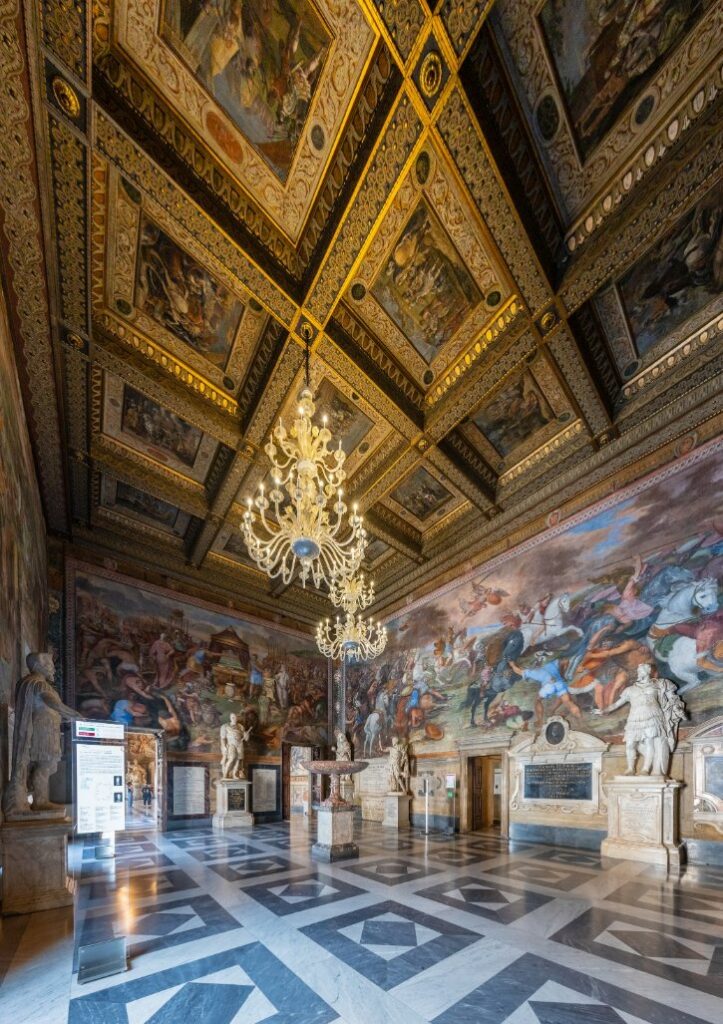
a. The world’s oldest public museum
The Capitoline Museums hold a remarkable title: the oldest public museum in the world. It began in 1471, when Pope Sixtus IV gave a collection of ancient bronzes to the people of Rome, with public access formalized in 1734.
b. Marcus Aurelius, a priority work
- The original bronze statue stands in a bright glass hall.
- You can study its surviving gold surface and the emperor’s calm face up close.
- Seeing it here links neatly to the copy you just passed outside.
c. Two ancient masterpieces
- The Dying Gaul rewards walking around all sides, so notice the twisted torc, the broken war-horn, and the wound below his ribs.
- The Capitoline Venus stands in a modest pose in her own intimate room, a quiet contrast to the giant monuments outside.
d. Smaller works worth finding
- The Spinario, a boy pulling a thorn from his foot, was part of the original 1471 gift.
- A dramatic Bust of Medusa by Bernini captures the moment she turns to stone.
- Baroque paintings broaden the collection well beyond antiquity.
e. The Tabularium viewpoint
Make this a priority. A gallery runs through the ancient Tabularium, Rome’s state archive from 78 BCE. From its Forum-facing arcade, you look straight down the Roman Forum toward the Arch of Titus and the Colosseum, which reframes everything you walked earlier.
f. The inscriptions
- The Galleria Lapidaria holds more than 1,400 ancient stones.
- They record ordinary life: epitaphs for freed slaves, guild rosters, dedications to foreign gods, and markers left by gladiators.
- These give real human voices to the monumental city outside.
9. Theatre of Marcellus
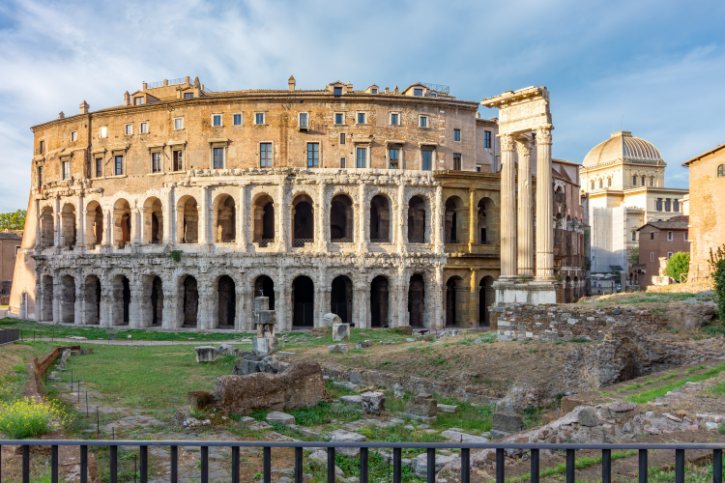
a. Not a small Colosseum
The Theatre of Marcellus is a theatre, not an amphitheatre, built for plays rather than gladiator fights. Julius Caesar began it, and Augustus dedicated it around 13 or 11 BCE, naming it for his young nephew Marcellus, who died at nineteen.
b. A developed Roman theatre
- Unlike Greek theatres, it did not lean on a hillside.
- Roman engineers used concrete and vaulting to build it freestanding on flat ground.
- Its semicircular form held 15,000 to 20,000 spectators.
c. What remains on the facade
- A ground floor with Doric half-columns.
- A second level with Ionic half-columns.
- A missing third level that once had Corinthian pilasters and bronze masks.
- This sequence became the blueprint for the Colosseum’s facade a century later.
d. Lost details and the audience experience
- Records point to bronze theatre masks and marble decoration now gone.
- About 36 bronze sounding vessels helped carry the actors’ voices.
- A huge linen velarium awning shaded the crowd in summer.
e. The palace on top
After the theatre fell out of use, it became a medieval fortress. Then in 1526, the Savelli family hired Baldassarre Peruzzi to build a palace directly on top of the ancient arcades. Ancient, medieval, and Renaissance Rome are literally stacked here.
f. What you can see today
- The upper palace is private apartments, so you cannot go inside.
- You can enjoy the exterior and the open archaeological area.
- Nearby stand three Corinthian columns from the Temple of Apollo Sosiano.
10. Mouth of Truth (Bocca della Verità)
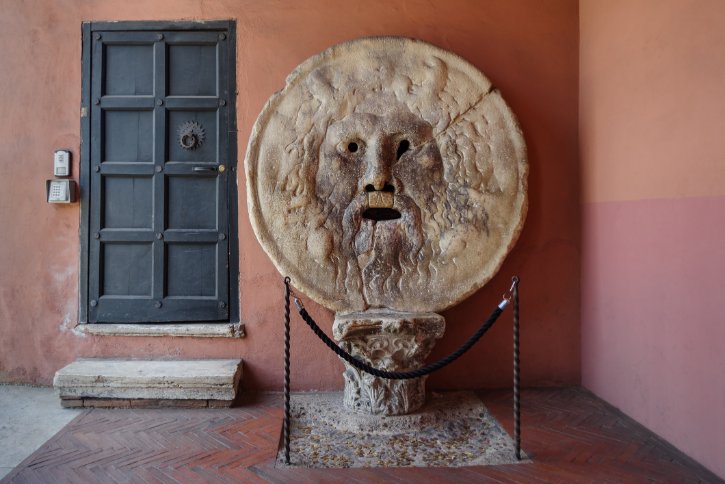
a. What we actually know
- A large marble disc carved with a bearded face, inside the church of Santa Maria in Cosmedin.
- Made of Phrygian marble, about 75 meters across and 1,300 kilograms.
- It dates to roughly the 1st century CE.
- Most scholars think it was an ancient drain cover or fountain mask.
b. Why the holes matter
The eyes, nostrils, and mouth are all open holes, which fits the idea that water once passed through, draining into the great Cloaca Maxima. Still, treat the drainage theory as the leading explanation rather than absolute fact, since the exact purpose is debated.
c. The legend, told separately
- The name Bocca della Verità appears in writing in 1485.
- Legend said the stone jaws would bite off a liar’s hand.
- It became tied to accusations of unfaithful spouses.
- This is folklore, not Roman history.
d. The church setting
The disc was moved into the church portico in 1632. That setting matters, because Santa Maria in Cosmedin is a lovely early medieval basilica with a mosaic floor and ancient crypt. So a Roman object ended up woven into a Christian space.
e. Roman Holiday
- In the 1953 film, Gregory Peck pretends the mouth has bitten off his hand.
- Audrey Hepburn’s shocked reaction was unscripted and caught in one take.
- That scene turned a local curiosity into a world-famous photo stop.
11. Circus Maximus
a. Scale and purpose
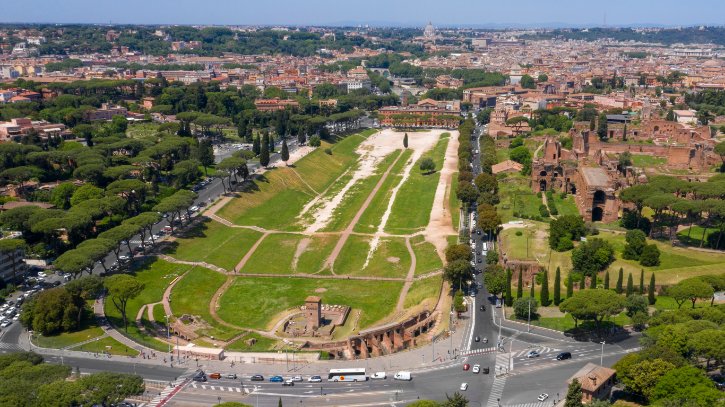
The Circus Maximus lies between the Palatine and Aventine hills. At about 600 by 140 meters, it was the largest entertainment venue in the ancient world. So much of its stone was recycled that visiting today takes imagination, reading the shape through the valley floor.
b. Its long history
- Tradition links it to Rome’s earliest days.
- Under the Tarquin kings the valley was drained and wooden seating went up.
- Caesar and Augustus rebuilt it in stone.
- Trajan rebuilt it in 103 CE as a three-story bowl, the phase most surviving remains belong to.
c. Roman chariot racing culture
- Four teams competed, known by color: Greens, Blues, Reds, and Whites.
- Twelve four-horse chariots raced seven laps, about 5 kilometers.
- Drivers tied the reins around their waists and carried a knife to cut free in crashes.
- Fans followed their favorite teams with fierce loyalty.
d. How to read the site today
- The flat grass field marks the old sand track.
- The steep slopes show where the tiered seating stood.
- The central depression traces the barrier, once topped with towering Egyptian obelisks now elsewhere in Rome.
e. Ruins and the tower
The main standing ruins sit at the curved southeastern end, where excavations uncovered arcades, paving, shops, and betting stalls. Above them rises the Torre della Moletta, a 12th-century brick tower that later held a watermill.
f. Bringing the vanished circus back to life
- The Circo Maximo Experience uses augmented reality headsets to rebuild the arcades, gates, obelisks, and a 3D race on the empty ground.
- Look up to the north and you will see the Palatine’s tall Severan palace arcades looming over the valley, the same hill you climbed earlier in the walk.