Occitanie might be the easiest road trip you ever fall in love with. In one connected drive, you roll from medieval citadels to Roman monuments, from pink lagoons to vineyard hills, without ever planning separate trips.
One stop you stand inside fortress walls, the next you watch flamingos over a salt marsh. Grab the keys, and let Southern France unfold in front of you. 😊
1. Toulouse
a. The City That Glows Pink
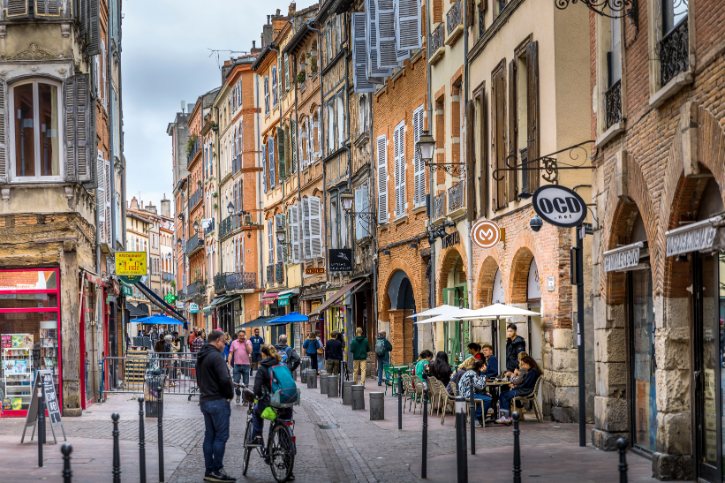
Toulouse is called La Ville Rose, the Pink City, and you will see why the moment the sun hits it. The old center is built from warm terracotta brick, made from local Garonne river clay, which glows apricot at dawn and deep crimson at dusk. After a huge fire in 1463, the city’s leaders pushed brick over flammable timber, and the pink look became its signature.
b. Start at the Grand Main Square
Begin at Place du Capitole, the pedestrian heart of the city:
- The Capitole, an 18th-century civic palace with a long brick-and-stone façade
- A giant bronze Occitan Cross in the ground, its twelve arms marked with zodiac signs
- Café terraces buzzing with students, locals, and street performers
- A perfect first coffee stop before you explore on foot
c. Monuments Worth Your Time
The city grew rich from the 16th-century blue-dye trade, and it shows:
- Basilica of Saint-Sernin, the largest Romanesque church in Europe and a UNESCO pilgrimage site
- Couvent des Jacobins, plain outside but hiding a stunning brick ceiling that fans out like a palm tree
- Hôtel d’Assézat and Hôtel de Bernuy, grand mansions built by wealthy dye merchants
- The Garonne River quays and the sturdy Pont Neuf, finished in 1632
- The Canal du Midi, which begins here on its way to the Mediterranean
d. Eat, Sip, and Linger
Head to the covered markets and taste the southwest:
- Magret de canard (grilled duck breast) and rich duck confit
- Genuine Saucisse de Toulouse, a coarse pork sausage coiled in a spiral
- Sweet violet-flavored candies, a city specialty
- A terrace seat in the old town, just to watch the city go by
- The lively Marché des Carmes in the southern quarter
e. A City of Rockets, Too
A few things that give Toulouse its modern edge:
- Europe’s aerospace capital, home to the headquarters of Airbus
- The Cité de l’Espace, a space park with full-scale rocket models
- One of Europe’s oldest universities, keeping the streets young and lively
- The quiet Lauragais farm country waiting just southeast, toward your next stop
2. Castelnaudary
a. The Home of Cassoulet
Castelnaudary is the proud home of cassoulet, the slow-cooked bean and meat stew that southwestern France loves. Local legend says the dish was born during a 1355 siege, when townspeople tossed their last provisions into one pot to feed the defenders.
b. What Makes the Dish Special
Real Castelnaudary cassoulet follows strict rules:
- Local haricots lingots, white beans with tender skins that soak up flavor
- Confit duck, fresh pork, salted pork rind, garlic, and pure Toulouse sausage
- Slow baking in a flared clay dish called a cassole, made in the nearby village of Issel
- An August food festival that fills the whole town to celebrate it
c. Stroll the Canal Harbor
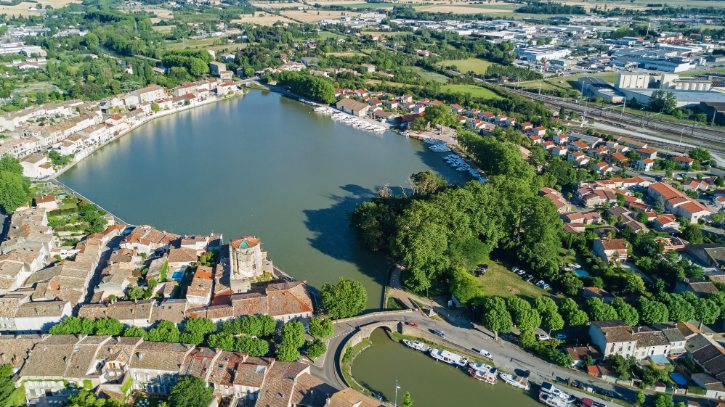
The Grand Bassin is the largest harbor on the entire Canal du Midi:
- Built in the 1670s, nearly seven hectares of open water
- Stone quays shaded by plane trees, perfect for a slow walk
- Old houseboats and cruising boats reflected in the water
- The Île de la Cybèle, a small island built to calm the waves
d. More Than a Food Stop
The upper town hides quiet highlights worth a wander:
- The Collégiale Saint-Michel, a fortress-like church with a 50-meter bell tower
- The Écluses de Saint-Roch, a staircase of four locks that lift boats nearly ten meters
- The restored Moulin de Cugarel windmill, with views toward the Pyrenees
- Old cobbled lanes dotted with 17th-century stone details
3. Carcassonne
a. A Fortress Out of a Storybook
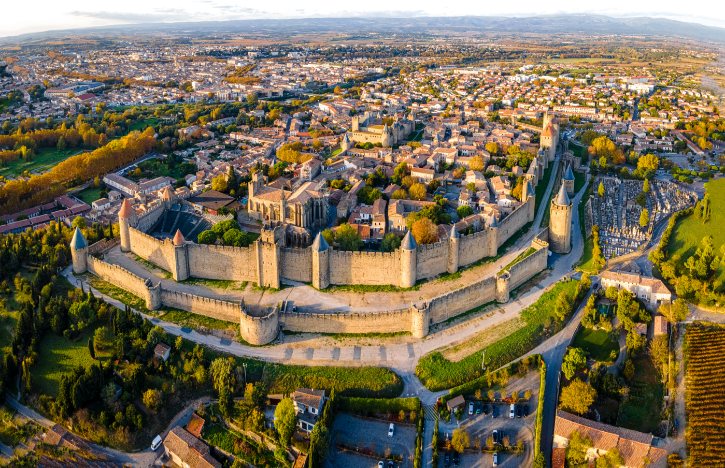
Your first look at La Cité, the walled medieval city of Carcassonne, is hard to forget. It sits on a steep rise above the Aude River, wrapped in a double ring of stone walls nearly three kilometers long and backed by 52 towers.
b. Explore the Walls and Castle
Inside the ramparts, look for these:
- Château Comtal, a castle within the castle, with galleries once used to drop stones on attackers
- The grand eastern gate, Porte Narbonnaise, with its drawbridge and twin towers
- The steep western Porte d’Aude, built with blind corners to trap invaders
- The lices, the open ground between the two walls, where the scale really hits you
- The Basilica of Saints Nazarius and Celsus, with glowing stained-glass rose windows
c. Centuries Stacked in Stone
You can read the whole history right in the walls:
- Settled as far back as the 6th century BC, then fortified by the Romans
- Thin red brick bands in the lower walls that mark the Roman stonework
- A thriving medieval city until the brutal Albigensian Crusade in 1209
- A near-ruin by the 1800s, saved by architect Eugène Viollet-le-Duc
- UNESCO World Heritage status, earned in 1997
d. Don’t Skip the Lower Town
Across the river lies the Bastide Saint-Louis, calmer and more everyday:
- Morning markets, cafés, and elegant townhouses around a central square
- The 14th-century Pont Vieux, joining the two halves of the city
- The classic postcard view back up at the floodlit walls
- Vineyards and countryside rolling out in every direction
4. Narbonne
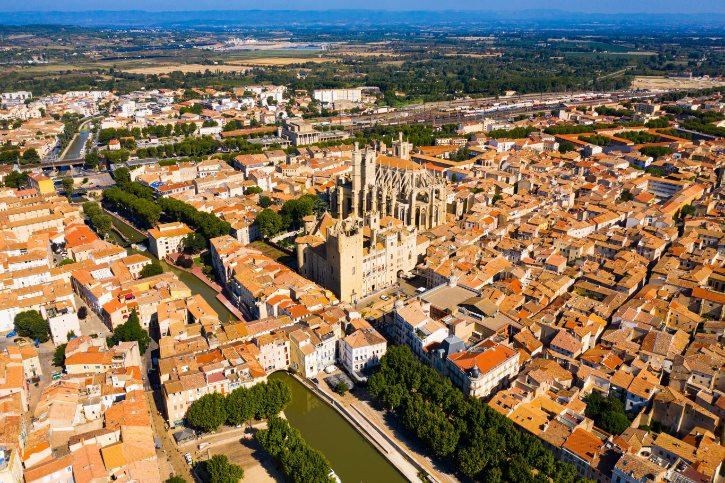
a. Rome’s First Colony in Gaul
Narbonne has an ancient pedigree. Founded in 118 BC as Narbo Martius, it was Rome’s first colony in Gaul and grew into one of the wealthiest ports in the western Mediterranean, right on the great Roman road.
b. Walk Through Roman History
Much of the Roman city is buried, but real pieces survive:
- A rutted section of the Via Domitia lies open in the main square, over 2,000 years old
- The Horreum Romain, an underground maze once used to store grain, wine, and oil
- Narbo Via, a modern museum whose huge wall displays more than 760 Roman carvings
c. Where Old and Older Meet
Medieval Narbonne grew right on top of the Roman city:
- The Cathédrale Saint-Just-et-Saint-Pasteur, with one of France’s tallest Gothic choirs, left unfinished
- The fortified Palais des Archevêques, showing the power of the old archbishops
- The tree-lined Canal de la Robine, part of the UNESCO canal network, through the center
d. Taste the City Center
The social heart of town is its market, Les Halles de Narbonne:
- A grand cast-iron and glass hall, full of life each morning
- More than 60 vendors selling seafood, cheese, olives, and charcuterie
- A bistro where orders are shouted to the butcher by megaphone
- The Pont des Marchands, a rare bridge still lined with houses and shops
- Pedestrian streets like Rue Droite, full of carved stone and café terraces
e. Toward the Lagoons
South of town, the scenery changes fast:
- Protected wetlands and shallow lagoons begin just past the streets
- The vast Étang de Bages-Sigean, dotted with old fishing villages
- Stone houses that cling to the cliffs above the water
- Wide coastal views and great birdwatching, only minutes from the Roman center
5. Gruissan
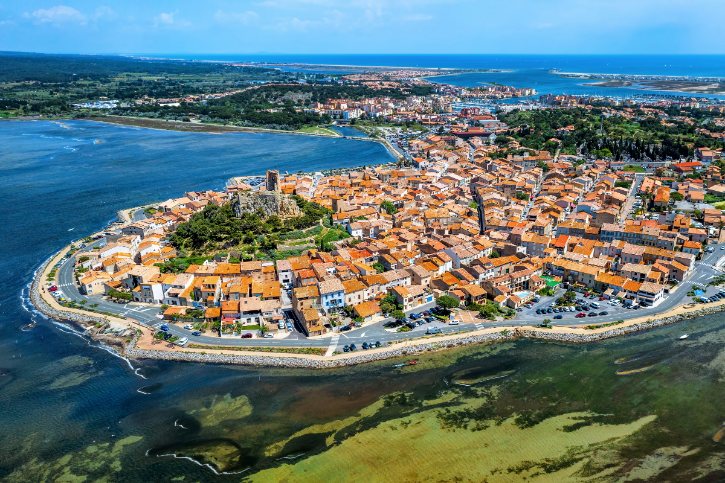
a. A Village Built in a Spiral
Gruissan looks like nowhere else on the coast. Its old village is a circulade, a circular layout of lanes that coil like a snail shell around a central rocky hill. Laid out around the year 1000, the winding alleys were designed to confuse invaders and block the sea winds.
b. Climb the Barberousse Tower
Crowning the hill are castle ruins and the Tour Barberousse:
- Built in the 1240s to watch the coast and guard against pirates
- Often linked to the corsair Barbarossa, though records show he never came here
- More likely tied to a local 16th-century captain, Gaspard Dot, nicknamed “Barberoussette”
- A 360-degree view at the top. Trust me, it is worth the short climb.
c. Beaches and the Famous Stilt Houses
Gruissan’s coast is wide beaches plus one very unusual neighborhood:
- Plage des Chalets, lined with over 1,300 wooden beach houses on stilts
- Stilts that let storm tides wash harmlessly underneath the homes
- A modern marina holding more than 1,600 boats
- Breezy beaches loved by windsurfers and kiteboarders
- A striking contrast between the tight old village and the modern seafront
d. Pink Salt and Wild Birds
Just south of the village, the Salin de Gruissan has made sea salt for generations:
- Salt pans that glow pink and deep red in summer
- Greater flamingos feeding in the shallow lagoons
- Black-winged stilts, avocets, and terns
- Walking paths across the aromatic Massif de la Clape, scented with pine and wild herbs
6. Béziers
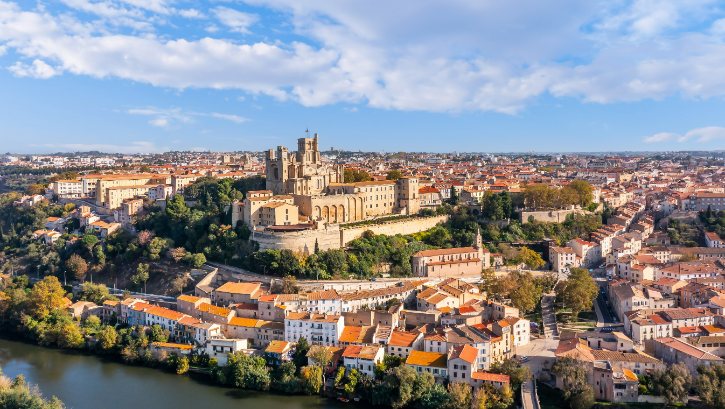
a. A Town on a Hilltop
Béziers rises on a high limestone ridge above the Orb River, with wide views over the plain. The landmark you spot first is the Cathédrale Saint-Nazaire, a fortified Gothic cathedral that looks more like a castle, with battlements and a 46-meter bell tower.
b. Views and Old Streets
The hilltop gives you some of the best scenery in the region:
- The bishop’s garden beside the cathedral, with a panorama over the Orb Valley
- The Pont Vieux, a 12th-century bridge stretching 241 meters on 15 uneven arches
- The Allées Paul Riquet, a tree-lined boulevard that forms the city’s lively spine
- Narrow old streets climbing from the river to the cathedral cliff
c. The Canal Genius Born Here
Béziers is the birthplace of Pierre-Paul Riquet, who designed the Canal du Midi:
- The Écluses de Fonseranes, a remarkable “water staircase” of linked locks
- A climb of more than 21 meters for boats passing through
- One of France’s most visited engineering sites
- A spot where the canal even crosses the Orb on a stone aqueduct
A quick note: the Roman amphitheater buried in the hillside is not the same as the later bullfighting arena from 1897.
d. Festivals and Flavors
Béziers loves a celebration, and its food culture is strong year-round:
- The five-day Feria de Béziers every August, drawing close to a million people
- Chichoumeille, a regional ratatouille found in the covered market
- Coques de Béziers, a brioche pastry scented with orange blossom
- Plenty of local Languedoc wines to try
- Characterful squares like Place Jean Jaurès, with its fountains
7. Pézenas
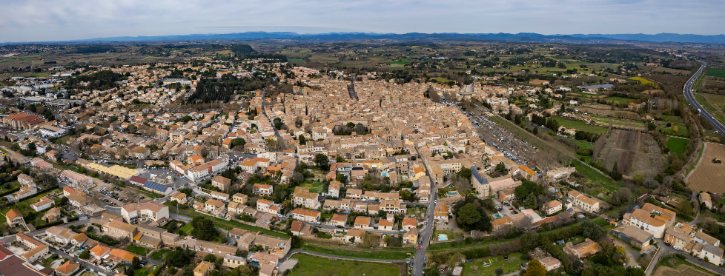
a. A Living Open-Air Museum
Pézenas is a jewel box of preserved 16th-, 17th-, and 18th-century architecture. Once the political seat of the Languedoc region, it earned the nickname “Versailles of Languedoc”, and wealthy nobles built lavish mansions here from honey-colored stone.
b. Wander the Historic Lanes
The old town is made for slow wandering:
- Carved Renaissance doorways and decorative stone lintels
- Hidden inner courtyards with spiral staircases and open loggias
- Stone faces, wrought-iron balconies, and covered alleyways
- The lively Place Gambetta at the heart of it all, once the town’s grain market
c. The Town Molière Loved
Pézenas is closely tied to the great playwright Molière:
- He spent long stretches here in the 1650s with his touring company
- He based famous characters on the local nobles and townsfolk he watched
- More than 40 craft workshops now fill the old stone vaults
- Woodturners, bookbinders, stained-glass artists, galleries, and antique shops
d. A Pastry You Should Try
Save room for the local specialty:
- The Petit Pâté de Pézenas, a spool-shaped pastry filled with spiced lamb, sugar, and lemon zest
- A recipe said to have arrived in 1768 by way of an Indian chef
- A sweet-and-savory mix that pairs beautifully with local wine
- A lively Saturday market that fills the center with regional producers
8. Saint-Guilhem-le-Désert
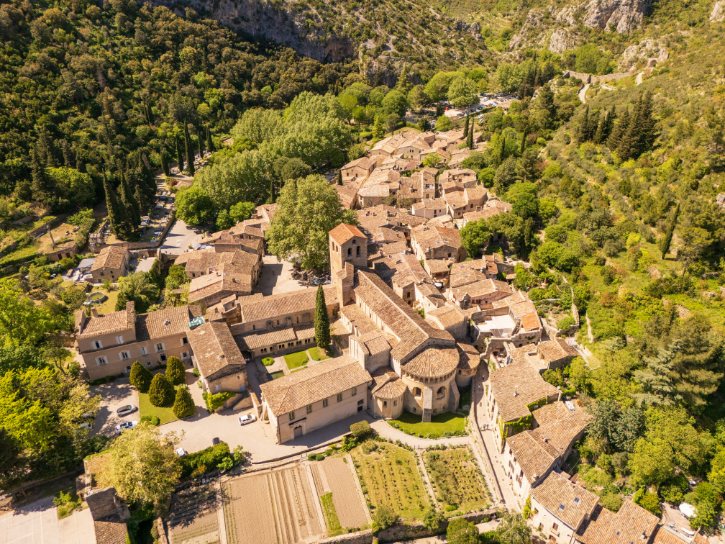
a. A Village Hidden in the Cliffs
Tucked deep in a rocky gorge, Saint-Guilhem-le-Désert is one of Southern France’s most beloved pilgrimage villages. Its story began in 804, when a cousin of Charlemagne gave up his titles and founded a quiet hermitage in this isolated canyon.
b. The Abbey at Its Heart
The village grew around the Abbey of Gellone, an 11th-century Romanesque church:
- Prized for its architectural purity and beautiful acoustics
- A simple stone nave and an early crypt holding the saint’s tomb
- A fragment of the True Cross, said to be a gift from Charlemagne
- UNESCO World Heritage status, as part of the Santiago pilgrimage routes
c. Streets That Feel Timeless
Counted among the “Most Beautiful Villages of France”, it is pure charm:
- Stone houses dressed with carved lintels and old windows
- Historic fountains and tiny tucked-away squares
- The shaded Place de la Liberté, under a huge old plane tree
- Small workshops selling olive wood carvings, herbal soaps, honey, and pottery
- Stone homes pressed right up against the sheer limestone cliffs
d. The Gorge and the Devil’s Bridge
The village sits inside the dramatic Gorges de l’Hérault:
- The Pont du Diable, or Devil’s Bridge, built between 1028 and 1031
- One of the oldest medieval bridges in France, with its own UNESCO status
- A local legend of the Devil outwitted by a clever saint
- Cliff trails, kayaking, and a seasonal swim below the bridge
9. Montpellier
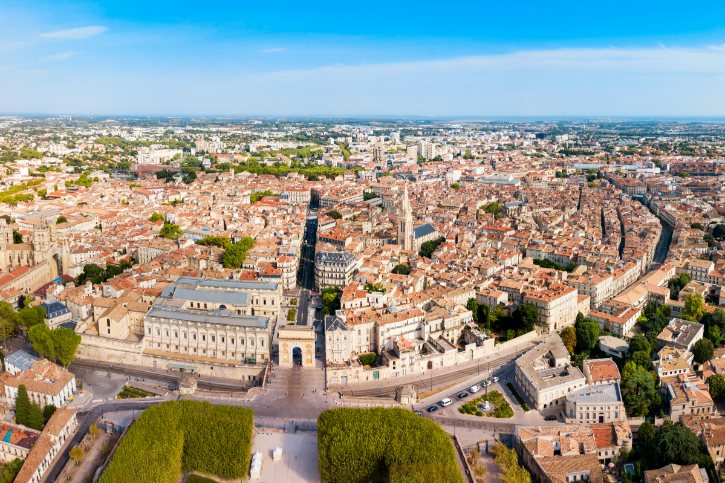
a. Where Old and New Collide
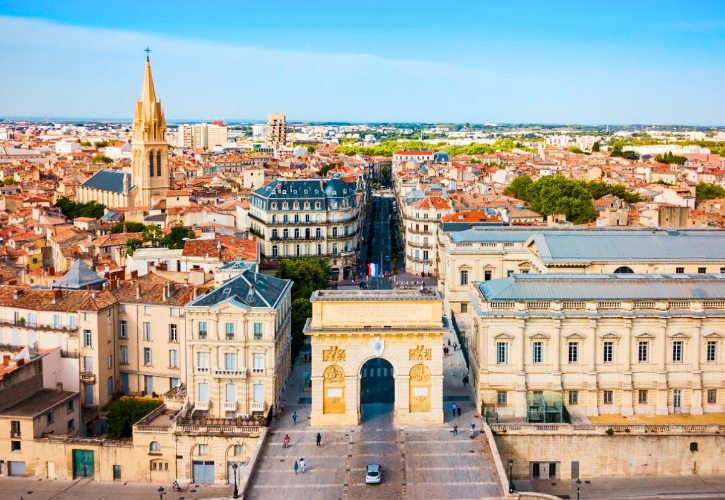
Montpellier blends a thousand-year academic tradition with bold modern architecture and an easy Mediterranean pace. Its living room is the huge oval Place de la Comédie, nicknamed “The Egg”, framed by grand façades and an elegant fountain.
b. A City of Scholars
Learning runs deep here, and you feel it everywhere:
- A Faculty of Medicine founded in 1220, the oldest still-working one in the Western world
- Famous former students, from Rabelais to Nostradamus
- Busy, café-lined streets full of festivals and student energy
- A relaxed change of pace after the smaller towns earlier on the route
c. Lose Yourself in the Old Quarter
The old heart of the city is L’Écusson, a medieval maze:
- More than 80 private mansions hidden behind heavy wooden gates
- The Cathédrale Saint-Pierre, with a fortress-like entrance on two massive pillars
- The Jardin des Plantes, France’s first botanical garden, planted in 1593
- The Promenade du Peyrou, an elevated terrace with a grand arch and old aqueduct
- Narrow alleys lined with bookshops, boutiques, and café terraces
d. A Bold Modern Side
Montpellier is not shy about new design, either:
- The Antigone district, reworking classical Greek shapes in honey-toned concrete
- The striking L’Arbre Blanc tower, with balconies that fan out like leaves
- A sharp contrast between the medieval core and the modern quarters
- The Mediterranean coast, only a short hop away
10. La Grande-Motte
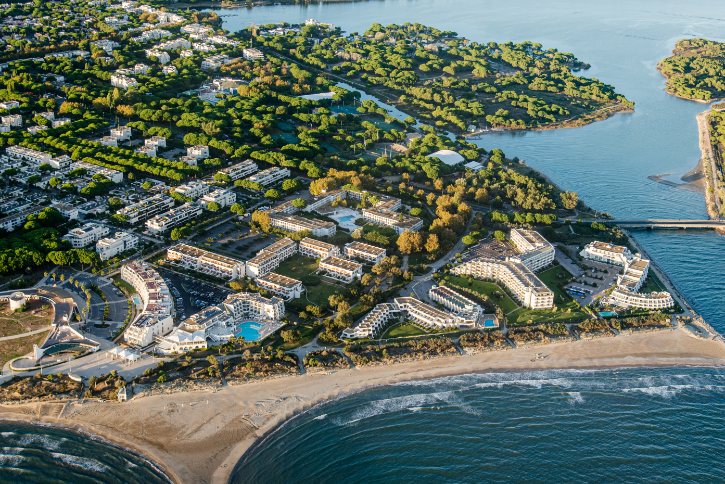
a. A Resort Like No Other
La Grande-Motte is one of Europe’s boldest urban experiments. In the 1960s, the French state set out to turn these marshes and dunes into planned holiday resorts, partly to keep French vacationers from heading to Spain.
b. The Pyramids by the Sea
Architect Jean Balladur designed the whole town from scratch:
- A skyline of pyramid-shaped concrete buildings, drawing on ancient step-pyramids in Mexico
- Buildings angled to catch the sun, steer the breeze, and open up sea views
- The 15-story Grande Pyramide, shaped to echo an inland mountain peak
- A national heritage label, the first ever given to a complete town in France
c. Sand, Sailing, and Sea Air
Beyond the architecture, this is a proper beach town with miles of sand:
- The central Plage du Point Zéro, right in the heart of things
- The family-friendly Plage du Couchant
- The wild, dune-backed Plage du Grand Travers
- A marina with more than 1,500 boats, plus sailing and paddleboarding
- Sea views framed by the resort’s unmistakable concrete pyramids
d. A Green Garden-City
The clever part of the plan was all the greenery:
- More than 70 percent of the town given to parks, gardens, and paths
- Tens of thousands of trees planted to hold the sandy soil
- Walkways designed so you reach the beach without crossing a road
- Concrete screens with patterns said to resemble sunglasses and seashells
11. Aigues-Mortes
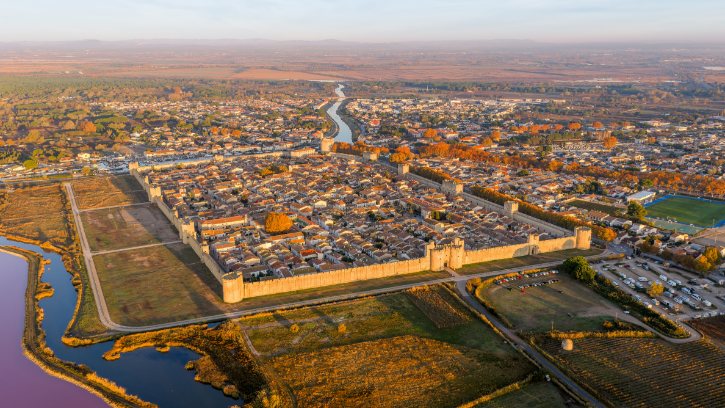
a. A Walled Town in the Marshes
Rising straight out of the marshes, Aigues-Mortes is a beautifully preserved example of 13th-century town planning. It was founded in 1240 by King Louis IX as the French Crown’s first royal port on the Mediterranean, and from here the king launched two Crusades.
b. The Ramparts and Great Tower
The fortifications are the town’s defining feature:
- A complete ring of walls stretching 1,640 meters, backed by 20 towers and gates
- The mighty Tour de Constance, a round keep with walls up to six meters thick
- A later role as a prison, where the Huguenot Marie Durand is said to have spent 38 years and carved “register”, the old word for “resist”, into the stone
- Sweeping views over the rooftops, marshes, and pink salt basins from the top
c. Life Inside the Walls
Inside, the streets follow a neat medieval grid:
- Place Saint-Louis, a leafy square with a bronze statue of the king
- The Église Notre-Dame-des-Sablons, the oldest building in town, lit by modern glass
- Café terraces, small shops, and stone houses along the shaded lanes
- Fortified gateways, one of which still shows the remains of its old portcullis
- Sweet, orange-scented local brioche to pick up along the way
d. Salt, Flamingos, and Wild Horses
Just outside the walls lie the Salins d’Aigues-Mortes:
- Salt pans that glow pink in the warmer months
- The edge of the famous Petite Camargue nature reserve
- Thousands of greater flamingos, herons, and egrets
- Grazing Camargue horses and black bulls, plus a local bull stew to try
12. Nîmes
a. The French Rome
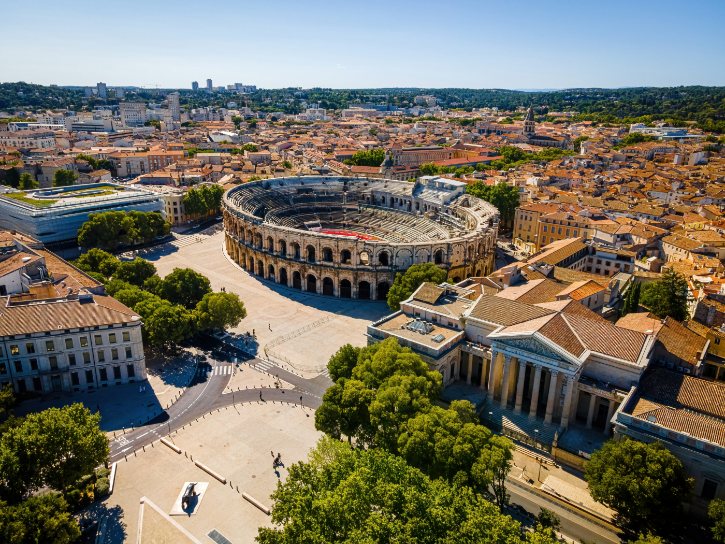
Nîmes earns its nickname through an incredible set of well-preserved Roman monuments. The city grew up around a sacred spring and became a grand Roman colony under Emperor Augustus.
b. Step Inside the Ancient Arena
The star of the city is the Arènes de Nîmes, built around 70 to 90 AD:
- A great ellipse measuring 133 meters by 101 meters, with 60 arches on two levels
- Room for more than 20,000 spectators on its stone seats
- Still in use today, hosting concerts, festivals, and historical reenactments
- A living arena that sets the tone for the whole city
c. More Roman Treasures
Nîmes is packed with ancient sites you can walk between on foot:
- The Maison Carrée, one of the best-preserved Roman temples in the world and a UNESCO site
- The Jardins de la Fontaine, gardens around the founding spring, with the ruined “Temple of Diana”
- The Tour Magne, a 32-meter watchtower and the largest piece of the old Roman wall
- The Musée de la Romanité, a modern museum whose façade suggests a pleated Roman toga
- The Castellum, where aqueduct water was once shared out across the city
d. The Home of Denim
Modern Nîmes mixes Roman pride with a strong local identity:
- The birthplace of denim, whose name comes from “serge de Nîmes”
- A crocodile-and-palm symbol taken from ancient Roman coins
- Bronze medallions of that symbol set into the pavement all over town
- Lively ferias and a local salt cod dish called brandade to try
13. Uzès
a. The First Duchy of France
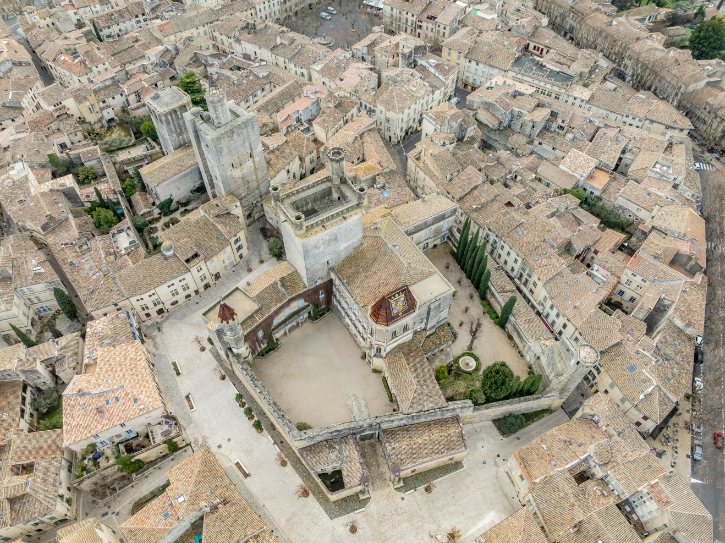
Uzès holds a proud title as the “First Duchy of France”, granted in 1565. Set on a plateau above a small valley, it grew from a medieval stronghold into an elegant town, calmer and more intimate than busy Nîmes nearby.
b. The Square and the Tower
The center of town is a joy to explore:
- Place aux Herbes, a square ringed by deep stone arcades and a fountain under plane trees
- Le Duché, the ducal castle, home to the same family for over a thousand years
- The Tour Fenestrelle, a unique 42-meter round bell tower with stacked rows of arched windows
- A weekly Saturday market, one of the finest in the south
- Regional goat cheese, truffles, olives, and honey on the stalls
c. Stone Streets and a Sweet Surprise
The pedestrian lanes are full of fine old mansions and small shops:
- Inner courtyards, hidden fountains, and carved stone crests
- Galleries, antique shops, and local pottery boutiques
- The popular Musée du Bonbon Haribo, built on the town’s long licorice history
- A fun fact to clear up: gummy bears were actually invented in Bonn, Germany, not here
d. Where the Roman Water Began
Below the town lies the lush Vallée de l’Eure, where fresh springs bubble up. Roman engineers chose this Eure spring as the water source for Nîmes, and from here a 50-kilometer underground aqueduct carried it across the countryside, straight toward the greatest monument of the whole system.
14. Pont du Gard
a. A Roman Engineering Marvel
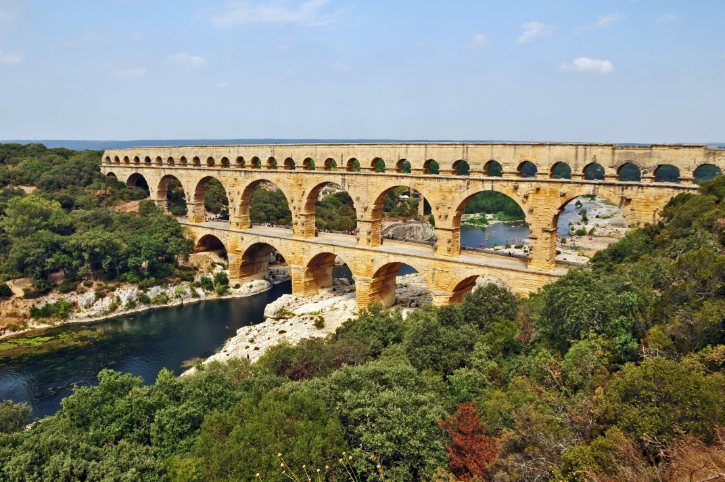
Spanning the gorge of the Gardon River, the Pont du Gard is a triumph of Roman engineering. Built in the mid-1st century AD, it was the main crossing point of the aqueduct carrying fresh water all the way from Uzès to Nîmes.
b. Numbers That Amaze
The scale and precision of the bridge are hard to believe:
- The highest aqueduct bridge the Romans ever built, rising nearly 49 meters
- Three tiers of stone arches stacked on top of each other
- A UNESCO World Heritage Site since 1985
- A total drop of only about 12.6 meters across the full 50-kilometer aqueduct
c. Built to Last Without Mortar
Up close, the craftsmanship is remarkable:
- Held together by gravity and precision alone, almost without mortar
- An estimated 50,400 tons of local limestone, quarried just downstream
- Projecting stones left in place to once hold wooden scaffolding
- Pointed cutwaters on the piers, designed to split the force of flash floods
d. Views and the River Below
The setting is as lovely as the bridge itself:
- Clifftop viewpoints looking down the full curve of the arches
- Riverbanks where the golden stone reflects in the water
- Trails through old olive groves and dry-stone shelters
- Kayaking beneath the arches or a swim in the clear river in summer
- A visitor center with models that explain the Roman water system
15. Avignon & Villeneuve-lès-Avignon
a. The City of the Popes
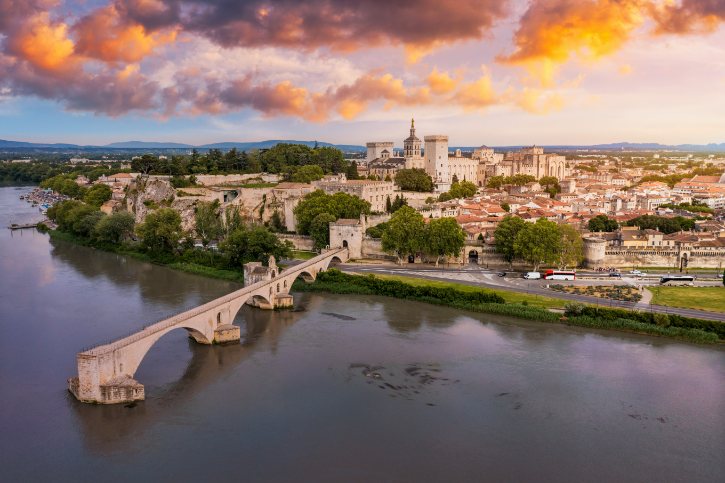
Avignon has a one-of-a-kind place in European history. For most of the 14th century, the popes ruled from here instead of Rome, turning a river town into an international capital of politics, money, and art.
b. Inside the Great Palace
The symbol of that era is the Palais des Papes, the largest Gothic palace of the Middle Ages:
- A huge complex covering 15,000 square meters, with a stern older wing and a lavish newer one
- Grand ceremonial halls and private papal apartments painted with beautiful frescoes
- UNESCO World Heritage status, shared with the city’s historic center
- The nearby Petit Palais, full of early Italian Renaissance paintings
c. Streets, Squares, and a Famous Bridge
Avignon’s old center is still ringed by medieval walls and full of life:
- The grand Place du Palais and the busy, café-lined Place de l’Horloge
- The Rue des Teinturiers, a romantic cobbled street with old waterwheels
- The Pont Saint-Bénézet, the famous “Pont d’Avignon” that inspired a children’s song
- The Rocher des Doms gardens, with lovely views over the river
- A world-famous theater festival that fills the streets every July
d. Cross to Villeneuve-lès-Avignon
Just across the Rhône sits Villeneuve-lès-Avignon, more than just a viewpoint:
- Fort Saint-André, a 14th-century royal fortress with grand views back to the palace
- The Chartreuse du Val de Bénédiction, once one of France’s largest monasteries
- The Tour Philippe-le-Bel, a tower that guarded the old bridge
- The peaceful terraced gardens of the Abbaye Saint-André
e. A Fitting End to the Road Trip
Finishing here brings everything together. On one bank stand royal fortifications, on the other the great palace of the popes, with the Rhône flowing between them. Looking back, the variety of the whole journey is remarkable:
- The Roman engineering of Nîmes and the Pont du Gard
- The medieval walls of Carcassonne and Aigues-Mortes
- The pilgrimage stone of Toulouse and Saint-Guilhem-le-Désert
- Grain fields, vineyards, limestone canyons, pink lagoons, and Mediterranean beaches
One connected drive links some of Southern France’s most beautiful cities, towns, monuments, and landscapes. Pack a bag, pick up the keys, and let the region unfold mile by mile.