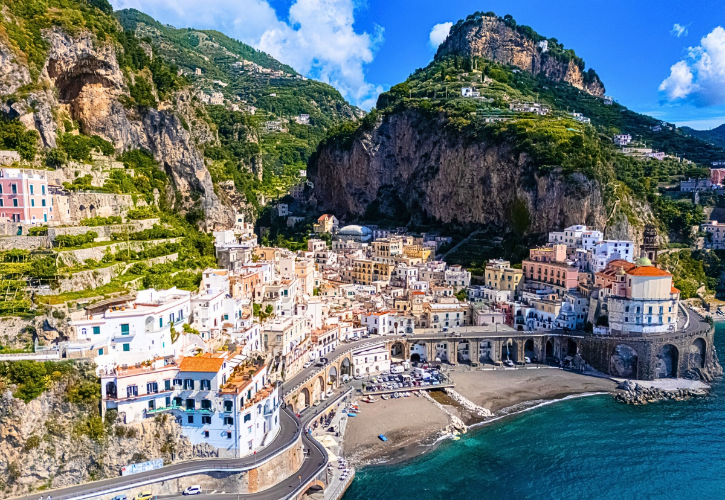
When you think of the Amalfi Coast, you probably picture one or two famous towns, and you’d be missing most of the story.
Just beyond those headline names sit volcanic islands with steaming springs, pastel fishing harbors, ancient Roman ruins, grand palaces, and gardens high above the sea.
The smart way to see it all is a loop that mixes scenic driving with short ferry and hydrofoil hops between the mainland and the islands, with many stops sitting just 20 to 40 minutes apart.
Most people only ever tick off one or two of these famous spots and head home. String them together, though, and you get the whole region in a single trip. 😊
1. Ischia (Island)
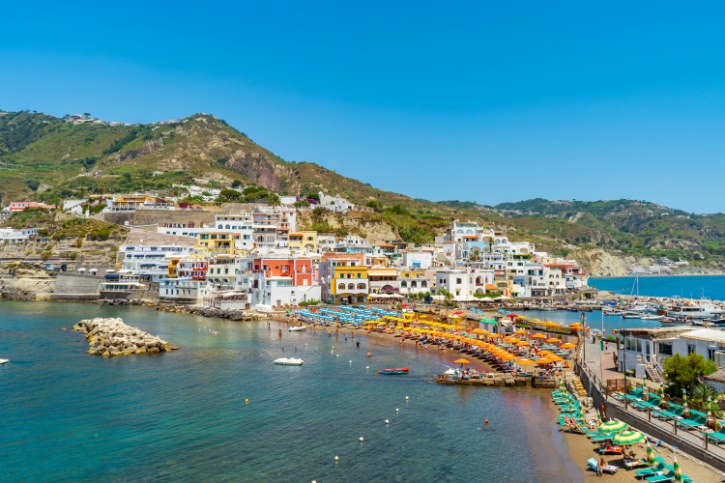
Ischia is the biggest island in the Bay of Naples, and it surprises nearly everyone. You get green volcanic hills, hot mineral springs, old farming villages, and a coast dotted with castles and gardens.
a. A Castle Perched on Its Own Rock
The Castello Aragonese is the island’s most dramatic sight, standing on a small rocky islet just offshore.
- You reach it across a stone causeway built in 1441, about 220 meters long.
- For centuries it was a safe refuge from sea raids.
- Inside, you can explore a cathedral with a frescoed crypt and an old convent.
- From the upper walls, the views reach across the water to the mainland.
b. Gardens That Grew From Bare Stone
The gardens of La Mortella turned raw volcanic rock into one of the Mediterranean’s finest.
- They were created in 1956 by Lady Susana Walton, wife of British composer Sir William Walton.
- The sheltered lower valley holds giant water lilies, tree ferns, and tropical plants.
- The sunny upper terraces fill with Mediterranean and South African species.
- An open-air Greek theatre, carved into the hillside, looks out over the bay of Forio.
c. Climb to the Island’s High Point
Monte Epomeo is Ischia’s highest peak at 788 meters, formed by the slow uplift of an ancient volcanic block. The climb begins in the town of Fontana, high on the island’s slopes.
From there, the final stretch to the summit is yours on foot, up a steep, well-signposted path cut into the soft green rock. At the top waits a tiny chapel carved into the stone and a 360-degree view over the sea, Vesuvius, and the Sorrento Peninsula.
d. Warm Waters and Local Flavors
Ischia’s volcanic heart feeds its famous hot springs, best enjoyed at the big garden spa parks.
- Poseidon Gardens and Negombo Thermal Gardens set pools of many temperatures into terraced cliffs.
- The car-free village of Sant’Angelo is a lovely spot for a slow stroll among pastel houses.
- Try coniglio all’ischitana, rabbit braised with tomatoes, thyme, garlic, and white wine.
- Pair it with local Biancolella wine, grown on steep dry-stone terraces.
Next stop: From Ischia Porto or Casamicciola Terme, hop on a ferry or hydrofoil heading northeast. A short crossing brings you to the smaller, colorful harbor of Procida.
2. Procida (Island)
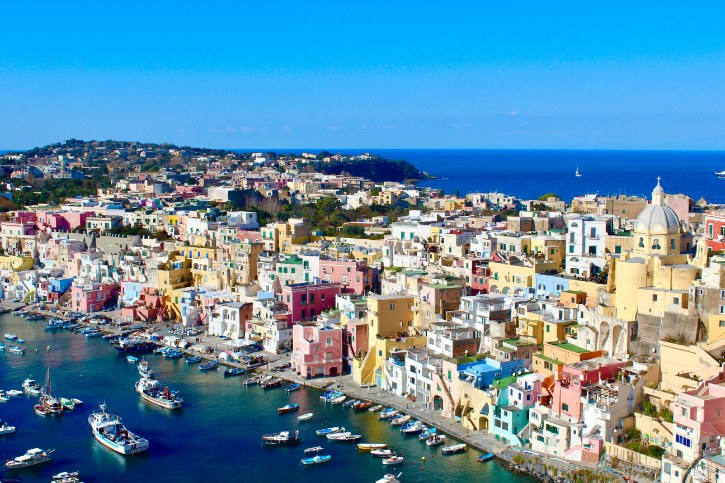
Procida is the smallest inhabited island in the bay, and it feels wonderfully honest. No big resorts here, just a real seafaring community of fishermen and boat-builders, with a gentle pace you won’t forget.
a. The Harbor That Launched a Thousand Photos
Marina Corricella is a seventeenth-century fishing port tucked into a small inlet, and the island’s most famous view.
- The houses glow in ochre, pink, white, and pale blue.
- The story goes that fishermen could spot their own home from the sea by its color.
- Look for the arched outdoor loggias and the web of stepped lanes.
- Old wooden boats still line the quay.
b. A Citadel on the Cliff
High above the harbor sits Terra Murata, the island’s historic walled town.
- It stands on a steep cliff about 90 meters above the sea.
- Its old walls once guarded against pirate raids.
- Narrow alleys lead to the Abbey of San Michele Arcangelo, from the eleventh century.
- Inside you’ll find a painting of Saint Michael attributed to Luca Giordano, a richly carved wooden ceiling, hidden catacombs, and a library holding a remarkable collection of books.
c. A Palace With Many Lives
Palazzo d’Avalos has had a remarkable run. Built in the early sixteenth century as a governor’s home, it became a royal hunting lodge, then a prison from 1830 until 1988. Today you can visit it on guided tours run by the local authorities, walking through courtyards, cell blocks, and old workshops.
d. Everyday Island Life and Local Lemons
The real joy here is simply walking, with plenty to taste along the way.
- Wander the lanes for stacked pastel houses, outdoor stairways, and quiet squares.
- Try fresh red mullet, squid, and anchovies straight from the boats.
- Look for the island’s huge lemons, called limone pane, used in a bright local salad.
- Finish with lingua di Procida, a pastry filled with lemon cream.
Procida earned a proud honor as Italian Capital of Culture, the first island ever to hold the title, recognized for keeping its heritage and traditions alive alongside the arts.
Next stop: To return to the mainland, catch a ferry or hydrofoil across the bay. You’ll land in the port of Naples, the historical heart of southern Italy.
3. Naples (City)
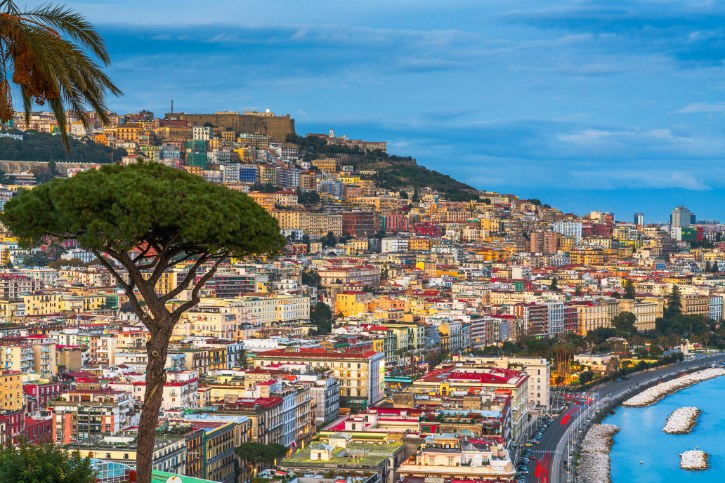
Naples is loud, layered, and bursting with life. Its historic center is UNESCO-listed and the largest of its kind in Europe, holding Greek street plans, Roman aqueducts, Gothic churches, and royal palaces, plus some of the most famous food in the world.
a. Grand Squares and Royal Palaces
Start with the monumental heart of the city.
- Piazza del Plebiscito is a vast square framed by a sweeping curved colonnade.
- Basilica di San Francesco di Paola, modeled on Rome’s Pantheon, faces it with a 53-meter dome.
- The Royal Palace lets you climb a grand marble staircase to apartments full of tapestries and portraits.
- Castel Nuovo, from 1279, guards the waterfront with stout towers and a white marble triumphal arch.
b. Where Music and Faith Come Alive
The Teatro di San Carlo, founded in 1737, is the oldest continuously working opera house in Europe, older than Milan’s La Scala by more than forty years. Its churches move you too. At the Duomo di Napoli, vials said to hold the dried blood of San Gennaro draw crowds three times a year for the traditional liquefaction ceremony.
c. A Marble Miracle in the Sansevero Chapel
The small Sansevero Chapel holds Giuseppe Sanmartino’s Veiled Christ from 1753. Carved from a single block of marble, its see-through veil looks so real that people once thought it had been turned to stone by some secret process. The crypt below holds two striking anatomical models as well.
d. The Beating Heart of the Old Town
The old center is where Naples feels most alive, and hungriest.
- Spaccanapoli is a dead-straight street that cuts through from west to east.
- Via San Gregorio Armeno is lined with workshops carving nativity figures all year round.
- The craft of the Neapolitan pizza maker is UNESCO-recognized, so eat a Margherita at its birthplace.
- Save room for fried street food, ricotta-filled sfogliatelle, and a rum-soaked babà.
Next stop: Leaving the city, the road heads southeast, skirting the southern foot of Mount Vesuvius and crossing the plain beyond. A short drive brings you to one of the world’s most famous ancient sites, the ruins of Pompeii.
4. Pompei (Archaeological Site)
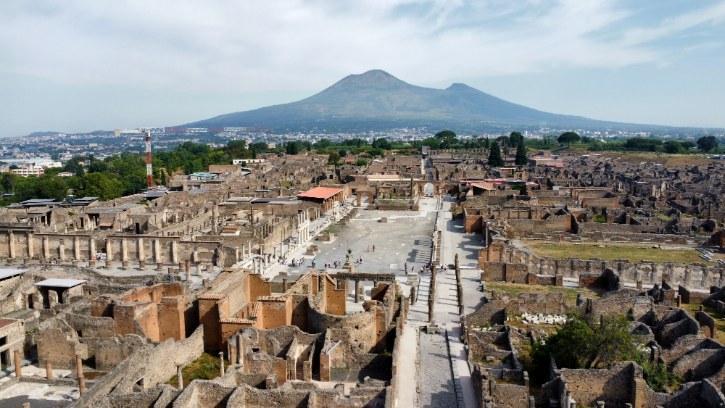
Few places let you step into the ancient world like Pompeii. When Vesuvius erupted in AD 79, a thick layer of ash buried this Roman city and froze it in time, leaving an extraordinary record of daily life.
a. The Forum and the Grandest Homes
The best of Pompeii mixes public grandeur with private wealth.
- The Forum was the city’s center for politics, religion, and business, facing Mount Vesuvius.
- The House of the Faun filled a whole city block of around 3,000 square meters, with twin courtyards and a bronze faun statue.
- The Villa of the Mysteries is famous for vivid frescoes on a deep red background.
- Those frescoes are widely believed to show a young woman’s initiation into a mystery cult, though the meaning is still debated.
b. Everyday Roman Life in the Streets
The small details are what bring Pompeii to life.
- Roads are paved with large stone slabs and raised crosswalk blocks, so people crossed without stepping in runoff.
- Public fountains sit at the street corners.
- You’ll pass bakeries with stone millstones, shops, and small household shrines.
- Together they help you picture ordinary days in the ancient city.
c. How Romans Relaxed and Gathered
Comfort and entertainment mattered a great deal here.
- The bath complexes used clever under-floor heating that pushed warm air beneath the floors and walls.
- Bathing was social as much as practical, a place to meet and talk.
- The stone amphitheater, built around 70 BC, is the oldest surviving permanent one in the Roman world.
- It could hold up to 20,000 people for public games.
d. Art, Mosaics, and a Human Story
Pompeii is full of surviving color, from bright wall paintings to a vast battle-scene mosaic made from more than a million tiny tiles. The most moving sight is different, though.
In the 1860s, archaeologists learned to pour plaster into the hollows left by victims in the hardened ash, capturing their final postures. These casts are a quiet reminder that real people once lived and died here.
Next stop: From the ruins, the route turns southwest and climbs along the coastal road of the Sorrento Peninsula. The scenery shifts from ancient history to open sea, rising toward the clifftop town of Sorrento.
5. Sorrento (Town)
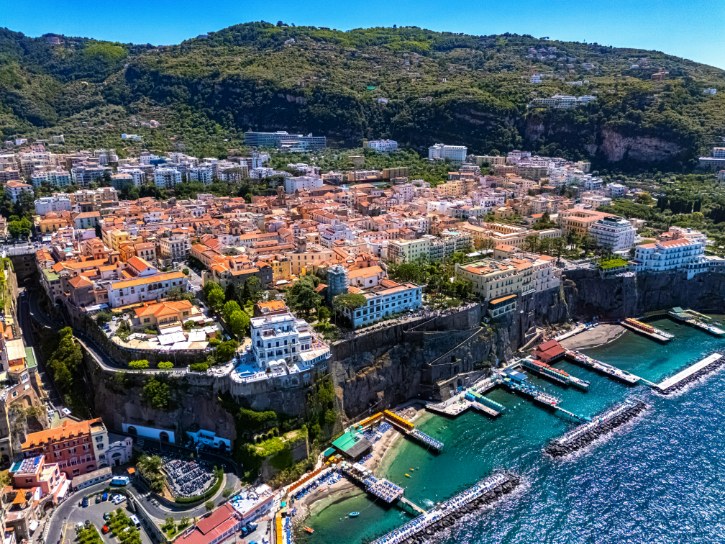
Sorrento sits on a dramatic shelf of rock that drops straight into the sea. It mixes elegant streets, sweeping bay views, lemon groves, and a lively old town, working just as well for sightseeing as for soaking up coastal life.
a. The Lively Heart of Town
Your first stop should be Piazza Tasso, the main square and social center.
- It’s named after the poet Torquato Tasso, born here in 1544.
- Cafés and shops ring the square, and it’s always full of movement.
- Narrow lanes lead straight into the old town from here.
- Look for workshops still making intarsio sorrentino, the local craft of inlaid wood.
b. Historic Churches and a Hidden Cloister
The town’s religious landmarks are full of quiet beauty.
- The Basilica di Sant’Antonino honors the patron saint and holds offerings left by sailors who survived storms.
- Sorrento Cathedral preserves a fifteenth-century marble font and carved wooden choir stalls.
- The Cloister of San Francesco mixes Romanesque and Arab-Gothic arches, draped in wisteria.
- It’s one of the most photogenic corners in town.
c. The Best Views and the Old Harbor
For scenery, head to the clifftop Villa Comunale gardens, where the terraces look across the Bay of Naples toward Mount Vesuvius and the island of Ischia. Time it for late afternoon and the light turns golden. Then walk down to Marina Grande, the old fishing harbor, where family trattorias serve gnocchi alla sorrentina, baked with tomato, mozzarella, and basil.
d. A Town Built on Lemons
Sorrento and citrus go hand in hand.
- The area grows the Limone di Sorrento IGP, an oval, fragrant lemon.
- Groves are often shielded by straw mats on chestnut-wood frames.
- These lemons are the base for the region’s beloved limoncello.
- You’ll taste lemon in everything from pastries to that final glass after dinner.
Next stop: From Sorrento’s Marina Piccola, catch a catamaran or hydrofoil across to the island of Capri. The route leaves the mainland briefly for one more island before turning toward the Amalfi Coast itself.
6. Capri & Anacapri (Island)
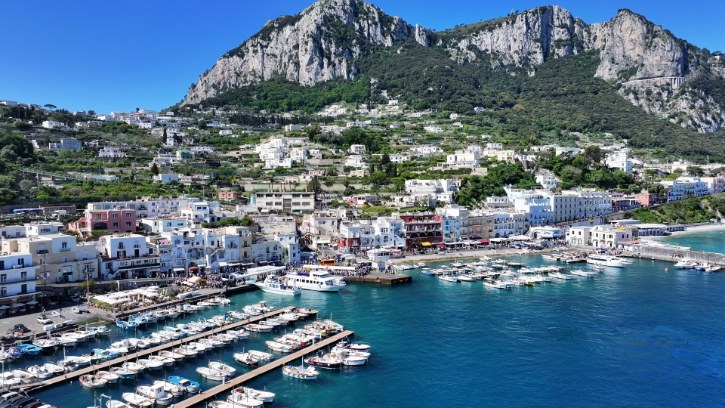
Capri earns its fame. Sheer cliffs, iconic rock formations, historic villas, and gardens with incredible views all pack into a small space. The island splits into stylish Capri town below and quieter Anacapri above, giving you two very different moods.
a. The Style of Capri Town
Down on the eastern plateau, Capri town is all elegance and energy.
- The famous little square, the Piazzetta, is the island’s social stage, ringed with cafés.
- Via Camerelle is the smart shopping street, with boutiques beside ancient Roman wall stonework.
- The Gardens of Augustus offer two views, over the switchbacks of Via Krupp and the Faraglioni.
- The Faraglioni are three sea stacks, the tallest rising about 109 meters from the water, among Italy’s most photographed sights.
b. Up to Peaceful Anacapri
Higher up the slopes, Anacapri keeps a calmer, more local feel.
- From Piazza Vittoria, a single-seat chairlift carries you up Monte Solaro, the island’s highest point at 589 meters.
- At the top, a 360-degree view takes in the Faraglioni, the gulf, Vesuvius, and the distant coast.
- Villa San Michele was built by Swedish doctor Axel Munthe on the ruins of a Roman villa.
- Its gardens hold Roman sculptures and a 3,200-year-old Egyptian sphinx overlooking the sea.
c. An Emperor’s Clifftop Ruins
On the eastern headland stand the ruins of Villa Jovis, the largest villa built by Emperor Tiberius, who ruled the Roman Empire from Capri between AD 27 and 37. Perched 334 meters up, you can still see the state rooms, private quarters, and huge cisterns that collected rainwater on an island with no streams.
d. The Magic of the Blue Grotto
The Blue Grotto is Capri’s most famous natural wonder.
- Sunlight passes through an underwater opening and lights the water a glowing electric blue.
- You reach it by small rowboats that slip through a very low entrance using a chain fixed to the rock.
- Entry depends entirely on calm seas and low swells, so it isn’t always open.
- When conditions are right, the color inside is unforgettable.
Next stop: From Capri’s Marina Grande, seasonal ferries and hydrofoils sail across to Positano, mainly from mid-spring through mid-autumn. In the quieter winter months, when the direct service isn’t available, you may need to transfer through a mainland hub like Sorrento or Salerno.
7. Positano (Town)
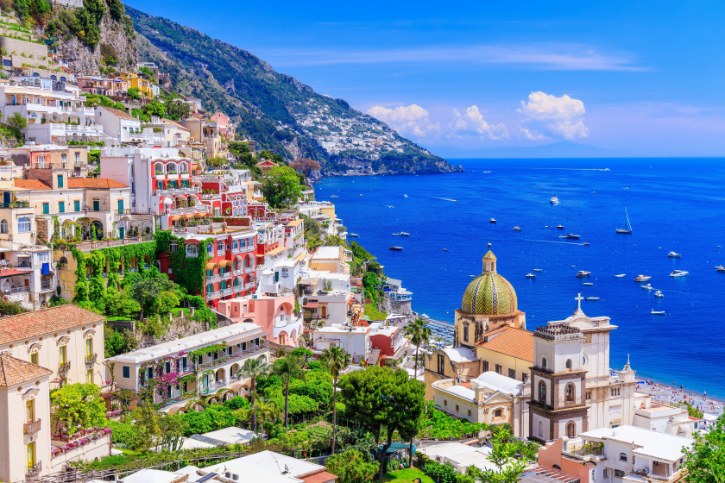
Positano is the image many people carry of the Amalfi Coast, a tumble of pastel houses spilling down steep cliffs to the sea. There’s far more to it than the postcard, from handmade crafts to hidden corners and an easy seaside mood.
a. The Village That Climbs the Cliffs
Positano is built into an amphitheater-shaped gorge, with houses stacked one above another down the rock. Painted in peach, terracotta, and white, and softened by bougainvillea, it forms one of the most recognizable village scenes in Italy. You’ll want to just stand and take it in.
b. Stairways, Lanes, and the Main Beach
Getting around means walking, and that’s part of the fun.
- The town is built on scalinatelle, steep whitewashed staircases and vaulted passages.
- Cars stay on the single road above town, so the lanes belong to you.
- Spiaggia Grande, the main beach, is a wide stretch of dark sand backed by restaurants.
- Look back toward town from the water’s edge for the classic Positano view.
c. The Church of the Tiled Dome
The Church of Santa Maria Assunta is the town’s landmark, crowned by a dome of yellow, green, and blue majolica tiles. Inside is a treasured medieval Byzantine icon of the Madonna and Child. Beneath the floor, excavations even uncovered a luxury Roman villa buried in the AD 79 eruption.
d. Handmade Style and a Legendary Trail
Positano rewards anyone who stays long enough to explore.
- The town gave rise to Moda Positano, a relaxed style of hand-dyed linen and flowing designs.
- Cobblers still make custom leather sandals on the spot, assembling them by hand while you wait.
- High above runs the Sentiero degli Dei, or Path of the Gods, between Bomerano and Nocelle above Positano.
- The trail clings to the cliffs with wide views along the coast toward Capri.
Next stop: From here, the coastal road east is an experience in itself, winding through tunnels and around deep ravines, hugging the cliffs with the sea far below, before easing you into the historic center of Amalfi.
8. Amalfi (Town)
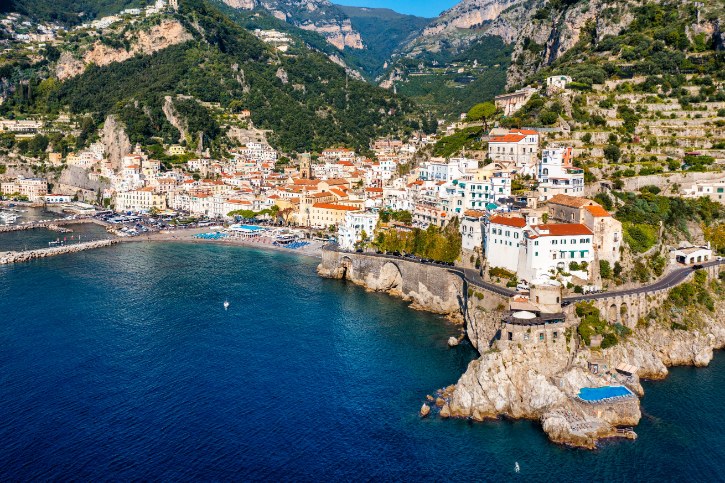
Amalfi gave the whole coast its name, and it carries real history. Once the first of Italy’s great maritime republics, it ruled the seas from the ninth to the eleventh centuries. That heritage lives on in its cathedral, its old paper mills, and its maze of streets above a lively harbor.
a. The Great Cathedral on the Steps
The Amalfi Cathedral, or Duomo di Sant’Andrea, is the town’s showpiece.
- It sits at the top of a grand 62-step staircase.
- Its striped façade of light and dark stone catches the eye straight away.
- The bronze doors were cast in Constantinople around 1060.
- The crypt holds the relics of the Apostle Andrew.
b. A Quiet Corner of Paradise
Beside the cathedral lies the Cloister of Paradise, built in the 1260s as a burial ground for noble families. Slender paired columns support interlacing pointed arches around a quiet garden of palms. The design reflects Amalfi’s old trading ties with the Arab world, and it’s a calm place to pause.
c. A Seafaring Republic’s Legacy
Amalfi’s power came from the sea, and you can still trace it.
- Its famous maritime code shaped trade and navigation rules for centuries.
- Down by the harbor, the old stone-vaulted shipyard still stands.
- It’s where the republic once built its war galleys.
- It’s the only preserved medieval dockyard of its kind in southern Italy.
d. Handmade Paper and Coastal Lemons
Two old crafts still define the town.
- Amalfi learned papermaking from the Arab world, producing the thick, durable bambagina paper.
- At the Museo della Carta, in a thirteenth-century mill, you can watch water-powered presses still at work.
- The hills grow the tapered Limone Costa d’Amalfi IGP, farmed on terraces since medieval times.
- Sailors once ate the fresh fruit to fight scurvy on long voyages.
Next stop: Just east of town, a short road tunnel through a rocky spur brings you almost immediately into Atrani. The two villages sit side by side, yet Atrani feels like a quieter, more intimate world of its own.
9. Atrani (Village)
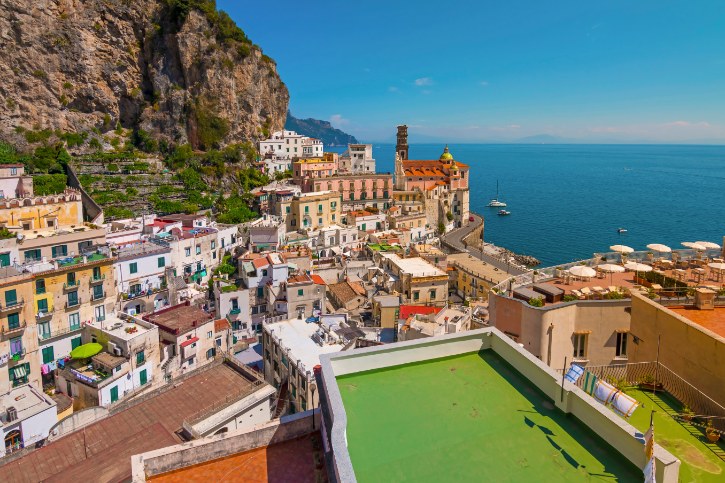
Atrani is tiny, and that’s exactly its charm. Verified by official land surveys, it’s the smallest municipality in Italy by area, covering just 0.12 square kilometers. Despite its size, it packs in a complete medieval layout, rising from a small beach like a little stone amphitheater.
a. The Square at the Center of It All
The heart of village life is Piazza Umberto I.
- It sits just steps from the shore.
- Homes and small cafés ring the square.
- It opens toward the beach through the arches of the coastal road viaduct.
- It’s a genuinely local gathering spot, not a tourist stage.
b. A Church With a Royal Past
The Church of San Salvatore de’ Birecto dates to the tenth century and holds a special place in local history. This is where the rulers of the Amalfi Republic were once formally installed. Look for its Romanesque marble carving and a bronze door cast in Constantinople in 1087.
c. A Maze Made for Wandering
Atrani is a tangle of passages waiting to be explored.
- Covered corridors and vaulted walkways twist through the village.
- Steep staircases climb between the houses.
- Whitewashed homes stack right on top of one another.
- Wandering these lanes is the very best way to feel the place.
d. The Best Views and the Beach
Atrani is a joy to photograph. For the classic shot of densely packed houses, the church, and the square against the sea, look from the beach and from the raised road arches above. The beach itself is a small cove of dark sand and gravel, framed by cliffs and the viaduct. Keep in mind the sea here can be lively, so conditions change with the weather.
Next stop: From Atrani, the road turns sharply inland and begins to climb. Hairpin bends wind up through terraced lemon groves, leaving the waterfront behind and rising toward the hill town of Ravello.
10. Ravello (Hill Town)
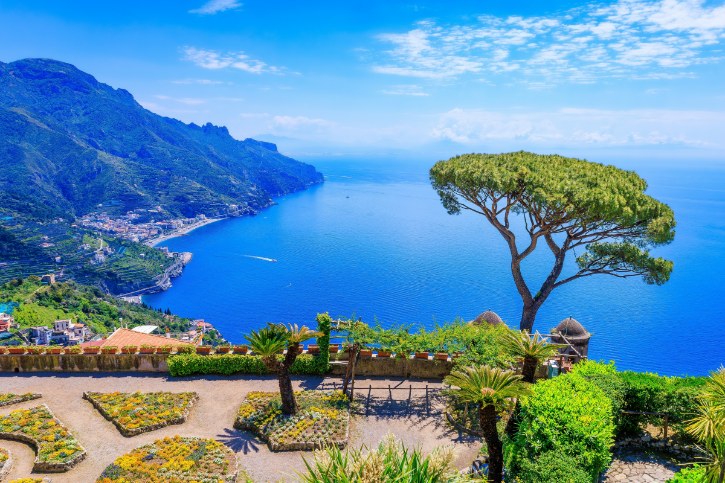
Ravello looks down on the coast from a ridge about 365 meters above the sea. For centuries it has drawn artists, writers, and composers. Grand medieval villas, beautiful gardens, and terraces that seem to float above the sea give it a refined, peaceful air.
a. The Gardens of Villa Rufolo
Villa Rufolo is one of Ravello’s great landmarks, built in the thirteenth century by a wealthy merchant family.
- You enter past a Moorish-influenced tower into a courtyard of paired columns and pointed arches.
- The gardens spread over two terraces above the Gulf of Salerno.
- They’re filled with Mediterranean and exotic plants, old pines, and colorful flower beds.
- The sea views from here are among the finest on the whole coast.
b. Music in the Air
Ravello has a deep musical soul.
- When composer Richard Wagner visited in May 1880, the gardens so moved him that he said he’d found the magical garden he imagined for his opera Parsifal.
- That inspiration helped spark the town’s famous summer music festival.
- Its orchestra stage is built right out over the edge of the cliff.
- The setting has made Ravello a leading cultural destination.
c. The Terrace of Infinity
Along the ridge sits Villa Cimbrone, transformed in the early twentieth century by the British nobleman Lord Grimthorpe. Its gardens blend English and Italian styles, leading past hidden grottos and statues to the famous Terrace of Infinity. Lined with classical white marble busts, this belvedere looks over an uninterrupted sweep of sea and sky, one of the most celebrated viewpoints in the region.
d. The Cathedral and Central Square
The town center has a quiet elegance worth savoring.
- The Duomo di Ravello, founded in 1086, is known for its bronze doors from 1179 with dozens of relief panels.
- Inside stands a remarkable marble pulpit from 1272, held up by columns resting on carved lions.
- Piazza Duomo is the calm heart of town, ringed by elegant buildings and cafés.
- It’s the perfect spot for a slow coffee with a hill-town view.
Next stop: From Ravello, the road winds back down toward the shore and continues east. The gardens give way to the sea once more as you reach Cetara, a working fishing village where the boats still rule daily life.
11. Cetara (Village)
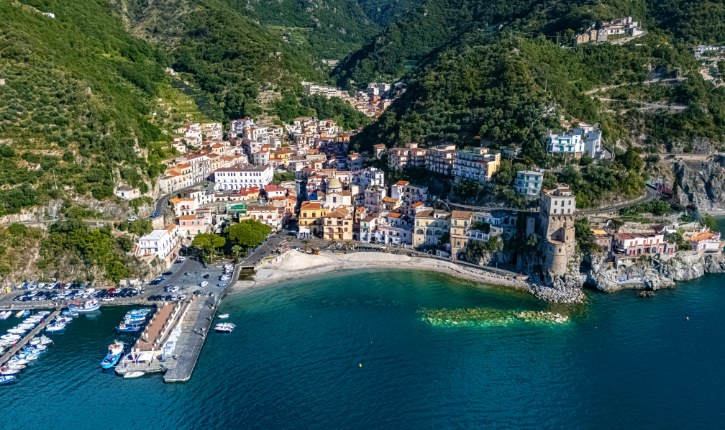
Cetara is the real thing, a fishing village that still fishes. Unlike many of its polished neighbors, its economy centers on a working fleet, which makes it one of the most authentic stops on the coast.
a. The Working Harbor and Its Watchtower
The fishing harbor is the heart of Cetara.
- It’s full of traditional wooden boats and larger fishing vessels.
- Lampara boats use bright lamps over the water at night to draw anchovies toward the nets.
- Guarding the beach is the Torre Vicereale, a stone watchtower built in the sixteenth century against pirate raids.
- The village beach looks back on the boats and the houses rising behind.
b. The Famous Amber Anchovy Sauce
Cetara’s culinary star is colatura di alici, an amber-colored anchovy sauce.
- Anchovies are salted and aged for months in small wooden barrels.
- The liquid is then drawn off and filtered through linen into fragrant drops.
- The sauce earned protected DOP status, a mark of its quality and heritage.
- A little goes a long way, adding deep savory flavor to simple dishes.
c. The Story Behind the Sauce
Colatura is widely seen as a descendant of garum, the famous fermented fish sauce of ancient Rome. The thread wasn’t unbroken, though. Local monks are credited with reviving the old method in the Middle Ages, salting anchovies in wooden barrels and collecting the amber liquid that dripped out. So the sauce in your bottle carries an ancient idea, kept alive and refined by later hands.
d. The Best of Local Seafood
The village kitchens showcase the daily catch.
- The classic dish is spaghetti con la colatura di alici, pasta tossed off the heat with garlic, parsley, chili, and olive oil.
- Try fried fresh anchovies for something crisp and simple.
- Look for marinated anchovies cured in vinegar and oil.
- Local tuna also features heavily on village menus.
Next stop: Following the coast road a little farther east, past olive groves and lemon orchards, you reach the eastern gateway of the Amalfi Coast. This is Vietri sul Mare, the colorful town where ceramics are a way of life.
12. Vietri sul Mare (Town)
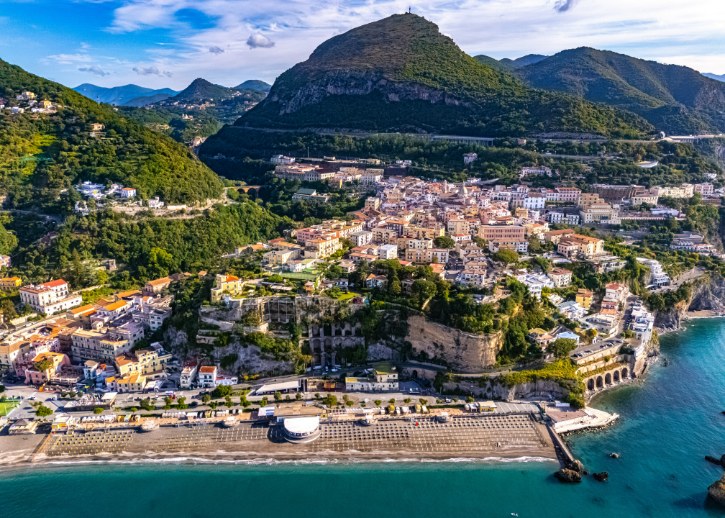
Vietri sul Mare brings your journey to a bright, artistic close. For centuries this town has been known for its hand-painted ceramics, a craft woven into its streets, its buildings, and even its church domes. Set where the hills meet the Gulf of Salerno, it’s as colorful as the pottery it’s famous for.
a. The Story of Vietri Ceramics
Pottery here goes back to antiquity and flourished during the Renaissance.
- Local workshops once supplied tiles and tableware across the Kingdom of Naples.
- The style stands out for bright glazes in cobalt blue, copper green, yellow, and purple.
- Designs often feature lemons, sea life, and country scenes.
- Visiting northern European artists later added folk motifs, including the famous little Vietri donkey.
b. Workshops and an Open-Air Gallery
The whole town feels like a gallery, with something to take home.
- Workshops sell hand-thrown pottery, painted tiles, and decorative plates.
- You can often watch the traditional patterns being painted by hand.
- Streets like Via Madonna degli Angeli and Corso Umberto I are lined with tiled signs and bright flowerpots.
- In nearby Raito, the Provincial Ceramics Museum at Villa Guariglia traces the full story of the craft.
c. The Landmark Tiled Dome
The town’s main landmark is the Church of San Giovanni Battista, founded in the tenth century and later reworked in Renaissance and Baroque styles. Its dome is covered in hundreds of green, yellow, and blue glazed tiles that shine across the gulf. Step inside to see a gilded coffered ceiling and ceramic tile panels.
d. The Waterfront to End On
Down at sea level, the coast invites you to slow down.
- Marina di Vietri has a wide sandy beach split by a small river.
- Colorful waterfront buildings line the shore.
- Offshore, two sea stacks known as the Two Brothers rise from the water.
- The views across the Gulf of Salerno make a lovely final backdrop.
And so your trip ends in a burst of color. You began with volcanic islands and thermal springs, passed through a grand city, walked an ancient Roman town, admired clifftop lemon groves, climbed through vertical villages, stood in high gardens above the sea, and shared in the life of working fishing harbors.
Twelve very different places, each with its own story, come together to show a side of the region most visitors never reach, all within easy reach of one another, and all well worth the journey.