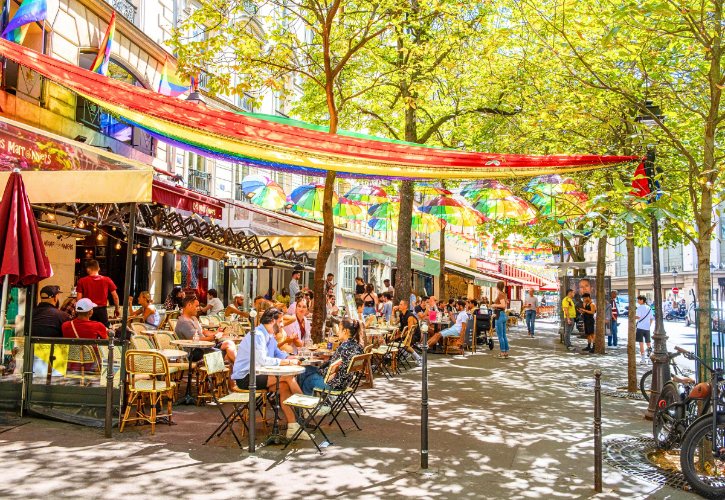
You do not need a whole day to see the heart of old Paris. The stretch from the northern Marais down to Sainte-Chapelle and Notre-Dame links a remarkable run of streets, mansions, squares, and monuments, all within short, easy strolls.
The mood keeps shifting as you go: from a lively high street to noble courtyards, from a royal square to streets shaped by Jewish and LGBTQ+ life, then across the river to medieval royal Paris. By the end, you will have crossed seven centuries on foot. 😊
1. Rue de Bretagne
a. Why you should start here
Most Paris walks open before a palace. Yours starts on a lively neighborhood high street, which sets the perfect tone.
Before the grand monuments, you feel the everyday life of the Marais, exactly how the neighborhood has always worked.
This is living Paris, not a museum. Rue de Bretagne is the spine of the Haut Marais (the upper Marais), where locals shop, eat, and linger.
b. The facts worth knowing
- Runs through the 3rd arrondissement, as the main artery of the Haut Marais
- One of the older routes in the quarter, tracing a path that linked settlements when the area was still half-rural
- Its name is thought to come from the Breton community that settled in Paris during the Middle Ages
c. A street that has always mixed trade and daily life
The Marais grew up as a place where food shops, workshops, and cafés sat right beside grand mansions and churches, and this street still shows that mix. In the 1600s the wider Marais became fashionable with the aristocracy, yet Rue de Bretagne kept its working, everyday character. In the 1960s and 1970s its cafés drew writers, artists, and intellectuals, and that easy social energy has never really left.
d. What you will find today
- Cheesemongers, bakeries, and charcuterie counters such as Fromagerie Jouannault and Maison Verot
- Specialty-coffee bars, natural-wine shops, and classic corner cafés like Café Charlot and Le Sancerre
- Independent fashion boutiques, design stores, and small galleries
- Terraces that spill onto the pavement, perfect for people-watching
e. Worth a glance nearby
- Square du Temple: a leafy garden on the site of a former Knights Templar fortress, opposite the 3rd arrondissement town hall
- Carreau du Temple: a handsome iron-and-glass market hall, now a cultural and events venue
Soak in the everyday energy, then turn down toward the quieter stone streets. From here, the way to explore is to start reading the streets themselves.
2. Rue des Archives
a. Learn to read a Marais street
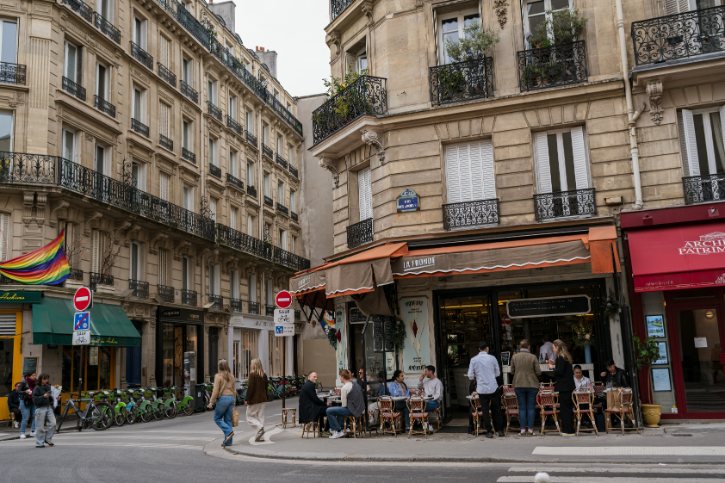
Rue des Archives deserves your attention, not just your footsteps. Formed by joining several medieval lanes, it now shows Parisian stone architecture from the late 1300s to the 1700s. Here you learn a skill you will use all day: looking up and reading history in the walls.
b. What gives the street its character
- Historic mansions, monumental gateways, cafés, and shops
- A central role in the modern LGBTQ+ history of the Marais
From the late 1970s through the 1980s, this became the main axis of the modern gay quarter, centered on its crossing with Rue Sainte-Croix de la Bretonnerie, as bookstores, cafés, bars, and publishers filled the old arcades.
c. Two buildings that tell the story
- The Clisson gateway (No. 58): a fortified portal built 1371 to 1375 for Olivier de Clisson, Constable of France, with a pointed arch and two rounded corner turrets, reflecting how nervous the nobility felt after the 1358 uprisings
- The Hôtel de Guénégaud (No. 60): designed 1651 to 1655 by François Mansart, the only fully intact Mansart mansion still standing in Paris, with calm symmetry and a carved lion-mask keystone
d. How these houses were arranged, and reused
Picture the standard layout: a high wall faced the street, a carriage gate broke through it, and behind hid a courtyard, the main residence, and often a garden. The beauty stayed out of public view, so peek through open gateways.
Carry one idea forward: architectural reuse. After the court moved to Versailles in 1682, nobles left, and their mansions became tenements, foundries, and workshops before artists and shops returned. That layering is what makes the Marais so rich.
3. Musée des Archives Nationales
a. A palace that became national memory
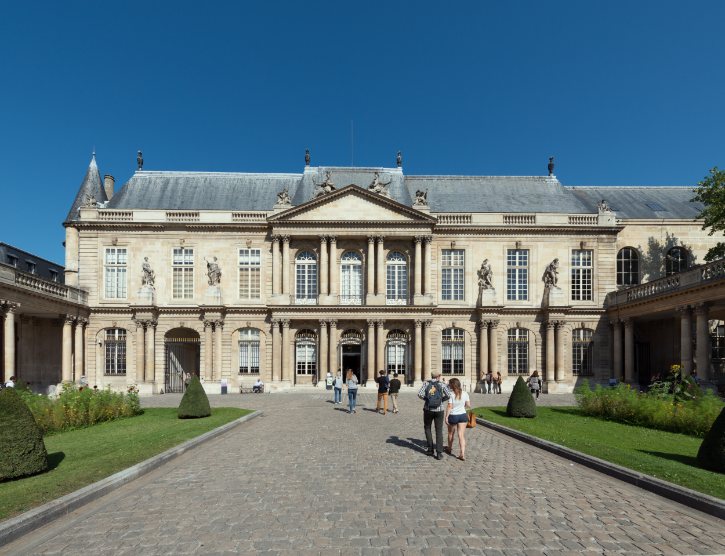
This stop uses its proper name, the Musée des Archives Nationales, and fills the Hôtel de Soubise at 60 Rue des Francs-Bourgeois. The special part is the mix: a lavish palace that later became the home of France’s written records, so building and contents both tell the country’s story.
b. Centuries stacked on one site
- Hôtel de Clisson (1375): the fortified medieval home of Olivier de Clisson
- Hôtel de Guise (from 1553): base of the ultra-Catholic Holy League during the Wars of Religion
- Hôtel de Soubise (from 1700): bought by François de Rohan, Prince de Soubise
Between 1705 and 1709, architect Pierre-Alexis Delamair reshaped everything, keeping the medieval Clisson gatehouse as a garden feature and laying out a vast semicircular courtyard ringed by paired columns.
c. The interiors that steal the show
The plain outside hides one of the finest Rococo interiors in France. Between 1735 and 1740, architect Germain Boffrand redid the private apartments with light, curved forms, blurring the line between architecture and decoration. In the centerpiece Salon ovale de la Princesse, look for:
- Corners dissolving into an oval ring of eight tall openings
- Alternating French windows and silvered mirrors
- Gilded plasterwork in shell and leaf shapes
- Eight canvases telling the myth of Psyche and Cupid, by Charles-Joseph Natoire
d. The documents, handled honestly
The museum has displayed the trial registers of Joan of Arc, the Edict of Nantes, and the 1789 Declaration of the Rights of Man. These appear in rotating, climate-controlled displays, so no single famous document is guaranteed to be out when you visit.
The lasting idea matters more: a prince’s palace became the home of France’s written memory. Napoleon assigned it to the imperial archives in 1808, and the museum was founded in 1867.
4. Rue Vieille-du-Temple
a. Old stone that stayed alive
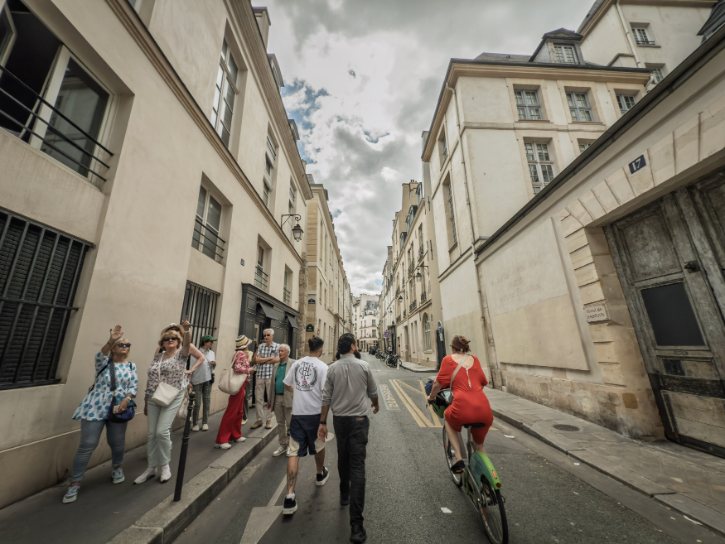
Rue Vieille-du-Temple shows historic architecture still lived in and worked in, not frozen behind glass. It traces a thirteenth-century route that once led to the fortified base of the Knights Templar, and today its old mansions and courtyards hold galleries and fashion shops.
b. A mansion hidden in plain sight
Watch for Hôtel d’Hozier at No. 110:
- Built in 1623 by Jean Thiriot, later owned by Louis-Pierre d’Hozier, Royal Genealogist of France
- Entered through an arched carriage gate carved with helmets, shields, and cornucopias
- Behind it: a paved court with carved stone faces and grand staircases
c. The best detail at the corner
At the junction with Rue des Francs-Bourgeois (Nos. 54 to 56), look up for the corner turret of the Hôtel Hérouët:
- Built 1500 to 1520 for Jean Hérouët, Treasurer of France under Louis XII
- A fine example of late Flamboyant Gothic, with a corbelled corner turret jutting over the intersection
- The main house was destroyed in a 1944 air raid, but the turret survived and was rebuilt with its original stone
d. The contemporary art layer
Behind the gate at No. 108 sits a glass-roofed courtyard with real history:
- In September 1986, gallerist Yvon Lambert opened an influential gallery there with a Cy Twombly show
- Until 2014 it hosted names like Sol LeWitt, Jean-Michel Basquiat, and Anselm Kiefer
- Since 2019, the international gallery David Zwirner has occupied the address
The joy here is the layering: old stone doors and courtyards beside galleries and design. Turn east at the Hérouët turret, and the shopping energy grows stronger.
5. Rue des Francs-Bourgeois
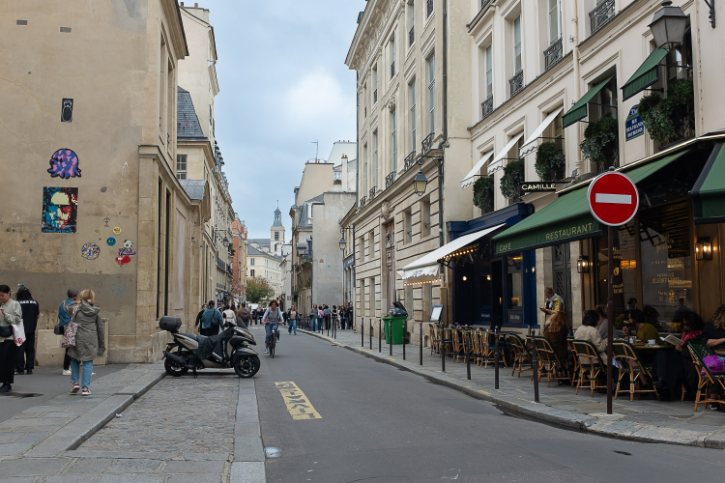
a. Mansion façades over busy shops
Rue des Francs-Bourgeois is the clearest place to feel the classic Marais contrast: historic architecture above, lively retail below. It runs east to west as the neighborhood’s central axis, and high-end shops fill the ground floors of centuries-old homes.
b. Where the name comes from
- In 1334, Alice Mazurier and local philanthropists set up almshouses for the poor
- Because of their poverty, these residents were legally freed from city taxes
- They became known as the “francs-bourgeois”, the tax-exempt citizens
c. Mansions to compare as you go
- Arc de Nazareth (No. 16): a Renaissance archway from around 1555, moved from the Île de la Cité and rebuilt into the museum wall in 1886
- Hôtel Mortier de Sandreville (No. 26): from 1585, remodeled in 1767, with slate dormers
- Hôtel d’Albret (Nos. 29 bis to 31): reworked by François Mansart, with a monumental doorway
- Hôtel de Creil (Nos. 37 to 39): early 1700s, with carved stone faces, or mascarons
d. Look above the storefronts
The real reward is in the upper stories. Look up for:
- Alternating triangular and rounded pediments over tall windows
- Slate mansard roofs with round bull’s-eye windows
- Sculpted faces and large historic doors, half-hidden by modern signage
These façades trace Marais design across the 1500s, 1600s, and 1700s. Continuing east, the homes give way to a museum built to tell the story of Paris itself.
6. Musée Carnavalet – Histoire de Paris
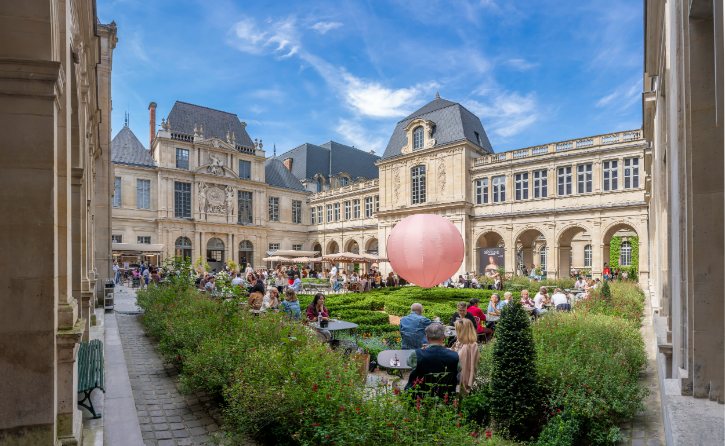
a. The story of how Paris became Paris
- Founded in 1866 and opened to the public in 1880, run by the City of Paris
- Its whole subject is the history of Paris from prehistory to today
- Very different from an art museum like the Louvre
b. The building comes first
The museum fills two joined mansions, so the setting is part of the visit. Hôtel Carnavalet is a rare survivor of Parisian Renaissance design.
- Commissioned in 1548 for Jacques des Ligneris, attributed to Pierre Lescot, who was also rebuilding the Louvre
- Its courtyard keeps Four Seasons reliefs attributed to Jean Goujon
- The letter-writer Madame de Sévigné lived here from 1677 to 1696
- The Hôtel Le Peletier de Saint-Fargeau was later joined to it
c. Details many visitors miss
The building absorbed pieces rescued from demolished Paris buildings. In the courtyards you can find the reconstructed Renaissance façade of the old Clothmakers’ Guildhall, moved stone by stone in 1888. Watch for salvaged fragments, painted ceilings, and carved wood paneling.
d. Highlights to plan around
- The Neolithic canoes of Bercy: hollowed oak boats from around 2800 to 2500 BCE
- The Salle des Enseignes: old painted shop signs that guided people who could not read
- Marcel Proust’s cork-lined bedroom: with his brass bed and writing table
- The Georges Fouquet jewelry boutique: an Art Nouveau interior designed in 1901 by Alphonse Mucha
e. The renovated museum today
Picture the modern museum, not the older one. Between 2016 and 2021, it was fully restored by Chatillon Architectes and Snøhetta. The work exposed Renaissance timber beams and medieval basements, added full accessibility, and reorganized more than 3,800 objects into a clear chronological path. From here, the walk steps into one of the most carefully planned spaces in the city.
7. Place des Vosges
a. From tangled lanes to royal order
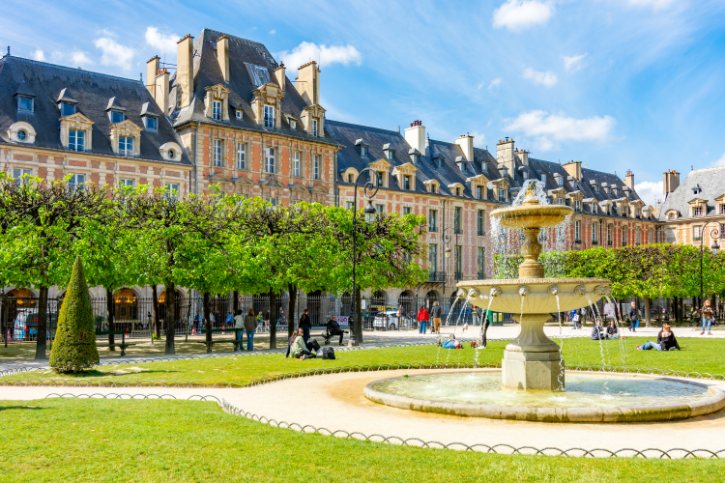
Place des Vosges marks a turning point in European city planning, the shift from crooked medieval streets to a single ordered royal square. After the uneven Marais lanes, its calm symmetry feels like a different world.
b. How it came to be
- Commissioned in 1605 by King Henri IV, on the site of a demolished royal residence
- Inaugurated in 1612 as the Place Royale, celebrating a double royal engagement between France and Spain
- Renamed Place des Vosges in 1800 to honor the first French department to pay its taxes in full
c. What to notice first
- A 140-meter by 140-meter quadrilateral of 36 matching pavilions, nine per side
- Strict rules kept every building at the same height, window line, and roof pitch
- White stone framing, reddish brick, and steep slate roofs with dormers
Here is a surprise: not every pavilion is really brick. To finish quickly and keep the color even, builders often used limestone or plaster painted red, with fine white lines drawn on to imitate brickwork.
d. The key anchors
- Pavillon du Roi: centered on the south side, forming a three-arched gateway toward the river
- Pavillon de la Reine: opposite on the north side, balancing the design
- Continuous vaulted arcades wrap the ground floor, letting residents stroll sheltered from rain and traffic
e. A literary corner
At No. 6, Victor Hugo rented a second-floor apartment from 1832 to 1848, writing major parts of Les Misérables there. The apartment is now the Maison de Victor Hugo. Walk beneath the arcades and pause in the central garden to feel the square’s sense of order. A few minutes west, the mood changes on a street shaped by community, memory, and food.
8. Rue des Rosiers
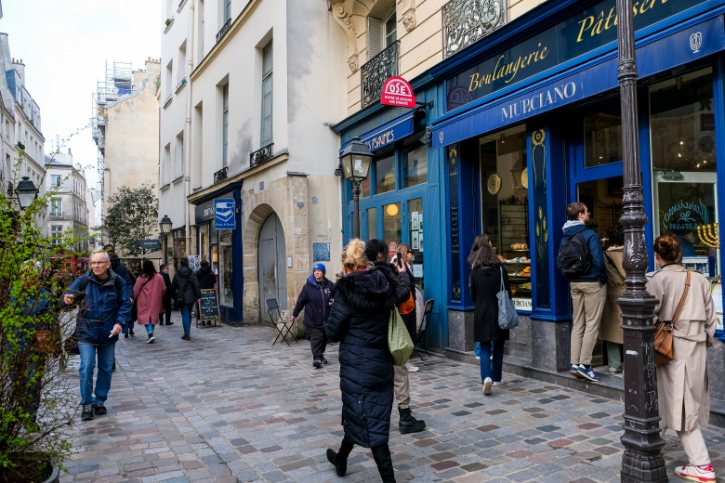
a. A street of cultural memory
Rue des Rosiers is the heart of the historic Jewish quarter of Paris, known in Yiddish as the Pletzl, or “little place”. Its name comes from the wild roses that once grew along the old city wall, and it holds more than eight centuries of Jewish heritage marked by settlement, expulsion, return, and tragedy.
b. Why this is more than a food street
The community grew stronger after 1791, when France became the first European country to grant Jews full legal rights. Two great waves shaped the street:
- 1881 to 1914: Ashkenazi Jews fleeing violence in the Russian Empire, Poland, and Romania built a Yiddish-speaking quarter of synagogues, study halls, and workshops
- 1950s and 1960s: Sephardic Jews from Algeria, Tunisia, and Morocco brought Mediterranean food, customs, and institutions
c. Walking with respect
Some of the most important things to see are quiet ones. Look above the shopfronts for bronze memorial plaques:
- At 16, a plaque remembers Jewish residents rounded up during the German Occupation
- Just off the street, the École des Hospitalières-Saint-Gervais (10 rue des Hospitalières-Saint-Gervais) carries a tablet remembering the 165 Jewish children from that school who were deported and murdered in the Nazi camps
Give them a moment; they are part of what the street means.
d. What you will experience today
- Bakeries with Ashkenazi pastries, poppyseed strudels, and challah
- Sephardic almond sweets and honey-drenched gazelle horns
- Kosher butchers and shops with Hebrew lettering
- Community study centers above modern retail
Food is one part of the street’s identity, not the whole story. One food counter here, though, has become famous worldwide.
9. L’As du Fallafel
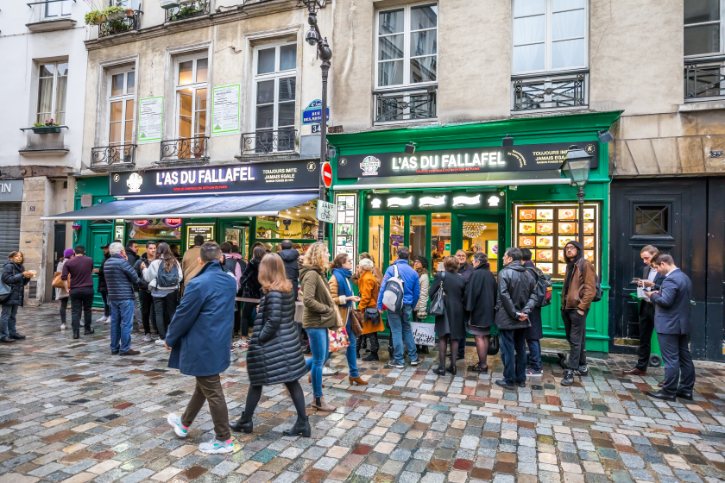
a. A great casual bite, kept honest
- Stands at 34 Rue des Rosiers, founded in 1979 by the Peretz family (Daisy and Isaac Peretz)
- Operates under the kosher supervision of the Grand Rabbinat de Paris
- Rooted in the city’s post-war Sephardic cooking
b. What is in the signature sandwich
The star is the Fallafel Spécial in a thick pita, built on contrasting textures:
- Falafel: ground chickpeas with parsley, coriander, cumin, garlic, and onion, fried crisp outside and soft inside
- Warm eggplant roasted until silky
- Crisp slaws of white and red cabbage for crunch
- Fresh salad of cucumber and tomato for coolness
- Sauces: hummus, ribbons of tahini, and optional harissa
c. Why it fits your walk
After mansions, museums, and squares, a casual bite on a lively pedestrian street is a welcome change of pace. Two street windows handle takeaway and there is an interior dining room, so you can grab and go or sit for a while. From here, weave west toward another street where the modern Marais is on full display.
10. Rue Sainte-Croix de la Bretonnerie
a. The modern Marais in plain sight
Rue Sainte-Croix de la Bretonnerie is one of the clearest places to feel the contemporary social identity of the Marais. It takes its name from a medieval monastery, the Canons of the Holy Cross, founded here in the thirteenth century, yet its modern character is very different.
b. A focal point of LGBTQ+ life
- Its modern identity took shape in the late 1970s and grew through the 1980s
- France had decriminalized homosexuality back in 1791, and a 1982 law equalized the age of consent for same-sex relations, helping the open community life of these years take hold
- Community-minded businesses opened along it, and it connects closely to nearby Rue des Archives
c. Culture you can see on the street
This history did not stay abstract. During the HIV/AIDS crisis of the 1980s and 1990s, the street’s venues were far more than nightlife. They served as places for solidarity, health organizing, and activism, including groups like Act Up-Paris. Today the street still carries that heritage, with rainbow crosswalks, community bookshops, and welcoming cafés.
d. Shopping and old stones together
- Independent boutiques, design stores, and perfume ateliers in vaulted old basements
- 44 (Hôtel de la Salle): a classical carriage portal with heavy stone framing
- 46: carved mythological faces over the first-floor windows
- Courtyard gateways opening onto hidden courts with stone arches and old staircases
The pleasure is the mix itself: historic stone, modern design, cafés, and LGBTQ+ culture in one place. One more relaxed stop makes a good pause before the walk grows grander.
11. Le Ju’
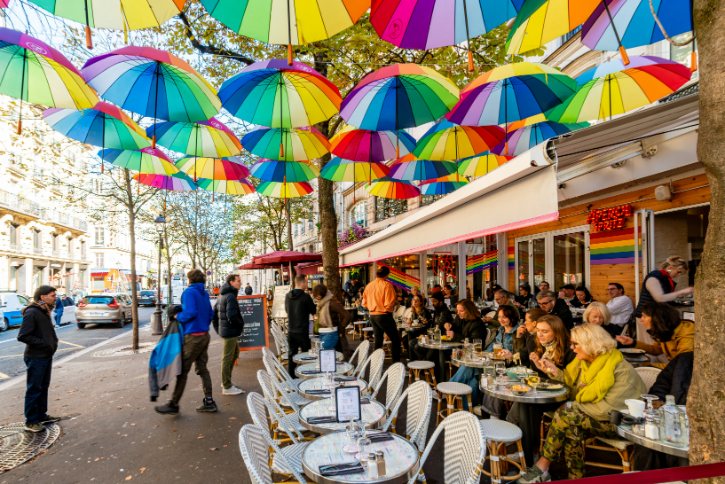
a. A deliberate pause
Le Ju’ sits at 16 Rue des Archives, by the corner with Rue Sainte-Croix de la Bretonnerie. It is a modern Marais bistro-café built for everyday dining, with a lively street terrace. It carries no heavy historical weight, and that is the point. It is simply a good place to sit and watch the neighborhood.
b. How to spot it
- A colorful ceiling of hanging upside-down umbrellas
- Bright interior murals and a relaxed, inviting style
c. The kind of food to expect
- Brunch: viennoiseries, tartines with good butter, eggs, and weekend spreads with fresh juices and espresso
- Casual plates: tartines with goat cheese or smoked salmon, poke and salad bowls, and burgers on brioche
- Comfort classics: house coquillettes with ham and Emmental, plus waffles and crumbles
d. The best way to enjoy it
Grab a spot on the outdoor terrace if you can, for front-row seats to Marais street theater. Enjoy it as an unhurried break, because the walk is about to change in scale. Step south, and the intimate streets open onto a wide civic square.
12. Hôtel de Ville
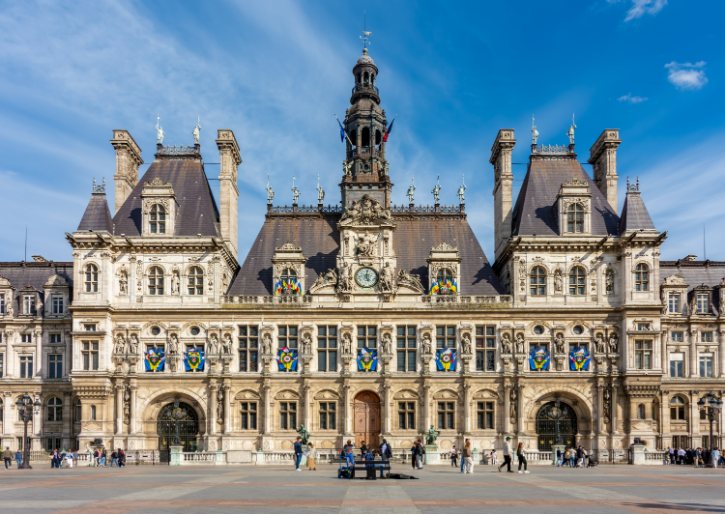
a. The civic heart of Paris
The Hôtel de Ville is the seat of the city’s own government, standing for local self-rule rather than royal power. A city administration has worked on this spot for seven centuries. In 1357, Étienne Marcel, the Provost of the Merchants, bought the old House of Pillars here for the city’s assembly, and in 1533 King François I hired the Italian architect Domenico da Cortona to design a Renaissance palace.
b. Fire and rebuilding
- On May 24, 1871, during the final days of the Paris Commune, revolutionaries set it on fire
- The blaze destroyed the city’s archives, library, and civil records back to the 1500s
- Between 1874 and 1882, architects Théodore Ballu and Édouard Deperthes rebuilt it, recreating the Renaissance exterior while the interiors were new and larger
So the outside echoes the old palace while the inside is a later creation.
c. The square in front
- It was once the Place de Grève, a sloping riverbank where boats unloaded timber, wine, and salt
- Workers gathered here for jobs, and the phrase “faire la grève” became the word for going on strike
- It was the city’s main public execution site from 1310 to 1830, and today hosts public gatherings
d. What to notice on the façade
The western front stretches about 143 meters wide. Look for:
- The central clock tower and the pavilions along the front
- 338 statues of notable Parisians, including Voltaire, Molière, and Delacroix
- The bronze equestrian statue of Étienne Marcel by the river side
Keep the roles separate: the national archives are about the memory of the whole country, while the Hôtel de Ville is about the government of the city. Turn west, and a single stone tower rises above the trees.
13. Tour Saint-Jacques
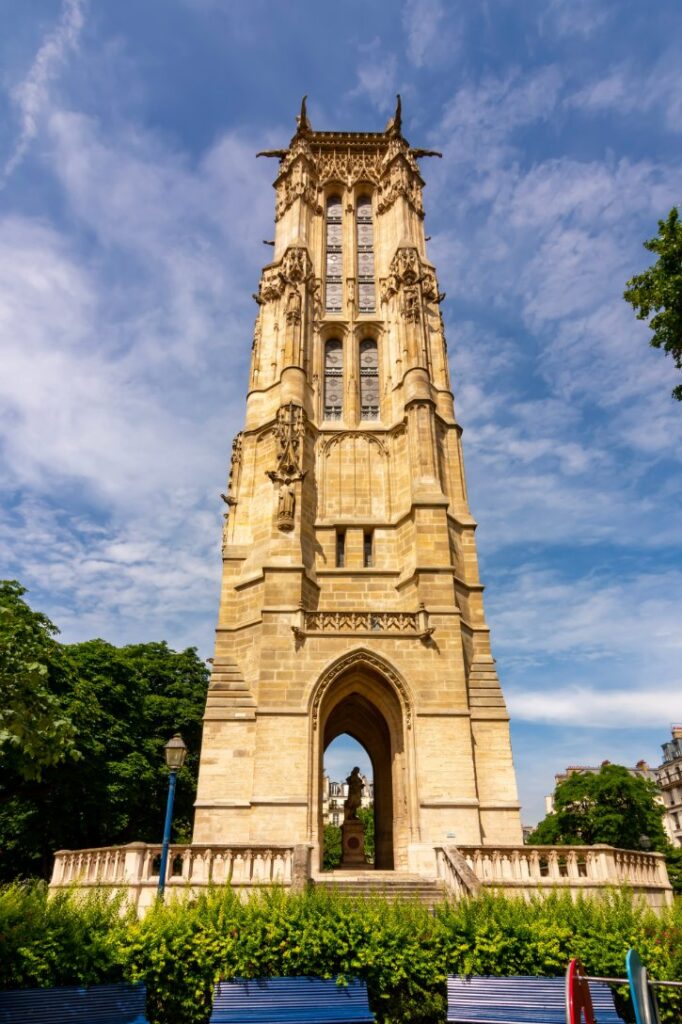
a. A survivor’s story
The Tour Saint-Jacques rises about 52 meters above a small public garden off Rue de Rivoli. It was never meant to stand alone. It was the bell tower of a large parish church, Saint-Jacques-de-la-Boucherie, built between 1509 and 1523 by the master mason Jean de Félin and paid for by the wealthy Guild of Butchers.
b. Why only the tower remains
- During the Revolution the church was seized and sold in 1797 to a contractor who tore down the main body for its stone
- The tower survived because it was used as a shot tower from around 1824, where molten lead was dropped from the top to form small lead shot
- The City of Paris bought it in 1836 and restored it in the 1850s within the city’s first planned public park
c. Details worth your attention
The tower is a fine example of late Flamboyant Gothic, full of upward-reaching lines. Look for:
- Four corner statues at the top: an eagle, angel, lion, and ox, the symbols of the Four Evangelists
- A tall statue of Saint James the Greater over the parapet
- Gargoyles, tracery, and a strong vertical rhythm
d. Pilgrimage and science
The church had a real link to the great pilgrimage to Santiago de Compostela, serving as a gathering point for pilgrims leaving Paris, and the tower is a UNESCO World Heritage site on those routes, best seen as a departure point rather than the single origin.
A statue of Blaise Pascal at the base recalls his 1648 experiments using the tower’s height to study atmospheric pressure. Picture the church that once surrounded this lone spire, then cross onto the Île de la Cité.
14. Sainte-Chapelle and Conciergerie
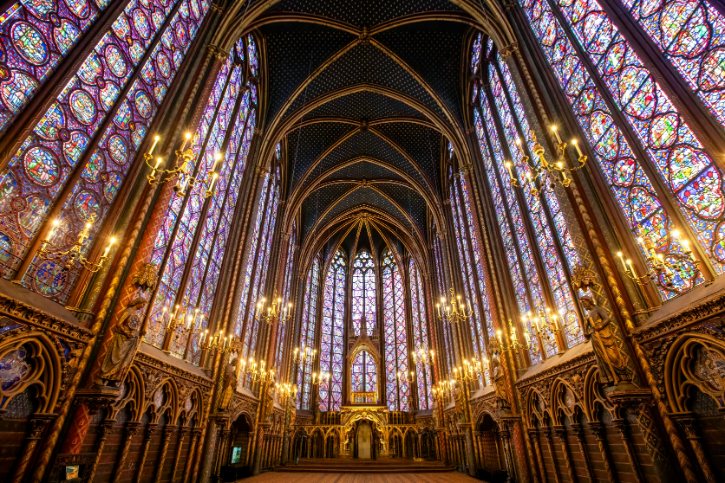
a. Two faces of the same palace
Sainte-Chapelle and the Conciergerie are the two great survivors of the medieval Palais de la Cité, the seat of royal power for centuries. After the 1358 uprising, when royal advisers were killed before the king, Charles V left the palace as a home. Seen as a pair, they have opposite moods:
- Sainte-Chapelle: royal faith, sacred relics, color, and light
- Conciergerie: palace service, administration, and later, prison and revolutionary justice
b. Sainte-Chapelle: why it was built
- Commissioned by King Louis IX, later Saint Louis, and consecrated on April 26, 1248, after only about six years of work
- Built as an architectural reliquary, a jeweled container in stone and glass
- Made to hold the Relics of the Passion of Christ, above all the Crown of Thorns, bought in 1239 for a sum far greater than the chapel itself cost
c. Two levels, two audiences
- The Lower Chapel was for servants and soldiers, with low vaults painted with gold lilies on blue, honoring Blanche of Castile
- The Upper Chapel was reserved for the king and his family; here the walls almost vanish, replaced by a cage of colored glass, the peak of the Rayonnant Gothic style
In plain terms, the outside supports carry the weight, which frees the walls to become windows.
d. The stained glass, and what to look for
- 15 tall window bays, each about 15 meters high
- 1,113 narrative scenes, roughly two-thirds original medieval glass
- Read each window from the bottom up: the nave windows tell Old Testament stories, and the apse windows show the Passion, Crucifixion, and Resurrection
- One southern bay shows Louis IX bringing the Crown of Thorns to Paris
A quick note on words: the large openings are bays, and the small pictures inside are scenes. Just stand in the center, let the color wrap around you, and follow one story upward.
e. Royal messages and the west window
Look closely for political messages in the religious art: fleurs-de-lis for the French crown, Castilian castles for the king’s mother, and imagery tied to Louis IX himself. Do not miss the western rose window, about nine meters across, commissioned around 1485 by King Charles VIII in the late Flamboyant Gothic style. It illustrates the Book of Revelation, letting you compare two phases of Gothic design in one room.
f. The Conciergerie: a change of mood
The Conciergerie takes its name from the royal governor who ran security and the palace prison. Its surviving spaces are grand examples of fourteenth-century Gothic civil architecture, heavier and darker than the glowing chapel:
- The Hall of the Men-at-Arms: built 1302 to 1313 under Philippe IV, 64 meters long, once a dining hall for up to 2,000 palace staff
- The Royal Kitchens: added around 1353 under Jean II, with four huge corner fireplaces
g. The Revolution and Marie-Antoinette
During the Revolution the Conciergerie became the main prison of the Revolutionary Tribunal, meeting here from 1793 to 1795. Known as the waiting room to the guillotine, it held more than 4,000 prisoners, including Robespierre and Danton. Its most famous prisoner was Queen Marie-Antoinette, held until her execution on October 16, 1793. In 1816 her cell was turned into a memorial chapel, so what you see there is a later act of remembrance, not the original cell. Two neighbors, two very different stories of power. From the royal island, the walk reaches its final and greatest stop.
15. Notre-Dame Cathedral of Paris
a. Medieval masterpiece and modern comeback
At the eastern tip of the Île de la Cité, Notre-Dame de Paris is a peak of Gothic architecture and one of the great restoration stories of our time. It was founded in 1163 by Bishop Maurice de Sully and took nearly two hundred years to build.
- The fire of April 15, 2019 destroyed the spire, the timber roof, and parts of the vaulting
- Rebuilt under the agency Rebâtir Notre-Dame de Paris, it officially reopened on December 7 and 8, 2024
- It is open now, but long-term conservation continues around it
b. Start outside, with the western façade
Built between about 1200 and 1250, the west front is a balanced, three-part design. Read it from the bottom up:
- The three portals: Saint Anne on the right (the oldest), the central Last Judgment, and the Virgin on the left
- The Gallery of Kings: 28 statues of biblical kings, pulled down by revolutionaries in 1793 and re-carved in the 1800s
- The west rose window: about 9.6 meters across, made around 1220 to 1225
- The grand gallery and twin towers, rising to about 69 meters
Do not try to name every sculpture. Just follow that ladder from doors to towers.
c. Flying buttresses, and why they matter
- As the vaults climbed past 30 meters, they pushed outward on the walls
- Masons built separate stone piers and threw arched bridges across to carry the force to the ground
- Freed from that load, the upper walls could hold huge windows, filling the interior with light
Keep in mind the cathedral grew over several periods, so not every support dates from the same moment.
d. Gargoyles are not the same as chimeras
- Gargoyles are working water spouts that throw rainwater away from the walls
- Chimeras are the famous decorative monsters along the upper galleries, and they drain nothing
- None of the well-known chimeras are medieval; they were added between 1844 and 1864 during the nineteenth-century restoration, inspired by Victor Hugo’s 1831 novel
e. The rebuilt spire and the statues that survived
The fire destroyed the 96-meter spire (dating from 1859) and the medieval oak roof nicknamed “the forest”. The rebuilding was a remarkable feat:
- Under chief architects Philippe Villeneuve, Rémi Fromont, and Pascal Prunet, France chose traditional methods
- Craftspeople felled more than 1,000 century-old oaks, shaped them by hand, and joined them with wooden pegs before covering the spire in lead
- The spire reached full height again in late 2023, topped by a gilded cross and a copper rooster
Around its base stand 16 copper statues of the Apostles and Evangelists. They survived only because they had been lifted off by crane on April 11, 2019, four days before the blaze, for cleaning. After conservation, they were put back and can be seen once more.
f. Inside the restored cathedral
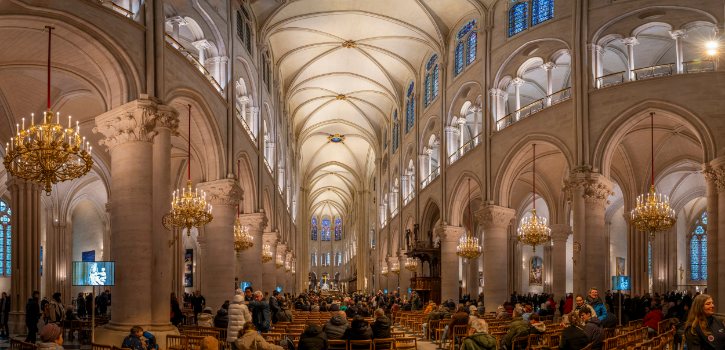
- Blonde limestone, cleaned of centuries of soot to a warm, honey color
- Polychrome side chapels with restored blues, reds, and gilding
- The Grand Organ, with more than 8,000 pipes, cleaned pipe by pipe of toxic lead dust
- A new altar in dark bronze, designed by Guillaume Bardet
Tall arcades line the nave, aisles run along the sides, and ribbed vaults soar overhead, carried by the outside buttresses. Height, rhythm, and light are the point. This is a working cathedral, not a disaster memorial.