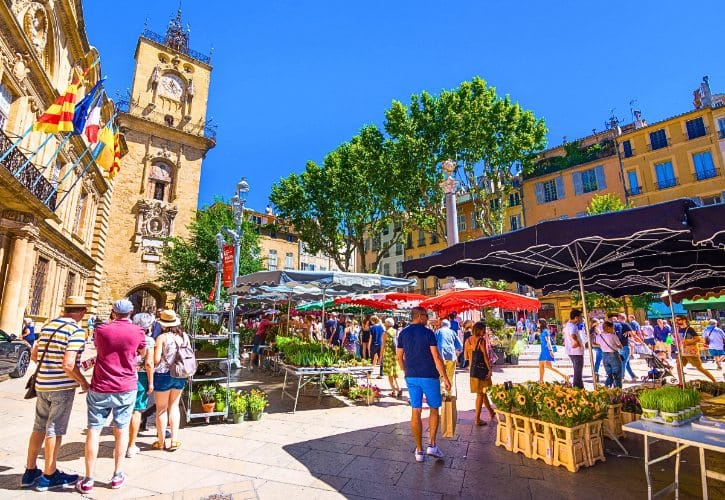
You do not need a rental car to fall in love with Provence. When you pick towns that sit on the region’s practical regional train lines, the whole area opens up in front of you.
One relaxed route can link historic cities, Roman monuments, morning markets, Mediterranean ports, dramatic coastal cliffs, and quiet inland landscapes.
The best part is that you can connect nearly all of it by train, with only a few short bus, shuttle, taxi, or walking steps in between. Here is how the route comes together. 😊
1. Avignon (Base – 4 Nights)

a. Why Visit Here
Avignon is the perfect northern anchor, with strong rail links for easy day trips to Orange, L’Isle-sur-la-Sorgue, and Arles without repacking.
It is also a great city in its own right: seat of Western Christianity in the 14th century, with Gothic architecture, medieval walls, wide squares, and covered markets by the Rhône. Once the tour buses leave, the old alleys turn quiet and genuinely Provençal.
One tip: choose Avignon Centre, right at the city walls, not Avignon TGV, which sits 5 km south (linked by the short L’Virgule shuttle).
b. Best Spots to Visit
- Palais des Papes: the largest Gothic palace in the world; allow 2 to 3 hours; the Histopad tablet guide is included; book online in peak season.
- Place du Palais: framed by Notre-Dame des Doms Cathedral and the Petit Palais Museum.
- Jardin du Rocher des Doms: hilltop park with Rhône and Mont Ventoux views; open, though conservation work may restrict some terraces.
- Pont Saint-Bénézet (Pont d’Avignon): the famous 12th-century bridge, four arches left; admission to walk the deck.
- Île de la Barthelasse: the best view back to the bridge and old city; reach it on the free, seasonal Navette Maritime Fluviale river shuttle.
- Les Halles d’Avignon: the covered food market on Place Pie, Tuesday to Sunday mornings.
- Rue des Teinturiers: a cobbled canal street with historic waterwheels.
- Place de l’Horloge and Place des Corps Saints: café squares, loveliest in the evening.
c. How Long to Stay
Four nights feels balanced: an arrival evening, one full day in Avignon, day trips to Orange and L’Isle-sur-la-Sorgue, and a departure morning for Arles. If you arrive early, you can split Avignon’s sights across two easy half-days.
2. Orange (Day Trip from Avignon)
a. Why Visit Here
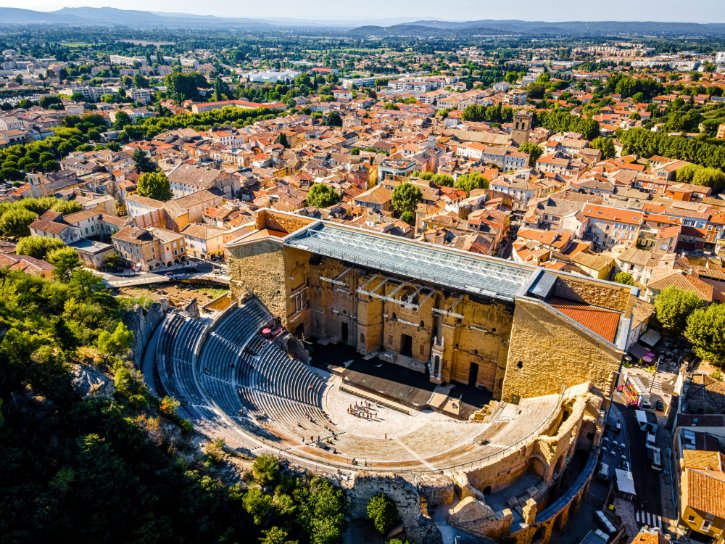
Orange is a Roman counterpoint to papal Avignon, holding some of the best-preserved classical architecture in Western Europe. The center is compact and walkable, so you need no local bus once you arrive. It deserves more than a quick photo stop.
b. Best Spots to Visit
- Théâtre Antique d’Orange: a UNESCO site with a huge stone stage wall (103 m long, 37 m high); allow 1.5 to 2 hours; audio guide and multimedia included; summer opera rehearsals can limit daytime access, so check ahead.
- Musée d’Art et d’Histoire: across the street; Roman finds and mosaics; usually included with your theatre ticket.
- Arc de Triomphe: an Augustus-era arch on the nortern edge, a 15-minute walk; free to see at any time.
- Old town: shaded squares and shops around Place aux Herbes; open-air market on Thursday mornings.
c. How Long to Stay
Half a day (4 to 5 hours) covers the theatre, museum, the walk to the arch, lunch, and the station walks. If you only want the theatre, a shorter visit works fine.
d. How to Get to Orange
Your first day trip is Orange.
- Departure: Avignon Centre
- Arrival: Orange
- Service: TER Sud regional trains
- Transfer: direct
- Typical travel time: 15 to 23 minutes
- Local connection: a flat 1.2 km walk (about 15 minutes) into the center
Search from Avignon Centre, not Avignon TGV.
Return on the same TER Sud line to Avignon Centre. Check your return train before entering any monument, then head back to your Avignon base. Take the L’Isle-sur-la-Sorgue trip on a separate day.
3. L’Isle-sur-la-Sorgue (Day Trip from Avignon)
a. Why Visit Here
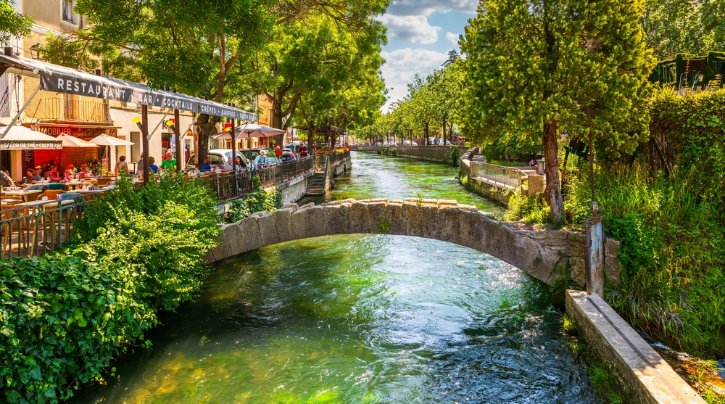
Known as the “Venice of Comtat”, this town is wrapped in the branching canals of the Sorgue and famous for antiques, galleries, riverside dining, and markets.
It is a relaxed change of pace. The station is Gare de L’Isle – Fontaine-de-Vaucluse, but it sits right in the center of L’Isle (a 5-minute walk to the canals), not in Fontaine-de-Vaucluse village 8 km further east.
b. Best Spots to Visit
- Canals and waterwheels: see 15 historic wooden waterwheels along the canals; allow about 1 to 1.5 hours.
- Antique villages: the third-largest antique center in Europe, with 300+ dealers (Le Village des Antiquaires de la Gare, L’Île aux Brocantes); big markets on Sundays, and many dealers close Tuesday and Wednesday.
- Markets: a huge Sunday food and antique fair along the riverbanks; a smaller Thursday food market on Place de la Liberté.
- Collegiate Church of Notre-Dame-des-Anges: plain outside, richly Baroque within.
- Campredon Art Centre: rotating modern and contemporary exhibitions.
c. How Long to Stay
On a Sunday, plan a full day (6 to 7 hours) for the antique market. On other days, a half-day (about 4 hours) covers the canal walk, church, and lunch. Add time on major market days.
d. How to Get to L’Isle-sur-la-Sorgue
- Departure: Avignon Centre
- Arrival: Gare de L’Isle – Fontaine-de-Vaucluse
- Service: TER Sud regional train
- Transfer: direct
- Typical travel time: about 25 to 30 minutes
- Local connection: a 5-minute walk to the canals
Return on the same line to Avignon Centre, and check later departures before a long lunch.
4. Arles (Base – 1 Night)
a. Why Visit Here
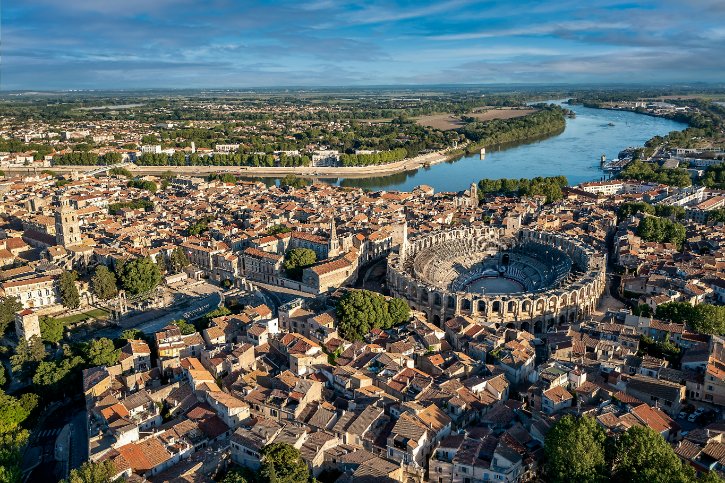
Arles is one of the most layered towns on the route: Roman monuments, Romanesque churches, Van Gogh links, and contemporary art, all walkable along the Rhône.
Unlike Orange’s single great monument, Arles spreads many ancient sites across a living city. One night lets you enjoy them in quiet morning and evening light.
b. Best Spots to Visit
- Arles Amphitheatre (Les Arènes): a 1st-century Roman arena modeled on the Colosseum.
- Ancient Theatre and Place de la République: a short walk on.
- Saint-Trophime Church: Romanesque, with a carved Last Judgment portal and cloister.
- Pass Monument: discounted combined access to the main civic monuments.
- Van Gogh trail: marked panels at his easel spots, including Place du Forum (Café Terrace at Night), Espace Van Gogh, and the Rhône riverfront. Note: originals appear only in seasonal exhibitions, with no permanent Arles collection.
- Choose one extra: Musée Départemental Arles Antique (Roman collection), LUMA Arles (Gehry tower, contemporary art), Alyscamps (Roman necropolis), or Musée Réattu (fine arts, with Picasso works).
c. How Long to Stay
One night works: arrive from Avignon in the morning, explore the Roman core and Van Gogh trail, dine around Place du Forum, see one museum the next morning, then continue to Aix after lunch.
Two nights suit anyone keen on archaeology, photography, contemporary art, or Van Gogh. A car-free Camargue day trip is not realistic in one night.
d. How to Get to Arles
- Departure: Avignon Centre
- Arrival: Arles
- Service: TER Sud regional train
- Transfer: direct
- Typical travel time: 16 minutes
- Local connection: about a 10-minute walk into the center
5. Aix-en-Provence (Base – 3 Nights)
a. Why Visit Here
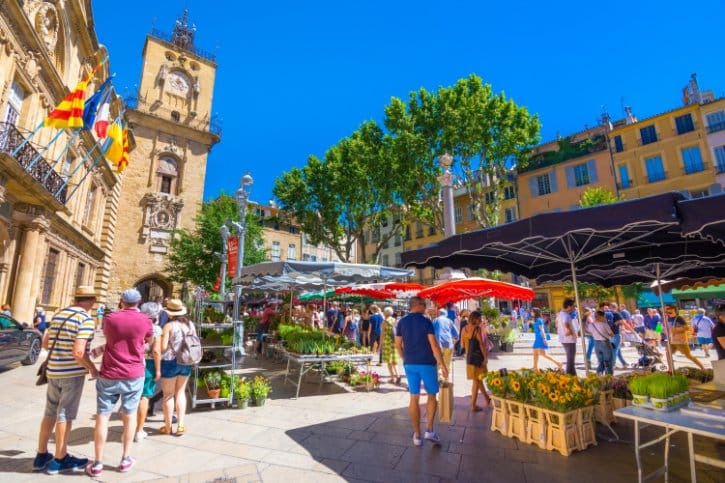
Aix is elegant and refined, with warm limestone, grand mansions, tree-lined boulevards, and easy café life.
As an inland base it balances the coast and launches the scenic Val de Durance line to Sisteron. The central Gare d’Aix-en-Provence is an 8-minute walk from Cours Mirabeau and convenient for both Marseille and Sisteron trains.
b. Best Spots to Visit
- Cours Mirabeau: a 440 m plane-tree boulevard with the Fontaine de la Rotonde and the mossy Fontaine Chaude.
- Place d’Albertas and Saint-Sauveur Cathedral: a Baroque square and a cathedral spanning Romanesque to Gothic.
- Markets: a daily food market on Place Richelme; a flower market on Place de l’Hôtel de Ville (Tuesday, Thursday, Saturday); antiques on Cours Mirabeau (Tuesday, Thursday).
- Calissons d’Aix: the local almond sweet, at Maison Béchard or Le Roy René.
- Cézanne sites: the Atelier de Cézanne (reopened in 2025), Jas de Bouffan (phased access, check ahead), and the Bibémus Quarries (shuttle and guided tour). The Atelier pairs best with a central day.
- Musée Granet and Hôtel de Caumont: two strong art museums; pick by taste.
c. How Long to Stay
Three nights fits an arrival evening, one full day in central Aix, one full day for the Sisteron excursion, and a final morning for a Cézanne site, museum, or market. Add a night if you want Bibémus, Jas de Bouffan, or several museums.
d. How to Get to Aix-en-Provence
Arles to central Aix needs a change, since no direct line links them.
- Departure: Arles
- Transfer: Marseille Saint-Charles (or Miramas)
- Arrival: Aix-en-Provence city center station
- First service: TER regional train to Marseille Saint-Charles (about 55 minutes)
- Second service: TER regional train to Aix-en-Provence (about 45 minutes)
- Typical total time: 1 hour 40 minutes to 2 hours 15 minutes
- Transfer time: allow 15 to 20 minutes in Marseille
Search “Aix-en-Provence” (center), not Aix-en-Provence TGV, which sits 15 km outside town.
6. Sisteron (Day Trip from Aix-en-Provence)
a. Why Visit Here
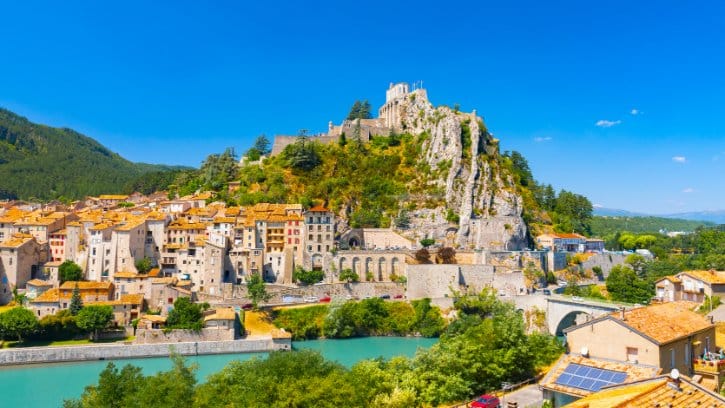
Sisteron is your mountain moment: the “Gateway to Provence”, where the Provençal hills meet the Alps.
It sits in a gorge cut by the Durance, with a huge fortified citadel on a limestone ridge facing the dramatic Rocher de la Baume. The scenery alone justifies the trip.
b. Best Spots to Visit
- Sisteron Citadel: a Vauban-era fortress about 500 m up, with a keep, underground passages, Napoleon museum rooms, and panoramic views; a 15 to 20-minute uphill walk from the station; a summer mini-train helps those with limited mobility.
- Old Town (Les Andrônes): vaulted medieval passages, the 12th-century Cathedral of Notre-Dame-des-Pommiers, and the Clock Tower.
- River and mountain views: cross the Durance bridge for the classic shot of the citadel and Rocher de la Baume.
c. How Long to Stay
Allow 4 to 5 hours for the station walk, old town, lunch, citadel, and river viewpoints. The timetable, not your energy, decides your day here, so pick your return train first.
d. How to Get to Sisteron
Your day trip runs to Sisteron.
- Departure: Aix-en-Provence city center station
- Arrival: Sisteron
- Service: TER Sud regional train
- Transfer: direct
- Typical travel time: 1 hour 20 minutes to 1 hour 25 minutes
- Local connection: a short walk into town, then a steep climb to the citadel
This is the most timetable-sensitive day trip on the route, so plan it carefully.
Return on the same line to Aix. This line runs only about 4 to 6 times a day, with fewer trains on weekends and holidays, so check the last two evening departures before you set out. Missing one can mean a long wait.
7. Marseille (Base – 3 Nights)
a. Why Visit Here
Marseille is France’s oldest city (founded around 600 BC) and its second-largest: big, bold, and full of life around the Vieux-Port, with deep maritime history, real cultural diversity, striking modern architecture, and coastline shaped by the Calanques.
It feels nothing like elegant Aix or historic Avignon. It is neither unsafe nor unattractive by default; just stay aware, as in any port city. Three nights lets you enjoy it without rushing.
b. Best Spots to Visit
- Vieux-Port and Le Panier: the old harbor and the oldest district, with sloping lanes, pastel facades, and the Vieille Charité almshouse.
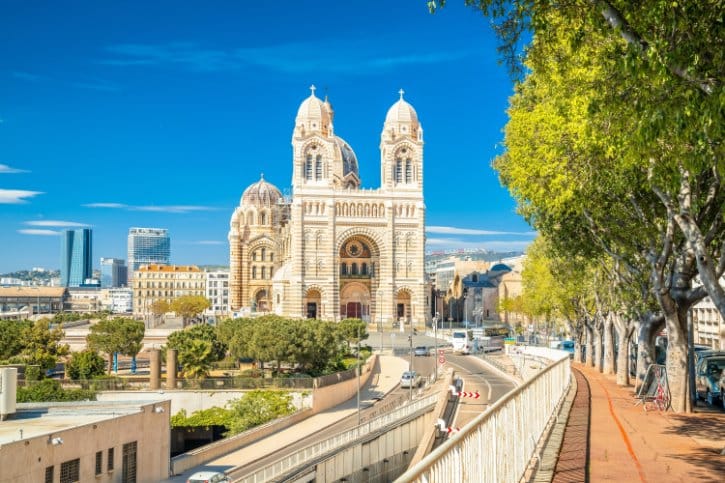
- Cathédrale de la Major, Fort Saint-Jean, and Mucem: a waterfront cathedral and museum linked by a high footbridge
- Notre-Dame de la Garde: a hilltop basilica with 360-degree views; skip the steep 30-minute climb and take RTM Bus 60 from the Vieux-Port to the gates.
- Corniche Kennedy and Vallon des Auffes: a coastal road to a tiny fishing harbor tucked under a stone bridge.
- Noailles and Cours Julien: the Marché des Capucins food market and a lively street-art neighborhood of cafés.
- Optional third day: a ferry to the Frioul Islands and Château d’If, or Palais Longchamp by Métro Line 1.
c. How Long to Stay
Three nights covers an arrival evening at the Old Port, one full day for Le Panier and Mucem, one full day for Notre-Dame de la Garde and the coast, and a partial day for Noailles, Cours Julien, or an island trip. A fourth night suits a slower pace.
d. How to Get to Marseille
- Departure: Aix-en-Provence city center station
- Arrival: Marseille Saint-Charles
- Service: TER Sud regional train
- Transfer: direct
- Typical travel time: 45 minutes
8. Cassis (Base – 2 Night)
a. Why Visit Here
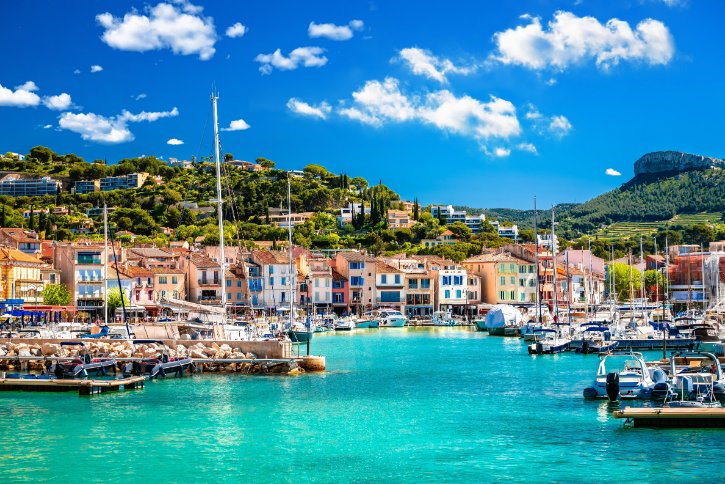
Cassis is a pastel coastal village set between the white Calanques cliffs and the red Cap Canaille.
It gets busy with day-trippers, which is exactly why staying over is worth it: the harbor, seafood, and beaches turn calm once the crowds leave. Two nights also give you weather flexibility for boats and hikes.
b. Best Spots to Visit
- Cassis port and village: a U-shaped harbor with dining along Quai des Baux, a Provençal market on Wednesday and Friday mornings, and local AOC white wines.
- Beaches: Plage de la Grande Mer by the harbor, and Plage du Bestouan a 10-minute walk west.
- The Calanques on foot: walk to Port-Miou (30 minutes), Port-Pin (45 to 60 minutes), or, for strong hikers, En-Vau (1.5 to 2 hours, steep). In summer, trails can close for wildfire risk, so check the My Calanques app each morning and carry water.
- The Calanques by boat: excursions leave Quai Saint-Pierre; they are cancelled in heavy swell.
- Cap Canaille: among Europe’s highest sea cliffs; the clifftop road suits a car or guided bike, but the harbor mole gives great views.
c. How Long to Stay
Two nights is the sweet spot: an arrival evening at the port, one full Calanques day, and a final morning before your afternoon train to Sanary. Planning the long En-Vau hike? Avoid an early departure the next day.
d. How to Get to Cassis
- Departure: Marseille Saint-Charles
- Arrival: Cassis
- Service: TER Sud regional train
- Transfer: direct
- Typical travel time: 20 to 25 minutes
- Local connection: Cassis station sits about 3.5 km inland; take bus Line M371 to the harbor.
9. Sanary-sur-Mer (Base – 1 to 2 Nights)
a. Why Visit Here
Sanary-sur-Mer is a gentle, genuine little port and a nice counterpoint to busier Cassis.
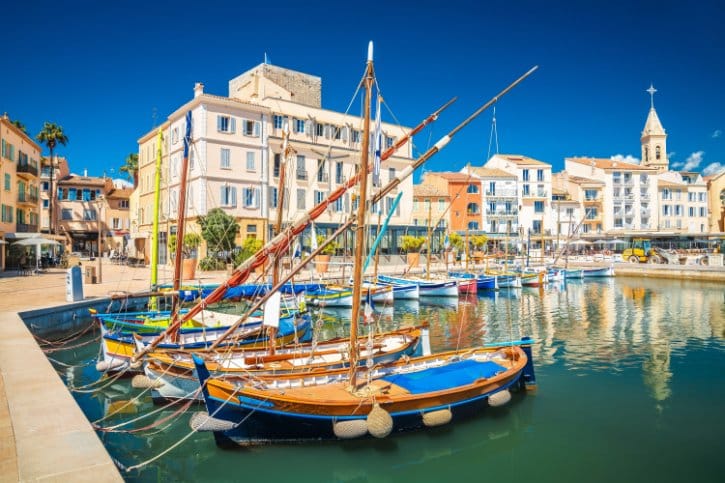
Life moves slowly around a working harbor full of traditional wooden pointu boats, with waterfront cafés, a lovely market, and easy beaches, and far less emphasis on hiking.
It makes a restful pause between Cassis and Toulon.
b. Best Spots to Visit
- Harbor and pointu boats: heritage-listed wooden fishing boats line Quai Charles de Gaulle, and fishermen often sell the morning catch straight from the boats.
- Historic center: pastel streets, the 13th-century Tour Romane (with a small diving-history museum and roof-terrace views), and the Neo-Gothic Church of Saint-Nazaire.
- Wednesday market: voted the “Most Beautiful Market in France”, wrapping the whole harbor; a smaller daily food market runs on Allées d’Estienne d’Orves.
- Beaches: Plage de Portissol, a sheltered cove 10 minutes west, and the long Plage de Bonnegrâce to the east.
c. How Long to Stay
One night covers an afternoon at the port, a seafood dinner, an evening stroll, and a morning at the center or a beach before the short train to Toulon.
Two nights suit beach time, a slower market morning, and an unhurried departure, especially if your stay includes the Wednesday market.
d. How to Get to Sanary-sur-Mer
- Local link: bus Line M371 from the harbor up to Gare de Cassis (8 to 10 minutes), timed to meet trains
- Departure: Gare de Cassis
- Arrival: Gare d’Ollioules – Sanary
- Service: TER Sud regional train
- Transfer: direct
- Typical travel time: 23 to 25 minutes
Your arrival station carries both the Ollioules and Sanary names and sits about 3 km from the harbor.
10. Toulon (Base – 1 to 2 Nights)
a. Why Visit Here
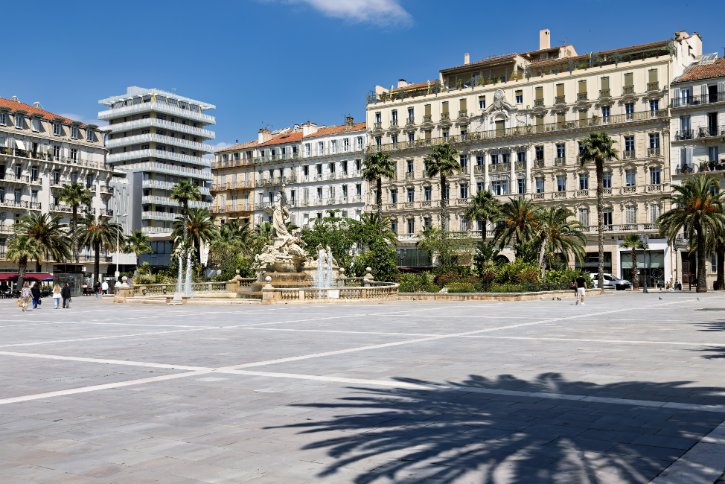
Toulon is a fitting, energetic finish: a working French naval base beside a restored medieval old town, busy markets, beaches, and mountains right behind the city.
This is the main home port of the French Navy’s Mediterranean fleet, so maritime history runs deep. In one stay you can mix sightseeing, naval heritage, coast, and big views from Mont Faron.
b. Best Spots to Visit
- Old Toulon: Place de la Liberté, the 11th-century cathedral, and the Cours Lafayette Market (Tuesday to Sunday mornings), where you can try cade, a baked chickpea pancake.
- Harbor and naval history: the Darse Vieille waterfront, the Musée National de la Marine (about 1.5 hours), and hour-long harbor cruises from Quai Cronstadt.
- Mont Faron: the red cable car climbs to the summit in 6 minutes for the Mémorial du Débarquement and sweeping views; take Réseau Mistral Bus 40 to the lower station. It closes in high winds and for maintenance from mid-November to early February.
- Mourillon: family beach parks and seaside dining 2 km east; take Bus 3 or 23 from the center.
c. How Long to Stay
One night lets you explore the old center, see the harbor, and choose Mont Faron or Mourillon. Two nights suit an unhurried pace, with time for both and flexibility if wind closes the cable car.
d. How to Get to Toulon
- Departure: Gare d’Ollioules – Sanary
- Arrival: Toulon
- Service: TER Sud regional train
- Transfer: direct
- Typical travel time: 10 to 12 minutes
- Local connection in Toulon: the old town is a 10-minute walk from the station
e. How to Finish the Route
- Station: Toulon’s central station, Gare de Toulon, sits on the main Mediterranean line, so onward travel is simple.
- Services available: TER regional trains, TGV INOUI high-speed trains, and other long-distance services.
- East toward Nice and Italy: direct trains run to Hyères, Cannes, Nice, and Menton.
- North toward Paris and Lyon: direct services run to Marseille Saint-Charles, Lyon Part-Dieu, and Paris Gare de Lyon.
- For airports: connect via Marseille Saint-Charles or Nice-Ville.