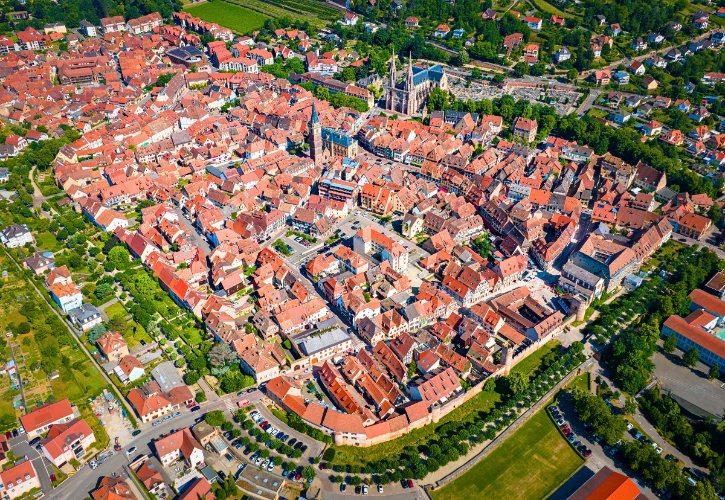
You do not need a long itinerary to see the best of Alsace. Along the foot of the Vosges Mountains, the Alsace Wine Route strings together grand cities, walled villages, and hilltop castles, most only a 10 to 30 minute drive from the next.
These are some of the sunniest, driest slopes in France, so vineyards climb right up to medieval walls. In one easy drive you go from Gothic spires to canal lined lanes, fresh beauty around every bend. 😊
1. Strasbourg
a. Why You Begin Here
Strasbourg sets the tone for everything ahead. It shows the French and German blend, the sandstone, and the timber at full scale before you meet them again in smaller villages.
b. What Makes It the Perfect Start
The historic heart, the Grande-Île, sits wrapped by two arms of the Ill River, and it earned UNESCO World Heritage status in 1988, later widened to include the German era Neustadt quarter.
Strasbourg spent five centuries as a free city, then became French, then German, so each era left its own layer. Learning to read those layers here makes the smaller towns ahead much easier to understand.
c. The Sights You Should Not Miss
- Cathédrale Notre-Dame (mainly 1176 to 1439), with a single 142 meter spire. It was the tallest building in the world for over two centuries, until the 1870s.
- The Astronomical Clock and the thirteenth century Pillar of the Angels inside.
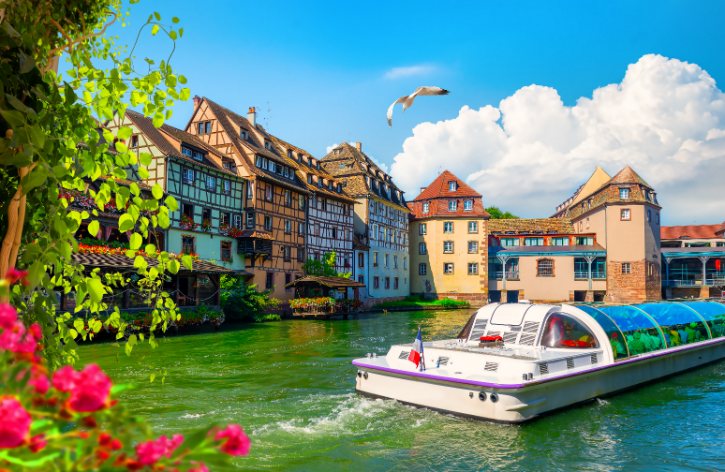
- Petite France, the old quarter of tanners and millers where the river splits into canals.
- The Barrage Vauban, a pink sandstone weir with a rooftop terrace and a clean view over the old city.
d. Streets and Details Worth Your Time
- Rue du Bain-aux-Plantes, lined with timber houses from the fifteenth to seventeenth centuries.
- The Ponts Couverts, guarded by four thirteenth century stone towers.
- Maison Kammerzell, with a stone arcade dated 1427 and carved timber floors finished in 1589.
- The name Petite France, which comes not from style but from an old hospice for syphilis, then called the “French disease”.
e. Where the Best Views Hide
Climb the cathedral’s 332 steps for the Vosges to the west and the Black Forest to the east. It shows the whole valley you are about to drive. Within minutes of leaving, vines appear and the walls of Obernai come into view.
2. Obernai
a. Your First Taste of Small-Town Alsace
Obernai eases you in gently. It is busier than the villages further south, yet more intimate than Strasbourg, and it still works as a real market town at the base of Mont Sainte-Odile.
The vineyards of the Schenkenberg climb right behind the rooftops, and double stone walls still ring the old center. It is an easy place to slow down.
b. The Heart of the Old Town
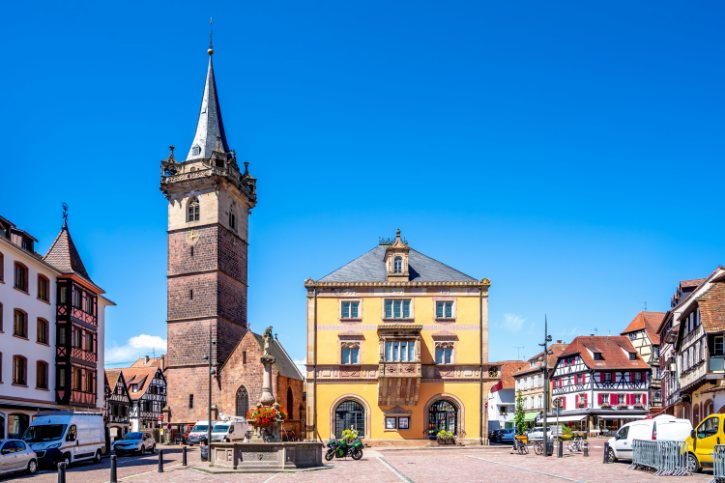
- Place du Marché, the main square and meeting point.
- The Kapellturm, a 60 meter tower that began as a chapel choir and was raised into a belfry in 1597.
- The Halle aux Blés (1554), a Renaissance corn exchange with stepped gables.
- The Six Buckets Well (1579), a carved Renaissance water monument.
- The Église Saints-Pierre-et-Paul, which still holds a genuine fifteenth century stone Holy Sepulchre.
c. Things to Notice as You Walk
- Carved trade emblems above the cellar doors, such as shears and pruning knives.
- The Renaissance oriel window on the town hall, added in 1610.
- Timber framing pegged with wood on Rue des Pèlerins.
- Rampart walks that follow the old defensive ditches.
d. History, Legend, and a Local Tip
- A founding member of the Decapolis alliance in 1354, independent until it passed to France in 1679.
- Tied to Saint Odile, patron of Alsace, said to be born here around 660. Treat this as cherished tradition, since exact records do not survive.
- That tall central spire belongs to the civic Kapellturm, not to the parish church.
e. What to Eat and Taste
- Crisp wines from the Schenkenberg hillside: Sylvaner, Pinot Blanc, and Riesling.
- Kougelhopf, a soft brioche with raisins and almonds.
- The Tarte d’Obernai, with almond cream, spiced apples, and a meringue top.
From Obernai the road climbs into the forest toward a fortress on a mountain crest.
3. Château du Haut-Koenigsbourg
a. A Castle With a Commanding View
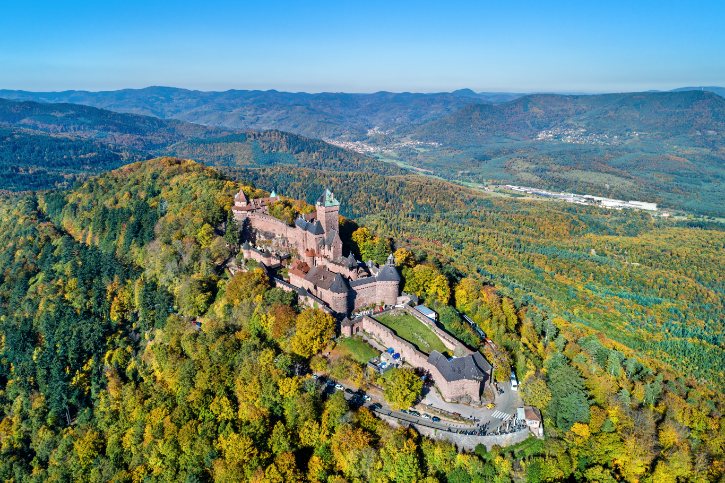
This is the one stop that trades streets for stone battlements. Perched around 757 meters up, it is the most completely restored mountain fortress in the Upper Rhine.
b. What to See Inside and Out
- The Grand Bastion, a late fifteenth century artillery redoubt with replica cannons.
- The High Keep, rebuilt to 62 meters, with battlements that reveal the whole defensive plan.
- The Kaiser’s Hall, covered in late Gothic rib vaults.
- A lower courtyard with a working forge, stables, and an inn.
c. Telling Old Stone From New
- Lower walls show weathered medieval blocks with original quarry marks.
- Upper levels, rebuilt between 1900 and 1908, show precise modern sandstone.
- The hall murals, painted by Léo Schnug between 1908 and 1914, are modern works in a historic style.
d. The Story Behind the Rebuild
The town of Sélestat gave the ruins to German Emperor Wilhelm II in 1899. He funded the work and shaped its imperial symbolism, including the motto Gott Mit Uns.
The archaeology and design, though, were led by the Berlin architect and scholar Bodo Ebhardt, who studied the foundations and modeled the rebuild on real fortresses. The result carried a political message, yet the stonework followed serious method, which is part of what makes it so interesting to walk.
e. A Short History and the Best View
- Founded as Castrum Estufin by the Hohenstaufen dynasty in the early twelfth century.
- Burned in 1462, then rebuilt as an artillery fortress after 1479.
- Sacked by Swedish forces in 1633, then left abandoned for over 250 years.
- Best view: looking up from the gatehouse to the keep, or from the south gallery over vineyards toward the Rhine.
Back down the winding road, a walled village waits among the vines.
4. Bergheim
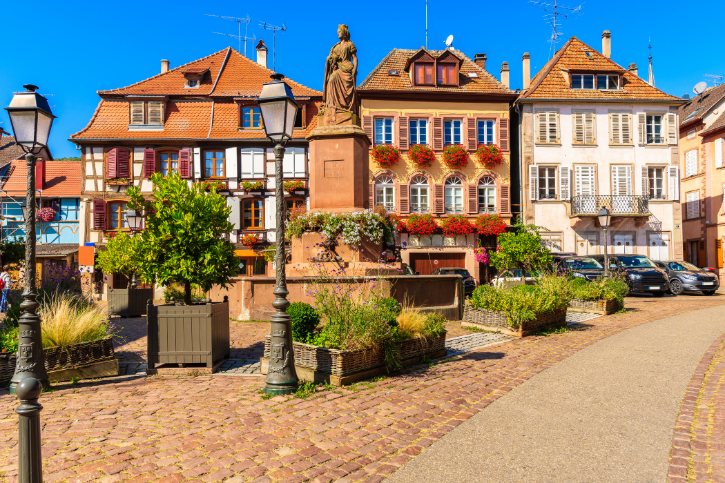
a. The Quiet, Authentic Walled Village
If you want the calm side of wine country, Bergheim delivers. While bigger neighbors tore down their walls, it kept its medieval ramparts almost unbroken. It never had a central castle, so the walled town itself was the fortress.
That gives it a quiet, lived in feel, with gardens growing in the old moat and vines pressing in from every side.
b. What to See and Do
- The Ramparts Trail, an easy loop of about 40 minutes past towers and arrow slits.
- The Porte Haute, the only surviving town gate, from the fourteenth century and raised higher in 1573.
- The Witches’ House museum, on the trials held here between 1582 and 1683.
- The Church of the Assumption, first built in 1320.
c. Details Worth a Closer Look
- Wide carriage entrances built to let grape wagons into the courtyards.
- Keystones carved with dates, family initials, and pruning shears.
- An eighteenth century covered washhouse fed by natural springs.
- A Roman mosaic of Bacchus, uncovered nearby in 1848.
d. The Wine Around the Walls
- Altenberg de Bergheim, a south facing marl and limestone slope that allows traditional field blends.
- Kanzlerberg, just 3.2 hectares, the smallest Grand Cru in Alsace.
e. A Sober Note and a Proud One
- Town archives record 43 women who died in the witch trials, most of them burned at the stake.
- Bergheim joined the association of Les Plus Beaux Villages de France not long ago.
- Best photo: the vineyard paths frame the Porte Haute, with Haut-Koenigsbourg on the crest behind.
The road then curves toward Ribeauvillé, where three castle ruins rise on the ridges ahead.
5. Ribeauvillé
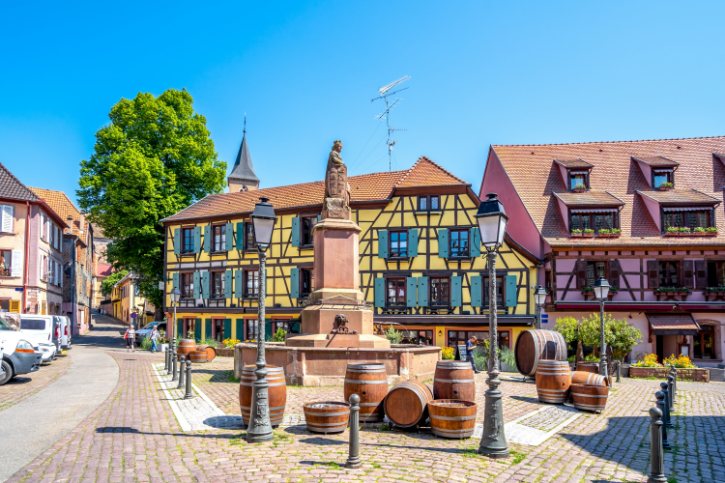
a. A Town Beneath Three Castles
Ribeauvillé raises the drama. A long medieval street runs through the valley, with three stone ruins standing guard above. This was the seat of the powerful Lords of Ribeaupierre.
The streets follow a stream between steep vine covered hills, lined with Renaissance fountains, gate towers, and grand old houses. The noble past shows at every turn.
b. The Three Castles Above
- Château de Saint-Ulrich, the largest, with a Romanesque knight’s hall and a tall keep.
- Château de Girsberg, on a granite pinnacle, with a five sided keep.
- Château du Haut-Ribeaupierre, higher up, ringed by a deep moat.
- A marked trail climbs through oak woods to reach them.
c. Down in the Old Town
- The Tour des Bouchers, a 29 meter gatehouse from the thirteenth century, raised higher in 1536.
- The Maison des Ménétriers (Fiddlers’ House, 1683), with a carved facade.
- Grand’Rue, the kilometer long spine of the town.
- Place de la Sinne, built around a fountain carved in 1862.
d. The Oldest Festival in Alsace
- The lords here were the legal protectors of the region’s wandering minstrels and fifers.
- Each September those musicians gathered to pay their dues.
- That lives on as the Pfifferdaj, on the first Sunday of September, with roots over 600 years.
- A “Fiddler King” offering a musical tribute is still the heart of it.
e. Wine to Know
- Geisberg, known for powerful, long lived dry Riesling.
- Kirchberg de Ribeauvillé, giving structured Riesling and rich Pinot Gris.
- Osterberg, which completes the town’s trio of Grand Crus.
Ribeauvillé feels grander than quiet Bergheim. The valley then tightens around the compact walls of Riquewihr.
6. Riquewihr
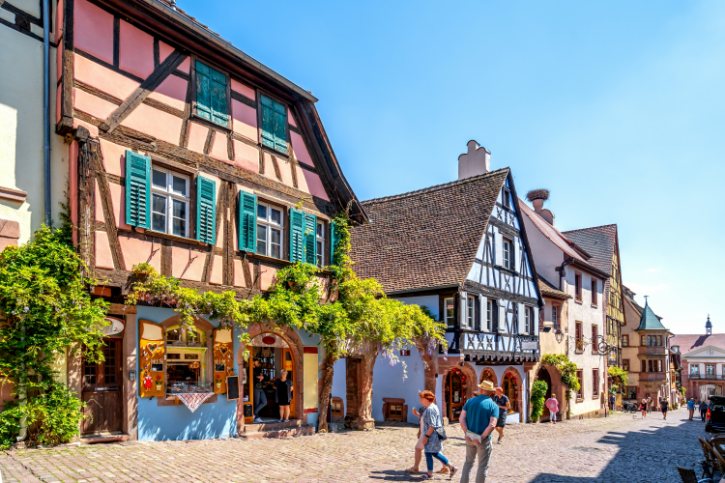
a. The Postcard Wine Village
Riquewihr is the picture most people imagine when they think of Alsace. Spared the worst of twentieth century fighting thanks to its tucked away location, it is one of the most tightly preserved wine towns on the route. It is a dense walled rectangle of timber houses in ochre, sage, rust, and indigo.
b. The Sights to Find
- The Dolder gate tower (1291), with a plain defensive outer face and a decorated timber inner face.
- The Thieves’ Tower (1550), an 18 meter tower that held the court of justice, with a cell and old interrogation rooms.
- The Maison Dissler (1610), a rare stone Renaissance house with a scrolled gable and a carved stone oriel.
c. Rewards Beyond the Main Street
- Rue du Général de Gaulle, which climbs from the lower gate up to the Dolder.
- Quiet side lanes like Rue des Juifs, Rue Saint-Nicolas, and Rue des Remparts.
- Carved corner posts twisted with vine and grape motifs.
- Stone brackets built to lower heavy wine barrels into the cellars.
d. The Wine Behind the Walls
- Schoenenbourg, giving concentrated, very mineral dry Riesling and historic late harvest wines.
- Sporen, known for rich Gewurztraminer and structured Pinot Gris.
- The Macaron de Riquewihr, a soft coconut pastry.
e. Why It Stayed So Perfect
When its wine trade slowed in the nineteenth century, there was no money to modernize, so the old houses stayed. For the widest view, the Schoenenbourg vineyard paths look down on red roofs inside the walls. More compact than Ribeauvillé, it leads you on toward a river valley.
7. Kaysersberg
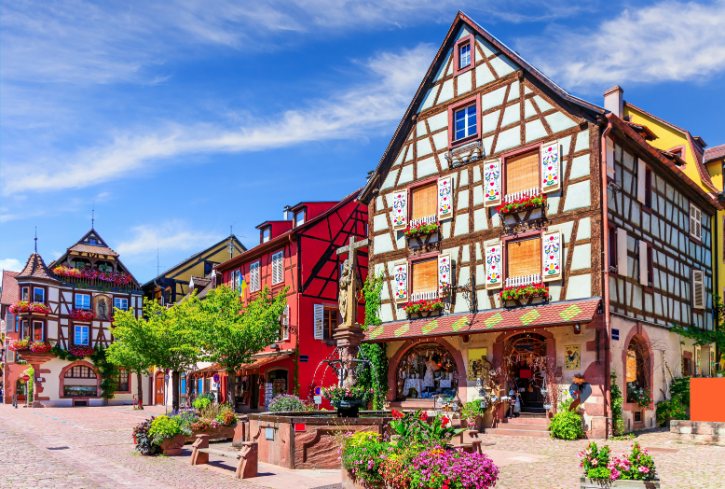
a. Where the River Joins the Story
Kaysersberg brings something new, water. The fast flowing Weiss River runs through the center, crossed by a fortified bridge, with a ruined keep watching from the slopes above. Timber houses lean right over the water.
Unlike the enclosed basin of Riquewihr, this town was shaped by mountain water and trade, so the mood feels open and lively rather than tucked away.
b. The River, the Bridge, and the Castle
- The Fortified Bridge (1514), in pink sandstone, with arrow slits and a niche holding an eighteenth century statue of the Virgin Mary.
- The Château de Kaysersberg, whose round keep was raised around 1220 to watch the trade route.
- A climb up the keep for views over the valley, the rooftops, and the Schlossberg vines.
c. In the Old Town
- Rue du Général de Gaulle, lined with old bakeries, cellars, and inns.
- Église Sainte-Croix, with a Romanesque portal from around 1230 and a carved retable from 1518 by Hans Bongart.
- The Hostellerie du Pont (Badhus, 1600), built right by the river.
d. The Albert Schweitzer Connection
- Birthplace of Dr. Albert Schweitzer, born here on 14 January 1875.
- A doctor, theologian, and musician, awarded the Nobel Peace Prize in 1952 for his work at Lambaréné in Gabon.
- His birthplace is now the Centre Schweitzer, an interactive center on his life and his ideas of peace.
e. Wine and Honors
- The Schlossberg, a granite slope named the first Grand Cru in Alsace in 1975, giving dry mineral Riesling.
- Local plates like river trout and Munster cheese from the high pastures.
- Its win as Le Village Préféré des Français in 2017, a public television vote rather than an official ranking.
The road then runs south past Ammerschwihr toward a town famous for its gates and a nightly ritual.
8. Turckheim
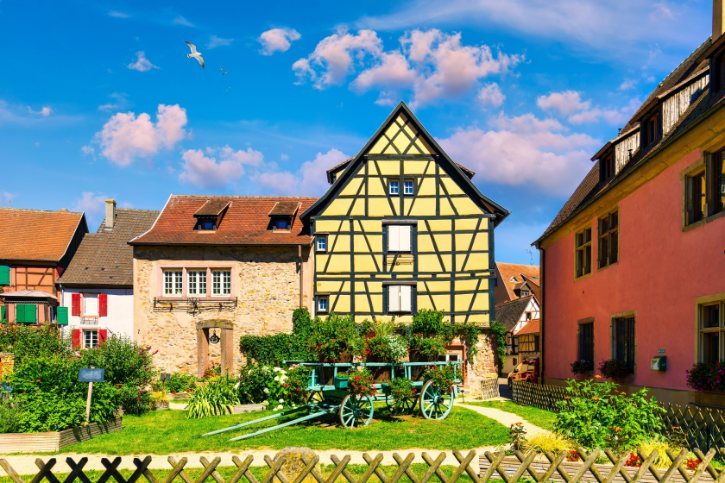
a. Gates and a Living Tradition
Turckheim is small, but it offers two rare things together. All three of its medieval gates still stand, and it keeps a night watchman tradition that never truly died. Storks nest on its towers, beneath the granite terraces of the Grand Cru Brand.
b. The Three Medieval Gates
- Porte de France (1330), the main trade gate, with royal arms added after 1681.
- Porte de Munster (fourteenth century), with a storm warning bell and scallop shell carvings.
- Porte du Brand (1312), a fortified artillery tower with a carved grotesque face to ward off evil.
c. Meeting the Night Watchman
- It began in the Middle Ages to guard against fire and lock the gates.
- Suppressed in 1791, restored in 1795, ended as a paid post in 1939, then revived in 1953 as a cultural tradition.
- He walks in a black coat with a halberd, horn, and lantern.
- He sings the old Alsatian call “Han sori zu Fir und Liacht”, which means “Take care of fire and candle light”.
- You can follow along through the warmer months, one of the most memorable half hours of the trip.
d. What to Notice
- The Romanesque base of the Église Sainte-Anne tower, from 1190.
- Large wicker platforms on the rooftops, placed to encourage nesting storks.
- Timber winemakers’ houses on Rue du Conseil, with overhanging upper floors.
e. The Wine Behind the Town
- The Grand Cru Brand, whose name means “the land of fire”, built on warm granite.
- Mineral Riesling and spicy, powerful Pinot Gris.
- Vines that climb straight up behind the church, so town and terroir read as one picture.
From here the route heads southeast, skirting Colmar, toward a village shaped into rings.
9. Eguisheim
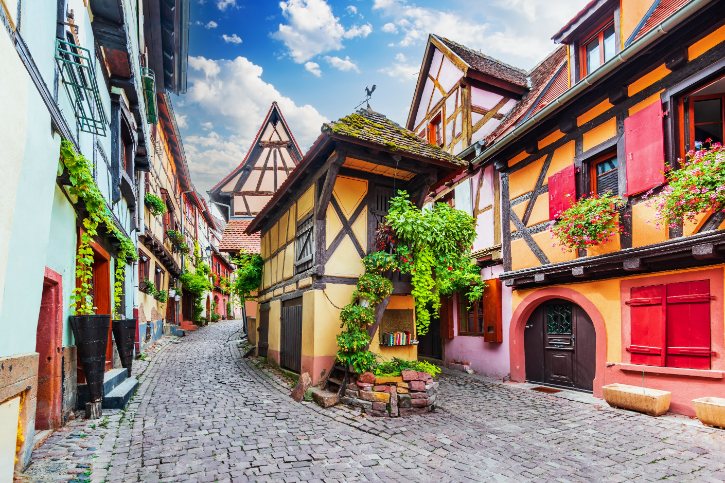
a. The Village Built in Circles
Eguisheim grew in concentric rings around a central castle, so walking it feels like circling slowly toward the middle. The outer houses are built into the old ramparts, which is why the lanes bend so gracefully.
Add pastel houses, cascading flowers, and a slice of papal history, and it is easy to see why so many travelers fall for it.
b. The Circular Walk
- Rue du Rempart Sud and Rue du Rempart Nord, which trace the full ring.
- Le Pigeonnier, a slim timber corner house and one of the most recognized sights in Alsace.
- Outer walls that curve along the old moat, often with no ground floor windows.
- The rings were built for defense, funneling attackers into curved, exposed lanes.
c. The Castle and the Pope
- Place du Château Saint-Léon, around the old castle of the Counts of Eguisheim.
- Bruno of Eguisheim-Dagsburg, born here in 1002, who became Pope Leo IX in 1049, the only Alsatian pope.
- Local tradition names the castle as his birthplace, though the exact room is tradition rather than record.
- The Chapelle Saint-Léon IX, which stands on the site of the old keep.
d. Wine to Know
- Eichberg, giving rich, long lived Gewurztraminer and structured Riesling.
- Pfersigberg, known for delicate Muscat, Pinot Gris, and refined Riesling.
- The Grands Crus path that climbs straight out of the village.
- The Parc aux Cigognes, which supports the local stork population.
e. More Than a Pretty Face
Eguisheim is a certified member of Les Plus Beaux Villages de France, and it won Le Village Préféré des Français in 2013, four years before Kaysersberg. Step into the inner courtyards to find working wine estates behind the postcard facades. From here the road crosses the plain into a full size city.
10. Colmar
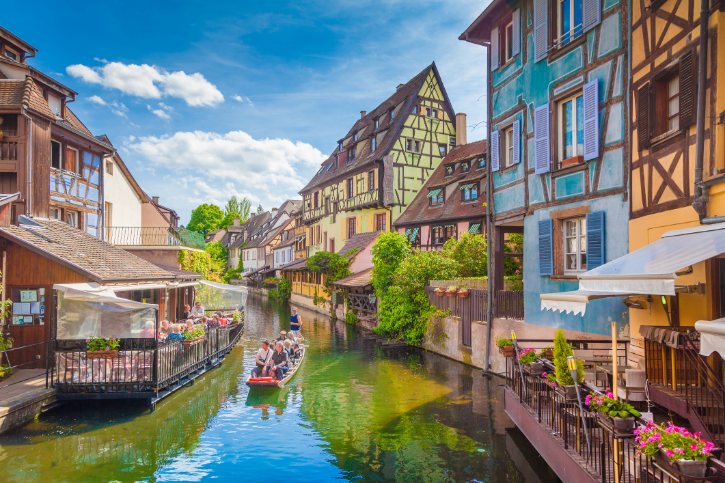
a. The Grand Finale
Colmar is where the whole trip comes together. Everything you saw in pieces, Gothic churches, Renaissance houses, canals, and wine country roots, appears here at city scale. Spared from wartime bombing, it kept its historic quarters almost whole.
b. Little Venice and the Water
- Little Venice (La Petite Venise), with timber houses leaning over the Lauch River.
- The best canal view, looking north from the Pont Saint-Pierre.
- The Quai de la Poissonnerie, the bright old fishermen’s quay.
- Rue des Marchands, the historic shopping street.
c. The Landmarks That Matter
- Maison Pfister (1537), with an octagonal corner turret, a wooden gallery, and a painted facade.
- The Koïfhus (Old Customs House, 1480), once the assembly hall of the Decapolis cities, under a glazed tile roof.
- Maison des Têtes (1609), covered with 106 carved heads and topped by a bronze cooper.
- Collégiale Saint-Martin (1234 to 1365), often called a cathedral, though it is really a collegiate church.
d. Art, Markets, and Wine
- The Musée Unterlinden, home of the Isenheim Altarpiece (1512 to 1516) by Grünewald and Niclaus of Haguenau, now beautifully restored.
- The Bartholdi Museum, honoring the Colmar born creator of the Statue of Liberty.
- The Covered Market (1865) by the river, best on a Saturday morning.
- Its title as the “Capital of Alsace Wine”, earned as home of the regional wine council rather than as an official rank.
e. Why Colmar Ends the Trip So Well
Colmar gathers the whole journey into one place. German woodwork, French order, Gothic ambition, and the wine trade all meet in a compact, walkable core.
Its grand civic buildings make sense once you know its old role as the largest city of the Decapolis, where the league’s deputies met at the Koïfhus, and later as the judicial capital of Alsace under France.
Walk beyond Little Venice to find the city that was always the center of the region you have just crossed.