France has far more beauty than its famous names suggest. Most visitors head straight to Paris, Nice, Bordeaux, or the lavender fields of Provence, and they miss the quieter places in between.
Yet across the country you will find colorful old towns, riverside streets, historic centers, cathedral skylines, coastal views, and medieval lanes.
These are the places made for slower travel. Here are ten beautiful French cities and towns that most tourists pass right by.
1. Albi (Occitanie)
The Red Brick City on the Tarn
a. The Red Brick City
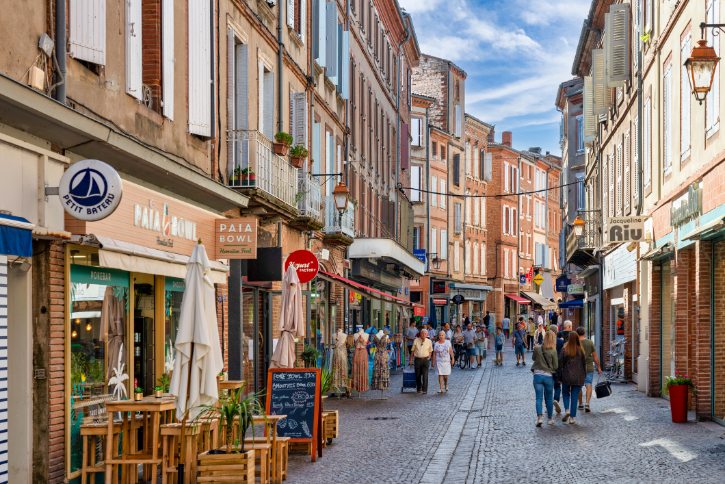
Albi sits on the Tarn River in southwest France, and the first thing you notice is the color. Almost the whole historic core is built from warm pink and red brick, so the city seems to glow. It is a small place, with about 51,290 residents, and it is compact and easy to walk.
b. Its UNESCO Heritage
- The heart of the city is the Episcopal City of Albi, a UNESCO World Heritage Site since 2010.
- Albi was shaped by the medieval Albigensian Crusade (1209 to 1229) against the Cathars.
- After the conflict, the Roman Catholic Church built on a grand scale here to show its power.
c. Why It’s Beautiful
The local “Toulouse brick” shifts through red, pink, and orange under the southern sun. The best views come from the water. Look up at the Episcopal City rising above the Tarn from the Pont Vieux, from the terraces of the Palais de la Berbie, or from the riverbanks below.
d. Key Attractions
- Cathédrale Sainte-Cécile: the largest brick building in the world, a fortress-style Gothic cathedral from the 13th to 15th centuries. Its walls rise about 40 meters under a 78-meter bell tower, and inside, roughly 18,500 square meters of Renaissance frescoes form the largest painted interior in Europe. A fee applies for the Choir of the Canons.
- Palais de la Berbie and Toulouse-Lautrec Museum: a 13th-century episcopal fortress holding the largest collection of works by Henri de Toulouse-Lautrec, born in Albi in 1864, with gardens overlooking the Tarn.
- Pont Vieux: built in 1040, one of the oldest bridges in France still carrying traffic, and the best spot for a panoramic photo.
- Saint-Salvi Church and Cloister: an 11th- to 13th-century Romanesque-Gothic building with peaceful courtyard gardens.
- Vieil Albi and the Marché Couvert: an old quarter that grew rich from the woad dye trade, with a covered market that is perfect for a morning breakfast.
e. Food
- Flavors: Gaillac AOC wines, Lautrec garlic, cured meats from the Monts de Lacaune, Aubrac beef, and cassoulet.
- A traditional southwestern breakfast at the covered market makes an easy start to the day.
f. Practical Details
- How long: one full day covers the main sights, with an overnight stay for evening photos of the illuminated brick.
- Getting there: about 78 kilometers northeast of Toulouse, by the A68 motorway or a direct TER train from Toulouse-Matabiau.
Read More: 10 Must Visit Spots in Occitanie
2. Collioure (Occitanie)
The Colorful Mediterranean Village That Changed Art History
a. A Catalan Harbor Town
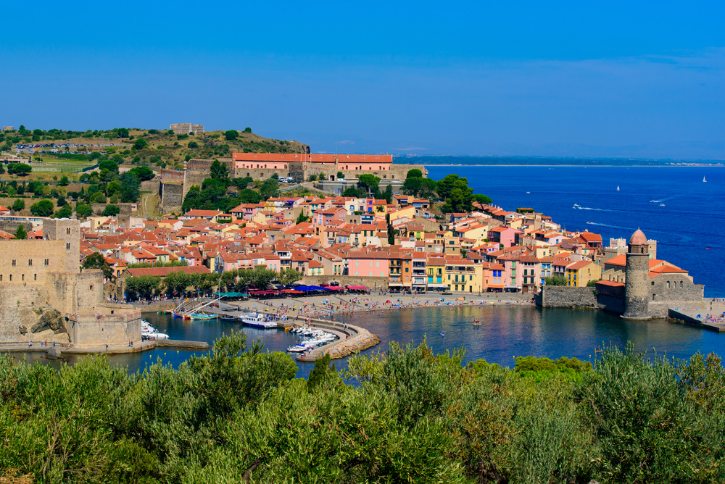
Collioure sits on the rocky Côte Vermeille, about 27 kilometers south of Perpignan and only 20 kilometers from the Spanish border. It is tucked into a bay where the Pyrenees drop straight into the Mediterranean, and it enjoys roughly 320 days of sunshine a year.
b. The Birthplace of Fauvism
- In the summer of 1905, painters Henri Matisse and André Derain worked here.
- Drawn by the strong light, they used pure, non-naturalistic colors, and critics called them “Les Fauves”, the Wild Beasts.
- Derain’s masterpiece The Port of Collioure came from this summer.
c. Why It’s Beautiful
Pastel houses reflect onto the harbor beside traditional Catalan fishing boats. At the water’s edge stands Notre-Dame-des-Anges, its pink-domed tower the town’s main landmark, with small pebble beaches right alongside. Everything feels close and easy.
d. Key Attractions
- Château Royal de Collioure: a large 13th-century coastal fortress, once a summer home for the Kings of Majorca and later reinforced by Vauban. It is open daily, with panoramic bay views.
- Notre-Dame-des-Anges: a 17th-century seaside church whose bell tower once worked as a lighthouse. Inside is a grand baroque altarpiece.
- Chemin du Fauvisme: a free, self-guided trail with 20 reproductions of works by Matisse and Derain, placed exactly where they were painted in 1905.
- Harbor and beaches: the pebble coves of Boramar and Saint-Vincent flank the harbor, alongside fishing boats and cafés.
e. Food and Local Flavor
- Collioure anchovies: protected since medieval times. Houses such as Roque and Desclaux offer tours and tastings.
- Local wines: the sun-drenched wines of AOC Collioure and the sweet, fortified wines of neighboring AOC Banyuls.
f. Practical Details
- How long: one full day covers the historic core.
- Getting there: the regional TER line between Perpignan and Cerbère/Port-Bou.
- Best time to go: the shoulder seasons, late May to June or September to October, to avoid summer crowds.
3. Troyes (Grand Est)
The Medieval Capital of Champagne
a. The Medieval Capital of Champagne
Troyes sits in the Aube department of the Grand Est region and is the historic medieval capital of Champagne. Its old town has a famous shape, an outline that resembles a Champagne cork, formed by medieval ramparts and old canal diversions.
b. Why It’s Beautiful
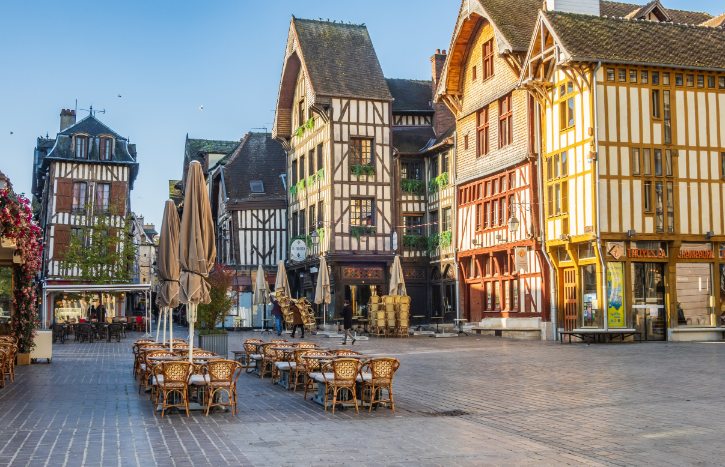
- Troyes holds the densest, most homogeneous collection of 16th-century half-timbered houses in France.
- The cobbled lanes are lined with pastel timber facades, wonky gables, and carved wooden corbels.
- The upper floors lean so far they nearly touch across the Ruelle des Chats, a lane so narrow that cats can supposedly jump from roof to roof.
c. Key Attractions
- Cathedral of Saint-Pierre-et-Saint-Paul: exceptional Flamboyant Gothic architecture with brilliant stained glass.
- Église Sainte-Madeleine: known for its finely sculpted stone rood screen, the jubé, and 16th-century windows depicting the creation of the universe.
- Cité du Vitrail: a museum dedicated to the region’s stained glass, explaining techniques from the Middle Ages onward.
- Maison de l’Outil et de la Pensée Ouvrière: more than 10,000 artisanal hand tools from the 17th to 19th centuries, in a Renaissance mansion.
- Vieux Troyes: the old town itself, made for wandering.
d. The Stained Glass Story
Troyes and the Aube area are strongly linked to stained glass, and that sets the city apart from the other medieval towns here. You can follow this thread through the cathedral, the windows of Sainte-Madeleine, and the displays at the Cité du Vitrail.
e. Food and Champagne
- Andouillette de Troyes: a well-regarded tripe sausage.
- Chaource: a soft, creamy local cheese.
- Prunelle de Troyes: a sloe-stone liqueur, made since 1840.
- Troyes is also a gateway to the southern Champagne vineyards, including the Côte des Bar and Montgueux.
f. Practical Details
- How long: a full day works well, with an overnight stay for a more relaxed walk.
- Getting there: about 1.5 hours from Paris-Est by direct regional train.
4. Nancy (Grand Est)
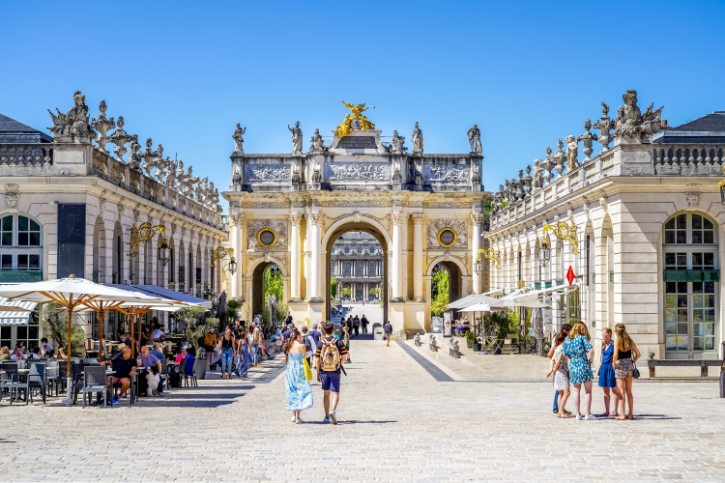
France’s Art Nouveau Capital
a. A Refined Lorraine City
Nancy, in the Grand Est region, was once the capital of the Duchy of Lorraine. It offers a lovely contrast between 18th-century classical order and the flowing lines of early-20th-century Art Nouveau.
b. Its UNESCO Squares
- The city’s central axis is a UNESCO World Heritage Site, inscribed in 1983.
- The listing includes three connected squares: Place Stanislas, Place de la Carrière, and Place d’Alliance.
- In the late 19th century, Nancy became the center of the French Art Nouveau movement, known as the École de Nancy.
c. Why It’s Beautiful
Place Stanislas is the showpiece, commissioned by Stanislas Leszczynski between 1752 and 1756 and designed by the architect Emmanuel Héré.
Pale stone facades, grand fountains, and magnificent gilded iron gates by Jean Lamour frame the square. Away from it, you will find decorative Art Nouveau buildings, delicate glasswork, and elegant villas.
d. Key Attractions
- Place Stanislas: one of France’s most beautiful squares, and the natural place to start.
- Place de la Carrière and Place d’Alliance: the two squares that complete the UNESCO trio.
- Musée de l’École de Nancy: Art Nouveau decorative arts in the former home of the patron Eugène Corbin, with organic furniture and delicate glassware.
- Villa Majorelle: a beautifully restored Art Nouveau villa.
- Musée des Beaux-Arts: a strong fine arts museum among the landmark buildings.
- Art Nouveau walking routes: dedicated routes that link the main design sites at your own pace.
e. Food
- Sweet treats: Bergamotes de Nancy candies and Macarons de Nancy, made from a secret 18th-century recipe.
- Savory classics: Quiche Lorraine and pastries filled with local Mirabelle plums.
f. Practical Details
- How long: one to two days for both the classical center and the Art Nouveau villas.
- Getting there: TGV in about 90 minutes from Paris Gare de l’Est.
5. Dijon (Bourgogne-Franche-Comté)
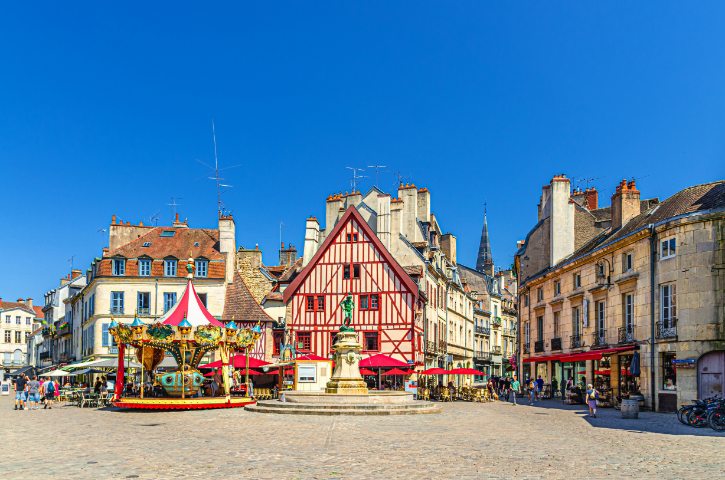
More Than Mustard
a. More Than Mustard
Dijon is the capital of the Bourgogne-Franche-Comté region, and yes, it is famous for mustard. But it offers far more. The historic center covers about 97 hectares and was recognized as a UNESCO World Heritage Site in 2015 as part of the Climats, Terroirs of Burgundy.
b. Why It’s Beautiful
The largely pedestrian center is full of gothic churches, medieval half-timbered houses, and grand stone mansions. The semi-circular Place de la Libération, designed by Jules Hardouin-Mansart, faces the Palace of the Dukes of Burgundy in a majestic open space.
c. Key Attractions
- Owl Trail (Parcours de la Chouette): a self-guided loop marked by 22 brass plaques set into the cobblestones, guiding you past the major sites.
- Notre-Dame owl carving: a small, worn stone owl on the church’s north wall. Local tradition says it grants a wish if you touch it with your left hand.
- Palais des Ducs and Musée des Beaux-Arts: one of France’s oldest art museums, home to the tombs of the Dukes of Burgundy and their carved alabaster mourners.
- Les Halles market: a covered market from the 1870s, with an iron-and-glass structure inspired by the Eiffel company.
- Tower of Philippe le Bon: a 46-meter medieval tower with a 316-step climb to panoramic views.
- Cité Internationale de la Gastronomie et du Vin: a center celebrating the French Gastronomic Meal.
d. Wine and Gastronomy
Dijon is the northern gateway to the Route des Grands Crus, the historic wine road that begins just south at Marsannay-la-Côte. Local specialties include pain d’épices (gingerbread), crème de cassis for a Kir, and authentic Burgundy mustard, which you can sample at La Moutarderie Edmond Fallot.
e. Practical Details
- How long: one full day for the center, or two to three days with wine tastings along the Côte de Nuits.
- Getting there: TGV in about 1 hour 35 minutes from Paris Gare de Lyon.
6. Besançon (Bourgogne-Franche-Comté)
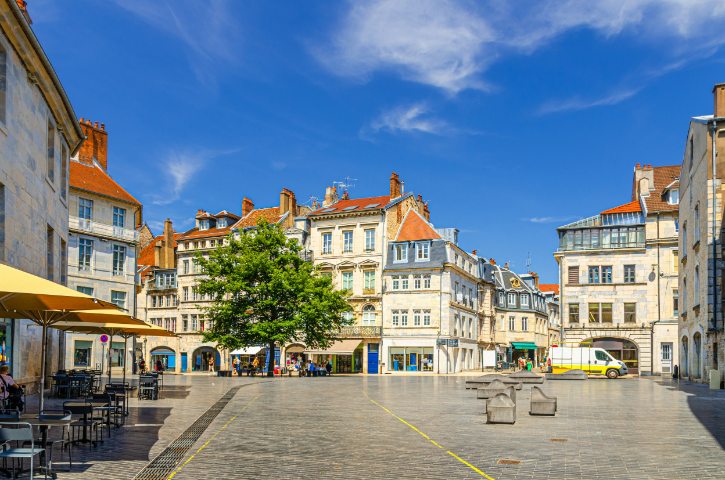
The City That Tells Time
a. A River-Wrapped City
Besançon has one of the most dramatic settings in France. The old town sits inside an almost perfect horseshoe loop of the Doubs River, known as La Boucle. This natural defense was first used by the Romans, then perfected by the architect Vauban, who built the Citadel on the rocky neck of the loop.
b. Its UNESCO Fortifications
- The Citadel and its city walls are inscribed on the UNESCO World Heritage list as part of the Fortifications of Vauban.
- Besançon is also known as the “Capital of Time”, the historic heart of French watchmaking.
c. Why It’s Beautiful
The historic core is quietly handsome, lined with uniform gray and blue-tinted Chailluz stone facades. Beyond the river, the green hills of the Jura rise as a scenic backdrop. If you love history paired with nature, this city suits you well.
d. Key Attractions
- Citadelle de Besançon: Vauban’s masterpiece on the high rock, home to a zoo, a folk museum, and the Museum of Resistance and Deportation. The views are the main draw, though it means walking uphill.
- Musée du Temps: set in the Renaissance Palais Granvelle, telling the story of local watchmaking through chronometers, dials, and workshop tools.
- Saint-Jean Cathedral astronomical clock: a mid-19th-century clock with 70 dials that coordinate 122 separate indicators. Guided visits are available.
- Victor Hugo’s birthplace: the writer’s family home, open as a municipal museum.
e. Watchmaking and Food
- Watchmaking is what makes Besançon different from the other cities here, best explored at the Musée du Temps.
- Local flavors: Morteau and Montbéliard smoked sausages, Comté and Morbier cheeses, and the oxidized “yellow wine” (Vin Jaune) of the Jura.
f. Practical Details
- How long: one to two days to walk up to the Citadel and explore the museums.
- Getting there: TGV from Paris in about 2.5 hours, and a TER to Dijon in about 1 hour.
- Honest note: expect some uphill walking to reach the Citadel.
7. Dinan (Brittany)
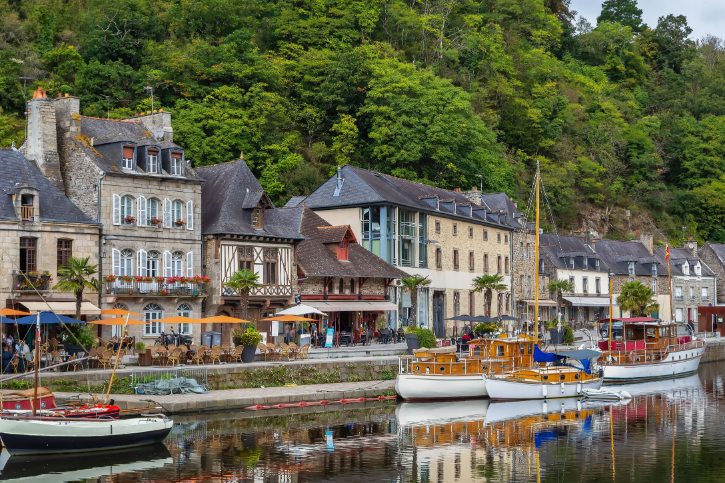
The Medieval Town the Middle Ages Left Behind
a. A Fortified Medieval Town
Dinan sits on a high granite cliff above the Rance River in eastern Brittany. It is wrapped in about 2.7 kilometers of medieval stone ramparts, the oldest and most extensive defensive walls in the region, and holds over 115 historic half-timbered houses.
b. Why It’s Beautiful
The magic is in the steep, cobbled streets and the split between the upper fortified town and a peaceful old port below. The most famous street is the Rue du Jerzual, lined with artisan workshops, stone-and-wood facades, and greenery climbing the ancient walls.
c. Key Attractions
- Rampart walk: sections of the medieval walls give views across the slate roofs and the surrounding Rance Valley.
- Dinan Castle: a 14th-century tower-palace about 45 meters high that once served as a prison and is now a museum of medieval warfare. It is open daily.
- Rue du Jerzual: a steep, cobbled artisan street linking the town to the port. Wear flat, sturdy shoes.
- Tour de l’Horloge: a 15th-century clock tower rising 40 meters, with 158 steps to panoramic views.
- Basilica of Saint-Sauveur: a Romanesque-Gothic church that holds the heart of the Breton hero Bertrand du Guesclin.
- Port of Dinan: a calm, pretty riverside with gentle walks.
d. Food
Crêperies line the Rue du Jerzual and the port, serving savory buckwheat galettes with local Breton cider. For something sweet, try kouign-amann, a caramelized butter pastry, or Breton shortbread.
e. Practical Details
- How long: one full day covers the core, but staying overnight lets you enjoy the quiet port after day visitors leave.
- Getting there: the BreizhGo Line 507 bus from Rennes, in about 1 hour 20 minutes.
- Tip: comfortable shoes make the steep, cobbled streets much easier.
8. Vannes (Brittany)
The Walled City at the Edge of the Sea
a. A Walled Harbor City
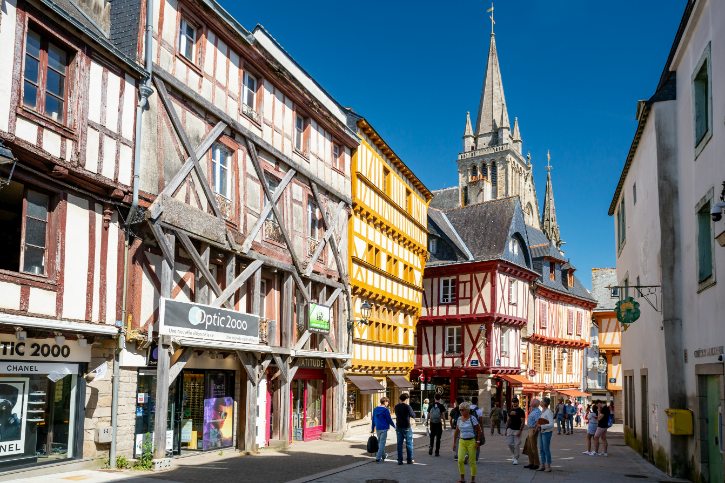
Vannes is a fortified harbor city in southern Brittany, right at the edge of the Gulf of Morbihan. It is a designated “City of Art and History”, blending a walled medieval core with a busy marina that leads into the island-dotted inland sea.
b. Why It’s Beautiful
- The rampart gardens feature manicured lawns and formal flowerbeds along the ancient walls, especially near the Château de l’Hermine.
- Cobbled lanes are lined with colorful, leaning half-timbered houses around Place Henri IV and the Saint-Patern quarter, the oldest neighborhood.
c. Key Attractions
- Historic center: the walled old town, home to “Vannes and his wife”, a 15th-century painted granite bust of a smiling couple carved onto a half-timbered building.
- Cathedral of Saint-Pierre: a gothic cathedral that holds the tomb of the Spanish preacher Saint Vincent Ferrer.
- Rampart gardens: among the prettiest spots in the city, and an easy, relaxed stroll.
- Marina and Porte Saint-Vincent: the southern gate opens onto the marina, with harbor-side cafés overlooking the boats.
- Conleau Peninsula: about 4.5 kilometers from the center, with a sandy beach and a natural saltwater swimming pool.
d. The Gulf of Morbihan
Vannes is a gateway to the Gulf of Morbihan. From here you can take a passenger ferry into the gulf to visit islands such as the Island of Arz or Île-aux-Moines, which turns a one-day visit into a richer two-day trip.
e. Food and Markets
- Halle aux Poissons: an indoor fish market with fresh catches, including native Gulf of Morbihan oysters.
- Halle des Lices: a year-round covered market filled with regional produce, salted butter caramel, kouign-amann, and Breton cider.
f. Festivals
- Vannes Côté Jardin (May): flower displays in the rampart gardens.
- Vannes Echos Jazz (July): free outdoor jazz on the city walls.
- Festival d’Arvor (mid-August): Breton folk dances, costumes, and fireworks.
- Semaine du Golfe (May, every two years): over 1,000 classic sailing vessels.
g. Practical Details
- How long: two days, one for the walled town and one for a boat trip.
- Getting there: TGV from Paris Montparnasse in about 2.5 hours.
9. Pontivy (Brittany)
Napoleon’s Town in the Heart of Brittany
a. Two Towns in One
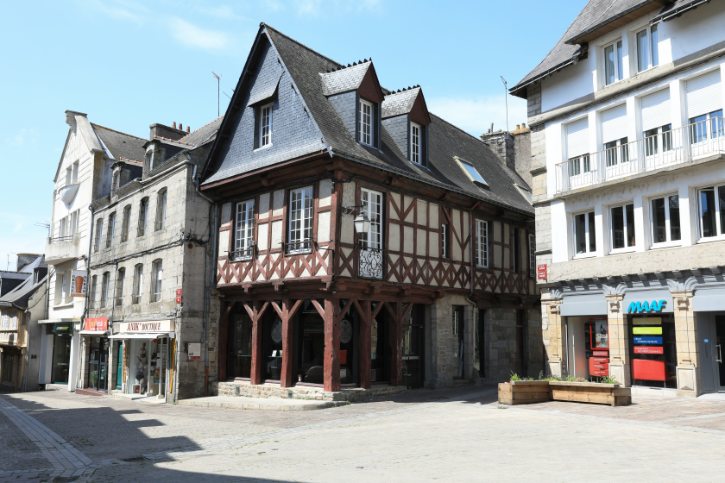
Pontivy sits in inland Brittany, along the Blavet River and the Nantes-Brest Canal. It has a rare double identity: a winding medieval quarter that grew under the House of Rohan, and a rational neoclassical grid designed under Napoleon Bonaparte, who renamed the town “Napoléonville” in 1802.
b. Why It’s Beautiful
The beauty comes from the sharp contrast between the two towns. In the north, winding medieval lanes and overhanging half-timbered houses. In the south, wide, straight avenues lined with grand granite neoclassical facades, including the courthouse, town hall, and old barracks.
c. Key Attractions
- Château des Rohan: a 15th-century fortress with massive circular towers and a moat.
- Medieval quarter: centered on Place du Martray, home to the Maison des Trois-Piliers, the only traditional Breton porched house in the Morbihan department.
- Napoleonic new town: the orderly southern grid that tells the town’s 19th-century story.
- Nantes-Brest Canal and Blavet River: flat, tree-lined towpaths ideal for cycling and walking.
d. History in Brief
Pontivy’s story has two chapters: the medieval heritage of the Rohan family, tied to the castle and old town, and the 19th-century transformation under Napoleon that gave the town its orderly new quarter. Seeing both is the whole point of a visit.
e. Food and Market Life
The food is honestly local rather than touristy. Expect Breton crêpes and galettes de sarrasin, plus real Breton pub culture and cider tastings, since the town stays largely off the mass-tourism path.
f. Practical Details
- How long: half a day to one full day covers both quarters.
- Getting there: rail access is limited, so the town is best reached by car or by regional bus lines linking to Rennes or Vannes.
10. Bayonne (Nouvelle-Aquitaine)
The Basque Soul of Southwest France
a. A Basque Capital
Bayonne sits where the Nive and Adour rivers meet, about 8 kilometers inland from Biarritz. It is the cultural capital of the French Basque Country, blending Gascon elegance with a strong Basque identity, and it is divided into three historic neighborhoods.
b. Why It’s Beautiful
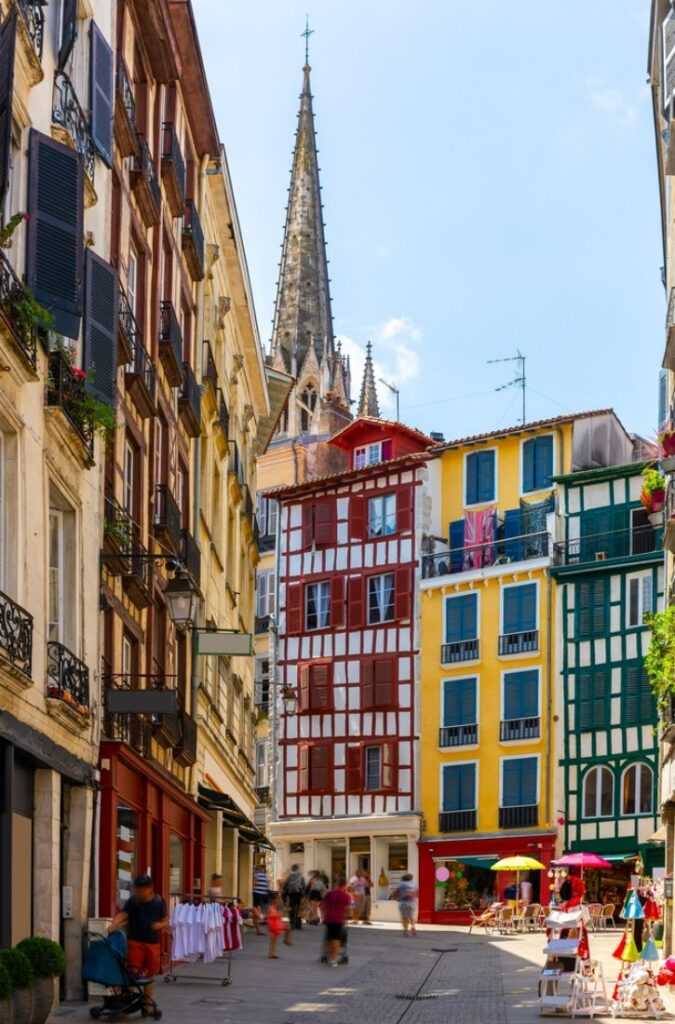
The beauty lies in the tall, narrow waterfront buildings along the Nive. They show classic Basque architecture: white-washed stone walls with painted wooden half-timbering, and shutters in the Basque colors of deep red, green, and blue.
c. Key Attractions
- The three quarters: Grand Bayonne is the historic core, with the Sainte-Marie Cathedral and Château-Vieux. Petit Bayonne is a lively student quarter known for street art and the Musée Basque. Saint-Esprit is the historic Jewish quarter, home to a Vauban Citadel, a synagogue, and the train station.
- Sainte-Marie Cathedral and cloister: a Gothic cathedral whose 13th-century cloister was inscribed as a UNESCO World Heritage Site in 1998.
- Musée Basque: the premier museum dedicated to Basque life, maritime history, and folklore.
d. Food and Chocolate
- Chocolate heritage: Sephardic refugees brought cocoa skills in the 17th century, making Bayonne the historic capital of chocolate in France. Sample it at houses such as Cazenave and L’Atelier du Chocolat.
- Jambon de Bayonne: a salt-cured ham with protected IGP status, seasoned with Espelette pepper.
- Les Halles: a covered market on the Nive where you can taste Ossau-Iraty sheep cheese and Gâteau Basque.
e. Day Trips
Bayonne makes a great base for the Basque coast. Biarritz is only about 8 kilometers away, and both Saint-Jean-de-Luz and San Sebastián are within easy reach.
f. Practical Details
- How long: one to two days, especially with a day trip added.
- Getting there: TGV from Paris Montparnasse in about 4 hours.
- Why it works: you get real Basque atmosphere without staying only on the beach.