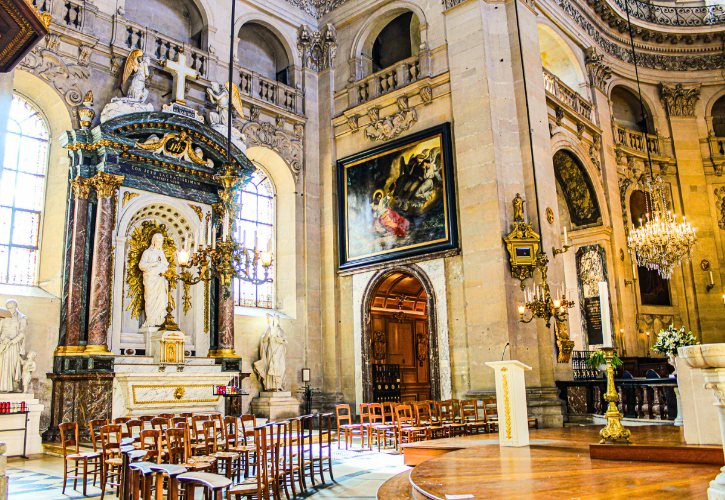
Paris draws millions of visitors every year, and most follow the same path: Notre-Dame, Sacré-Cœur, the Louvre.
But step just slightly off it, and the city opens up. Down quiet streets and tucked behind grander landmarks, you will find churches full of golden domes, twisted stone columns, ancient capitals, and rare stained glass.
Each one holds centuries of overlooked stories. Here are ten that most tourists miss, and why each is worth a small detour.
1. Saint-Pierre de Montmartre Church
a. Why It’s Worth Visiting
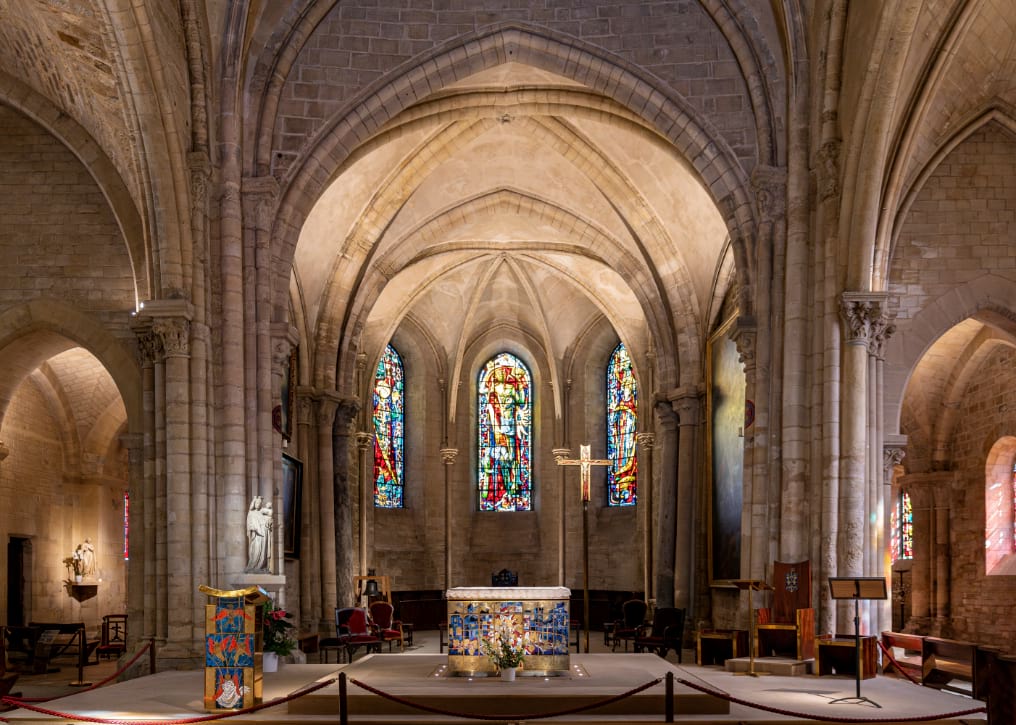
It sits just steps from Sacré-Cœur, yet while crowds climb the basilica’s white steps, almost no one stops here.
That is a shame, because Saint-Pierre is the second oldest surviving church in Paris, and the place where, in 1534, Ignatius of Loyola and his companions took the vows that led to the founding of the Jesuits.
b. What Makes It Unique
Step inside and you walk through more than a thousand years of history in one building.
Roman foundations, Merovingian capitals, a Romanesque choir, and Gothic vaults all sit side by side.
The apse even keeps what is widely considered the oldest pointed arch in Paris.
c. Architecture to Notice
The styles here are a real mix. You will see a Romanesque nave, an early Gothic apse, Flamboyant Gothic vaults, and a Neo-Classical façade from 1765.
Look for the four Roman marble columns topped with 7th-century Merovingian capitals, and the restored Cavaillé-Coll organ.
d. Key Things to Notice Inside
- The Romanesque nave sitting beside the Gothic apse and vaulting.
- The ancient Roman columns with their Merovingian capitals.
- The tomb of Adelaide de Savoie, the abbey’s foundress.
- The Cavaillé-Coll organ and Gismondi’s bronze doors.
e. Practical Information
- Nearest Metro: Abbesses (Line 12) or Anvers (Line 2).
- You will need to walk up the Montmartre hill from the station.
- The entrance hides behind a quiet courtyard, so most people miss it.
f. Combine With
- Sacré-Cœur Basilica, just next door.
- Place du Tertre and its painters.
- Clos Montmartre, the last working vineyard in Paris.
2. Saint-Alexandre-Nevsky Cathedral
a. Why It’s Worth Visiting
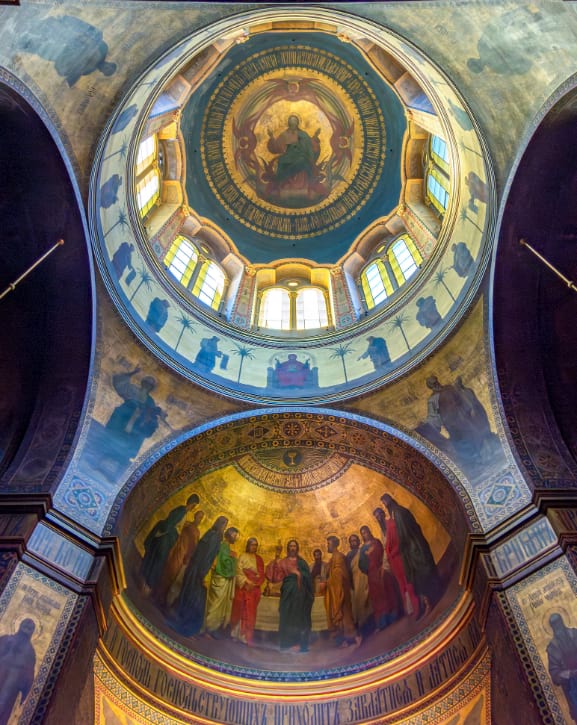
This is the biggest surprise on the list. Saint-Alexandre-Nevsky is the main Russian Orthodox cathedral of Paris, hidden near the Arc de Triomphe, and the only major non-Catholic church here.
It is also where, in 1918, Pablo Picasso married the Russian dancer Olga Khokhlova.
b. What Makes It Unique
Picture five golden onion domes rising above the calm Haussmann rooftops
It feels like a slice of Russia in the heart of Paris, and inside it speaks a completely different visual language from every other church in this guide.
c. Architecture to Notice
The cathedral is built in the Neo-Byzantine Muscovite style, laid out as a Greek cross. The five gilded domes, one central and four around it, instantly recall the classic profile of Russian Orthodox churches.
d. Key Things to Notice Inside
- The rich frescoes, gilding, and icons.
- The central dome, crowned with an icon of Christ.
- Apse paintings by the Russian artist Alexei Bogolioubov.
- The magnificent iconostasis, the screen of icons that separates the nave from the sanctuary.
e. Practical Information
- Nearest Metro: Courcelles or Ternes, both on Line 2.
- It opens to visitors only on select afternoons when no services are taking place, so conditions can vary.
- Approaching from Boulevard de Courcelles gives a lovely first view of the domes.
f. Combine With
- Parc Monceau and its elegant lawns.
- The Arc de Triomphe and Champs-Élysées.
- The Musée Jacquemart-André, a short stroll away.
3. Saint-Roch Church
a. Why It’s Worth Visiting
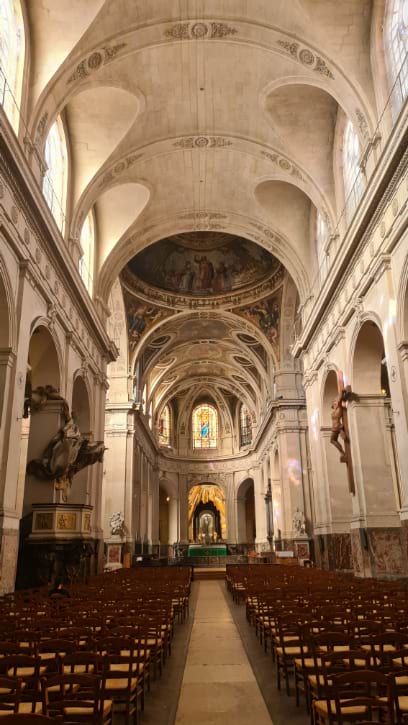
Saint-Roch is a major church hiding in plain sight, just a short walk from the Louvre. It is often called the artists’ church of Paris, and its vaults hold the graves of Corneille, Le Nôtre, and Diderot.
Its most dramatic moment came in 1795, when a young Napoleon Bonaparte ordered cannon fire on royalist insurgents from these steps.
b. What Makes It Unique
Step inside and it feels almost like a museum, filled with artworks rescued from churches destroyed during the Revolution.
The interior runs a remarkable 126 meters, with five chapels built end to end, making it one of the largest churches in Paris.
c. Architecture to Notice
The church blends a calm classical nave with a richer Baroque choir. The highlight is the Chapelle de la Vierge, the Virgin Chapel, with its oval dome crowned by Jean-Baptiste Pierre’s fresco, The Triumph of the Virgin.
d. Key Things to Notice Inside
- The Chapelle de la Vierge and its oval dome fresco.
- Artworks rescued from demolished Revolutionary-era churches.
- The historic grand organ.
- The patched bullet marks on the façade steps, the trace of Napoleon’s 1795 cannonade.
e. Practical Information
- Nearest Metro: Pyramides (Line 14) or Tuileries (Line 1).
- The parish offers free guided tours.
- It stands on a famous designer shopping street, so most passersby never look inside.
f. Combine With
- The Louvre and the Tuileries Garden.
- The Palais-Royal.
- The shopping of Rue Saint-Honoré and Place Vendôme.
4. Saint-Nicolas-des-Champs Church
a. Why It’s Worth Visiting
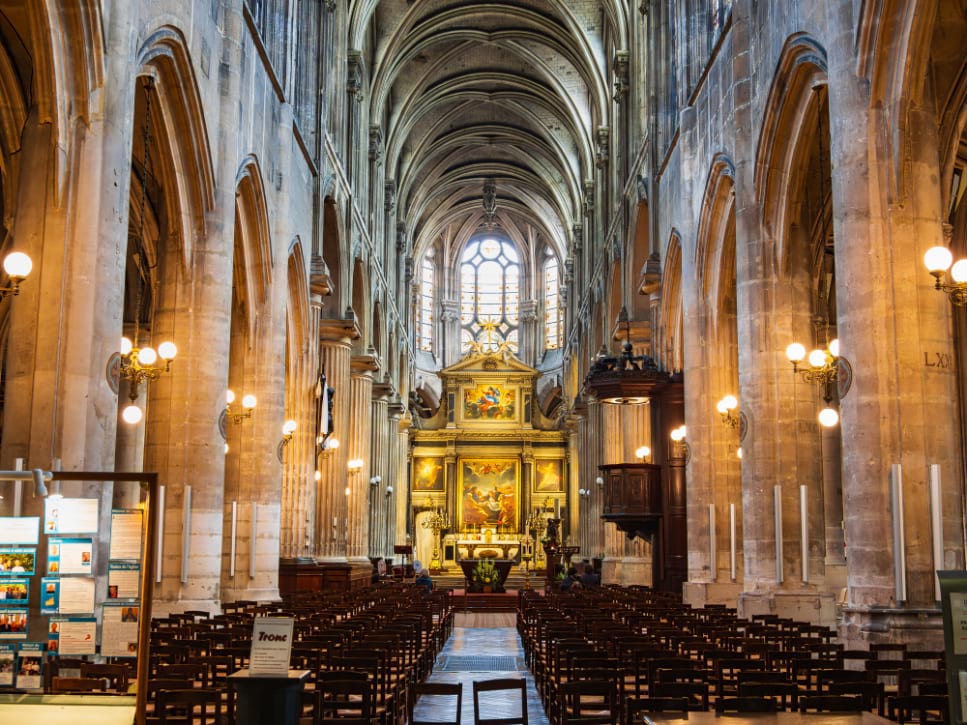
Here is a place you might judge too quickly from the street. It looks modest outside, but inside waits an exceptional collection of 17th-century paintings.
Its great treasure is a monumental altarpiece by Simon Vouet, around 12 meters high, which stayed in place right through the Revolution.
b. What Makes It Unique
The church is a living record of three building eras at once. Walk down the nave and you watch one style hand over to the next. It also has a touching link to Louis Braille, who served as the organist here.
c. Architecture to Notice
You can see a Flamboyant Gothic west front, a French Renaissance south portal, and a 17th-century Classical choir. Inside, 25 large windows flood the space with a warm, luminous light.
d. Key Things to Notice Inside
- Simon Vouet’s Assumption of the Virgin altarpiece, still in its original place.
- The gallery organ, the very instrument Louis Braille played.
- The visible shift from Gothic arches to grooved Classical columns near the altar.
e. Practical Information
- Nearest Metro: Arts-et-Métiers (Lines 3 and 11) or Réaumur-Sébastopol (Lines 3 and 4).
- The Renaissance south portal on Rue Cunin-Gridaine is a beautiful entrance, easy to miss from the main street.
f. Combine With
- The Musée des Arts et Métiers, in the old abbey buildings this church once served.
- The northern edge of the Marais.
- The Centre Pompidou (temporarily closed) and market street Rue Montorgueil.
5. Saint-Gervais-Saint-Protais Church
a. Why It’s Worth Visiting
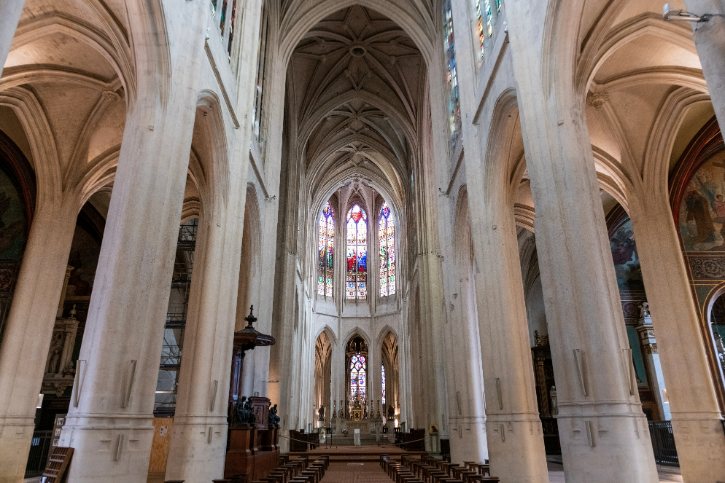
This church stands on one of the oldest continuously sacred sites in Paris. It has a curious split personality too: from the front it looks Classical, but from behind it looks Gothic.
It also has a strong musical legacy, since the famous Couperin family served as organists here for generations.
b. What Makes It Unique
The west façade by Salomon de Brosse was the first monumental church front in Paris to use all three classical orders, stacked from bottom to top: Doric, Ionic, and Corinthian. It became a model for French church design.
c. Architecture to Notice
Behind that calm front sits a Flamboyant Gothic nave and choir with stained glass from several centuries. Do not miss the Chapelle Dorée, the Golden Chapel, a small jewel-box space in Louis XIII style.
d. Key Things to Notice Inside
- The three-tiered façade and its three orders of columns.
- The Chapelle de la Vierge and its hanging keystone, around 2.5 meters across.
- The 1531 window La Sagesse de Salomon, in exceptional condition.
- The historic 1601 organ, one of the oldest in Paris.
e. Practical Information
- Nearest Metro: Hôtel de Ville (Lines 1 and 11).
- Approaching along Rue des Barres gives a wonderful medieval view of the Gothic transept.
- This is an active church with a living monastic community, the Jerusalem Community.
f. Combine With
- The Hôtel de Ville and the wider Marais.
- Place des Vosges and the Centre Pompidou.
- A stroll down Rue des Barres.
6. Saint-Paul-Saint-Louis Church
a. Why It’s Worth Visiting
Saint-Paul-Saint-Louis is the first Jesuit church in Paris, and the first in the city to leave Gothic design behind for the bold new Baroque style. Cardinal Richelieu celebrated the inaugural Mass here in 1641.
b. What Makes It Unique
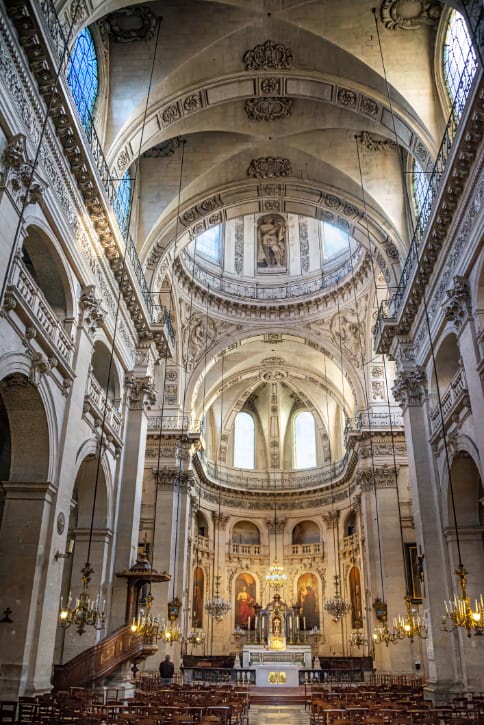
Its great feature is a soaring dome, one of the earliest and largest built in Paris. It became a direct model for the domes of the Sorbonne, Val-de-Grâce, and Les Invalides.
Inside hangs Eugène Delacroix’s Christ in the Garden of Olives, one of his rare religious works.
c. Architecture to Notice
The church follows a Latin cross plan, with a single wide nave lined by chapels and a large dome above the crossing. The three-level façade rises with Corinthian columns and niches.
d. Key Things to Notice Inside
- The dome above the crossing. Step into the center and look up.
- Delacroix’s Christ in the Garden of Olives in the transept.
- The grand organ from 1867, whose case is a listed Historic Monument.
- The two holy water stoups made from giant clam shells, a gift from Victor Hugo.
e. Practical Information
- Nearest Metro: Saint-Paul (Line 1).
- The church faces a busy street, so it is easy to walk past without looking up.
- Step back across the road to take in the full three-level façade.
f. Combine With
- Place des Vosges and the Village Saint-Paul.
- The Marais Jewish Quarter around Rue des Rosiers.
- The Carnavalet Museum and the Hôtel de Sully.
7. Saint-Louis-en-l’Île Church
a. Why It’s Worth Visiting
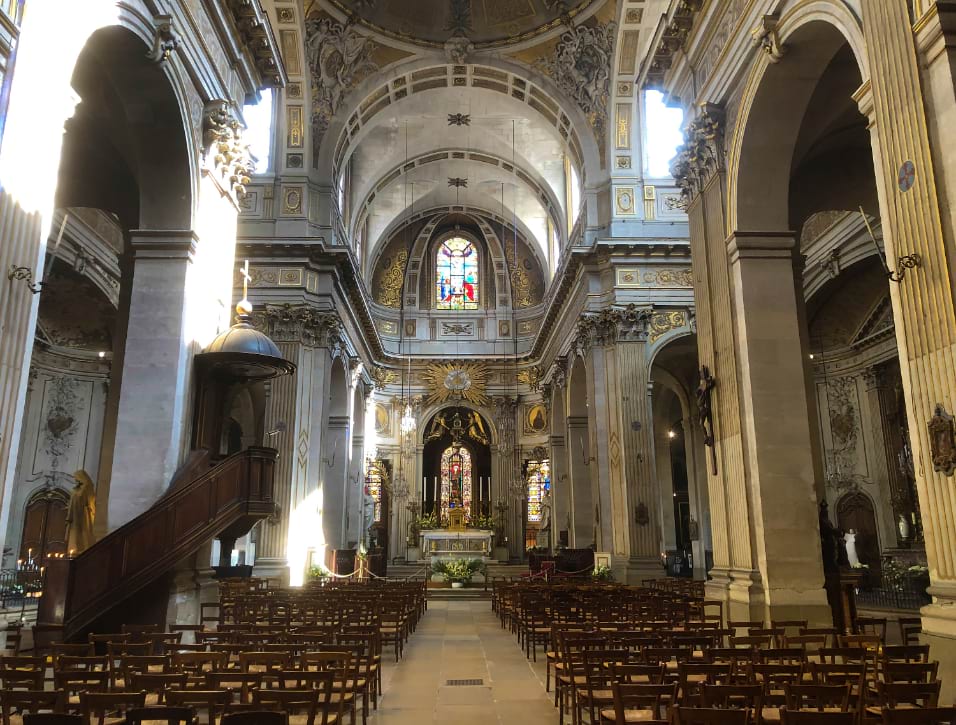
This one hides in plain sight on Île Saint-Louis, tucked into a narrow island street where many visitors simply walk past. The plain outside is part of the magic: because the exterior is so sober, the rich Baroque interior feels like a genuine discovery.
b. What Makes It Unique
Saint-Louis-en-l’Île is the only 17th-century church in Paris to pair a traditional Gothic floor plan with Italian Baroque decoration.
It is also a celebrated venue for sacred music, thanks to a 2005 organ by Bernard Aubertin, considered one of the finest in Paris.
c. Architecture to Notice
The sober stone exterior gives way to an interior full of 19th-century gilding, marble, and paintings. Outside, look up for the distinctive openwork iron clock from 1765.
d. Key Things to Notice Inside
- The ornate, gilded Baroque interior, all the more striking after that plain façade.
- The 2005 Aubertin organ.
- The Chapel of Saint Louis, dedicated to the crusader king.
- A plaque linking the church to Saint Louis, Missouri, named after its patron saint.
e. Practical Information
- Nearest Metro: Pont-Marie or Sully–Morland, both on Line 7.
- The church regularly hosts concerts, and guided visits are available.
- It is squeezed between buildings on Rue Saint-Louis-en-l’Île, so it is genuinely easy to miss.
f. Combine With
- A treat at the original Berthillon ice cream shop.
- A walk to the Île de la Cité for Sainte-Chapelle and Notre-Dame.
- The quiet Seine riverbanks.
8. Saint-Julien-le-Pauvre Church
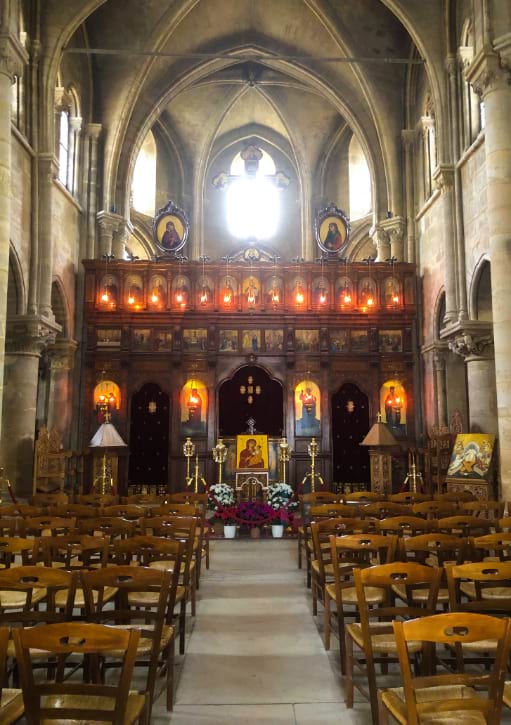
a. Why It’s Worth Visiting
Saint-Julien-le-Pauvre is one of the oldest surviving churches in Paris, built at almost the exact moment work began on Notre-Dame.
What makes it special is that, since 1889, it has followed the Byzantine Melkite Greek Catholic rite, which makes it truly unusual in the center of Paris.
b. What Makes It Unique
Its centerpiece is a beautiful wooden iconostasis, the screen of icons that separates the nave from the altar in Eastern worship.
There is no Western-style organ here, and the music is purely vocal, drawing on ancient Near Eastern chant.
c. Architecture to Notice
The building blends Romanesque and Gothic elements. From the leafy square outside, you can admire the large Romanesque buttresses. Inside, look down for a Roman paving stone set into the floor.
d. Key Things to Notice Inside
- The wooden iconostasis and its central Royal Doors.
- The carved capitals decorated with harpies, mythical half-woman, half-bird figures.
- A 14th-century bas-relief on Rue Galande showing the legend of Saint Julian.
e. Practical Information
- Nearest Metro: Saint-Michel (Line 4) or Cluny–La Sorbonne (Line 10).
- RER access: Saint-Michel–Notre-Dame (RER B and RER C).
- The church regularly hosts classical concerts, thanks to its warm acoustics.
f. Combine With
- Saint-Séverin Church, just around the corner.
- Square René Viviani, home to the oldest tree in Paris and a fine view of Notre-Dame.
- Shakespeare and Company and the wider Latin Quarter.
9. Saint-Séverin Church
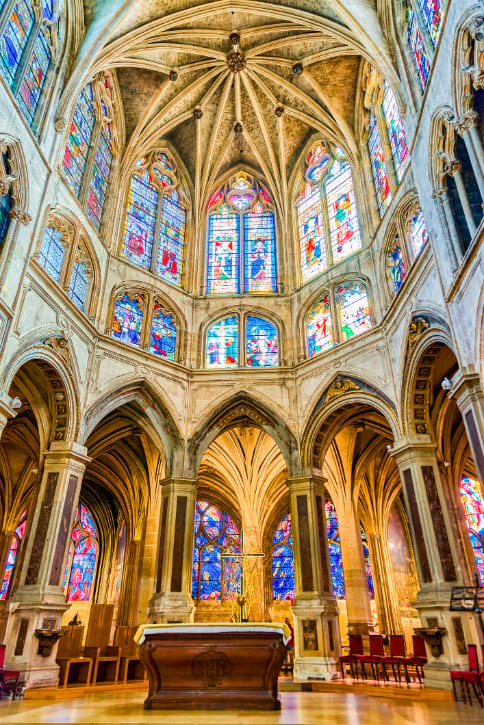
a. Why It’s Worth Visiting
Saint-Séverin is a Flamboyant Gothic masterpiece hidden in plain sight in the Latin Quarter, just steps from the busy restaurants around Rue de la Huchette.
It is one of the most complete examples of Gothic architecture in Paris, and you get it without the crowds.
b. What Makes It Unique
The showstopper is the famous twisted spiral column in the ambulatory, where the stone ribs of the vaulting fan upward like the branches of a palm tree. It is one of the most admired Gothic details in all of Paris.
c. Architecture to Notice
Built and reshaped between the 13th and 16th centuries, the church pairs medieval stained glass with seven abstract modern windows by Jean Bazaine from 1970. Seeing medieval and modern glass share one space is quietly thrilling.
d. Key Things to Notice Inside
- The twisted spiral column, and how the vaulting fans out from it.
- The medieval stained-glass panels showing the lives of the Apostles.
- The seven Jean Bazaine windows and their vivid abstract color.
- The exterior gargoyles and the sharp Gothic steeple.
e. Practical Information
- Nearest Metro: Saint-Michel (Line 4) or Cluny–La Sorbonne (Line 10).
- RER access: Saint-Michel–Notre-Dame (RER B and RER C).
- The church sits one block back from the busy streets, so it is easy to walk right past.
f. Combine With
- Saint-Julien-le-Pauvre, a few steps away.
- The exterior of Notre-Dame Cathedral.
- Shakespeare and Company and the cafés along Rue de la Huchette.
10. Saint-Étienne-du-Mont Church
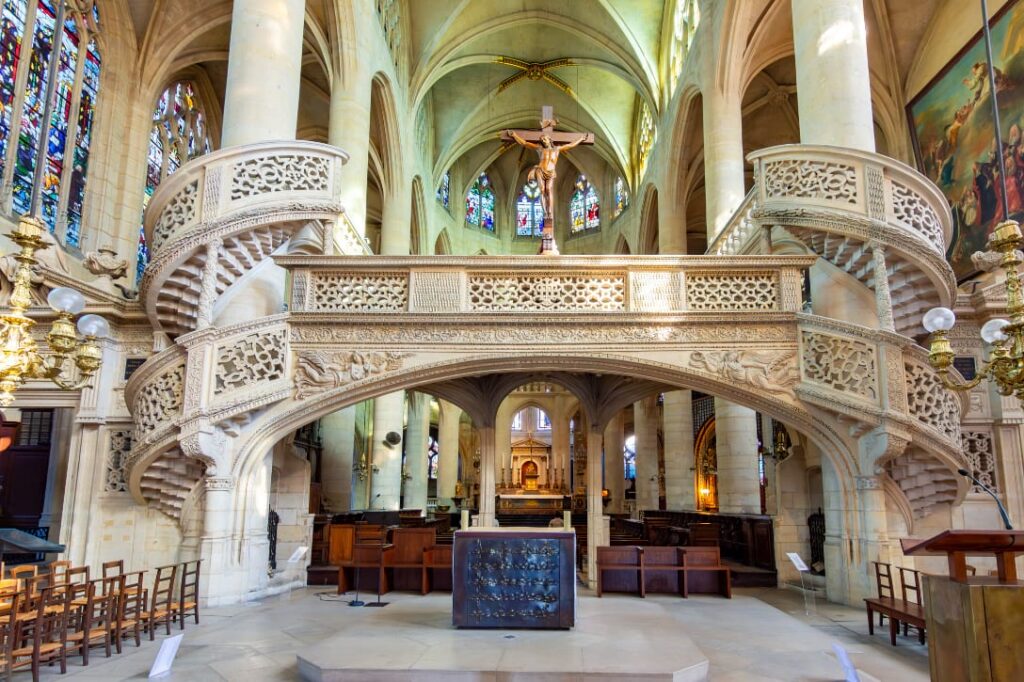
a. Why It’s Worth Visiting
Saint-Étienne-du-Mont might be the strongest hidden gem of them all. It holds the shrine and relics of Sainte-Geneviève, the patron saint of Paris, and is a resting place for both Blaise Pascal and Jean Racine. Film fans may recognize its steps from Woody Allen’s Midnight in Paris.
b. What Makes It Unique
The great treasure here is the rood screen, or jubé, the last one still standing in Paris. Built around 1545, it is a delicate Renaissance stone bridge that spans the width of the nave, and it survived where almost all the others were torn down.
c. Architecture to Notice
The church blends Gothic and Renaissance architecture, visible on both the façade and inside. It is designed as a hall church, with side aisles that rise to the same height as the central nave, keeping the interior bright and airy.
d. Key Things to Notice Inside
- The rood screen, with its twin spiral staircases.
- The shrine of Sainte-Geneviève, with a gilded reliquary holding a fragment of her sarcophagus.
- The tombs of Pascal and Racine, marked by simple plaques.
- The great organ, whose carved case is the oldest in Paris.
e. Practical Information
- Nearest transport: Cardinal Lemoine (Line 10) or Luxembourg (RER B).
- The Panthéon gets all the attention, but this nearby church may feel like the quieter highlight.
f. Combine With
- The Panthéon and the Lycée Henri-IV.
- The Clovis Tower, the old abbey bell tower.
- The lively Rue Mouffetard market street and the Luxembourg Garden.