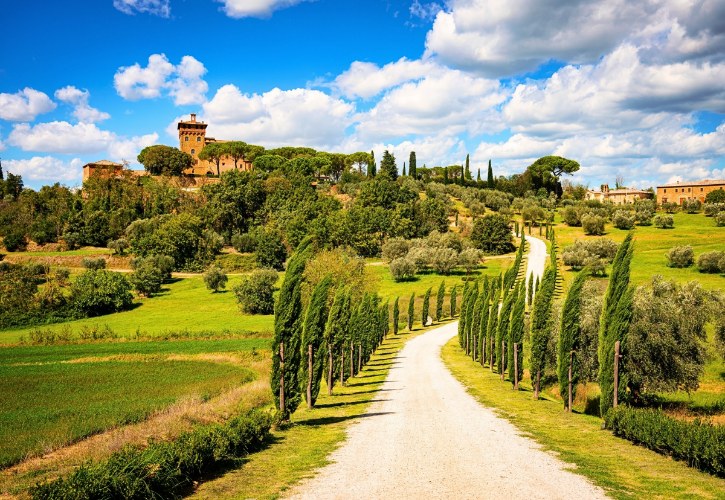
You already know Italy’s big cities. But it is the small towns that tend to stay with you. Picture narrow stone lanes, pastel walls glowing at sunset, and views that open onto hills, cliffs, and sea.
Life here moves slowly, built around morning coffee, evening strolls, and food made the way it always has been. These are the places where you slow down, breathe out, and fall a little in love along the way. 😊
1. Pienza (Tuscany)
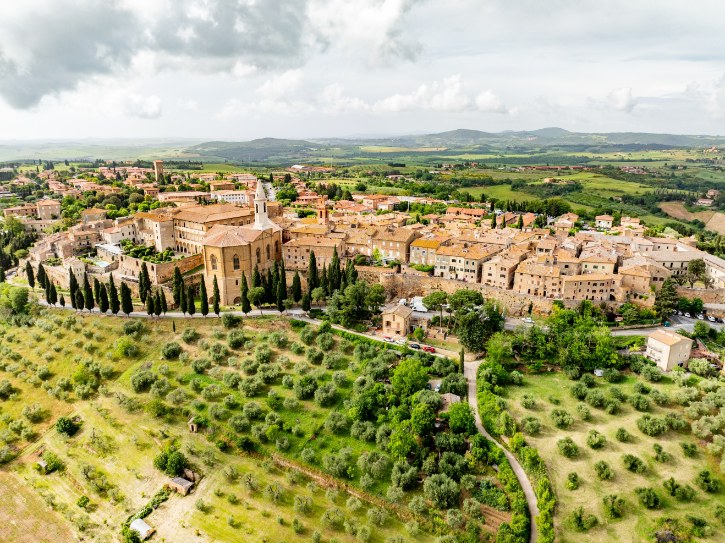
a. The Little Town a Pope Rebuilt From Scratch
Pienza began as a humble village until a local boy became Pope Pius II and decided to turn his birthplace into something beautiful. He hired a Renaissance architect to redesign the whole center around one carefully planned square. You can still feel that sense of order the moment you walk in.
b. The Square Designed to Trick Your Eye
The main square, Piazza Pio II, was shaped to make the cathedral look grander than it really is. Around it you will find:
- The Duomo di Pienza, with a bright, airy interior
- Palazzo Piccolomini, the pope’s own residence, with its hanging garden
- Palazzo Borgia, the old bishop’s palace
- The town hall, with a stone portico and a low clock tower
- Red herringbone brick paving that quietly ties it all together
c. Where the Countryside Opens Up
Pienza sits on a ridge, so the views are a big part of the experience.
- Walk Via del Casello, a raised path along the old walls, for the best panorama
- Look out over rolling clay hills, lone cypress trees, and golden fields
- Spot the distant cone of Monte Amiata on the horizon
- Come at early morning or late afternoon, when the light is softest
d. Cheese Wheels and Streets Named for Love
Pienza is cheese country, and its lanes have a romantic side too.
- Taste Pecorino di Pienza, a sheep’s milk cheese from the local hills
- Try it young and soft, or aged, sharp, and wrapped in walnut leaves
- Visit in September for the Fiera del Cacio, where players roll cheese wheels across the square
- Wander Via dell’Amore and Via del Bacio, sweetly named alleys that end in a wide valley view
Read More: A Beautiful Tuscany Road Trip With 17 Amazing Stops
2. Polignano a Mare (Puglia)
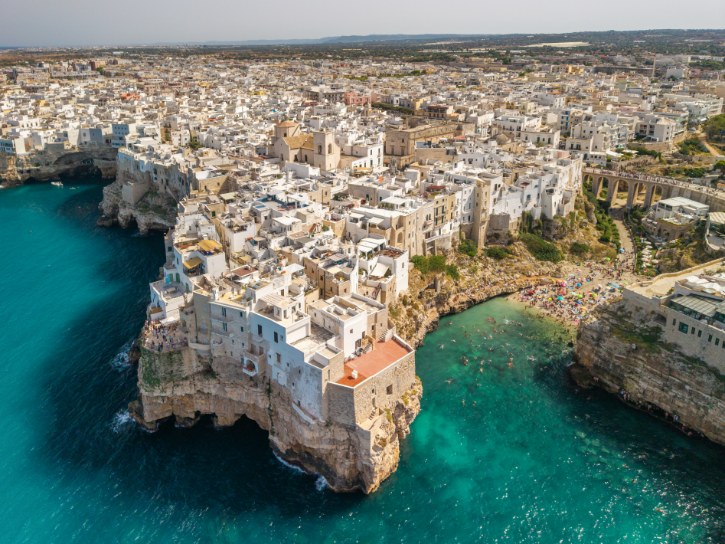
a. A White Town Balanced on the Cliffs
Polignano a Mare sits on a wall of limestone that drops straight into the Adriatic. The waves have carved caves and arches right beneath the houses. You enter the old town through a 16th century gate and quickly lose yourself in a maze of whitewashed alleys. Some of them simply stop at the cliff edge, where the sea opens up below you.
b. The Beach Tucked Beneath a Roman Bridge
The signature sight is Lama Monachile, a narrow cove framed by tall cliffs.
- A tall stone bridge, built in the early 1800s in the Bourbon era, arches high above the beach
- The water shifts between emerald and deep blue
- The shore is smooth pebbles, so wear sturdy shoes
- It gets busy in summer, so early morning or late spring is calmer
- The view down from the bridge is the one you will remember
c. Poetry on the Walls and a Famous Song
This town has a creative streak you will notice as you walk.
- A local writer has painted poems and quotes across walls, doors, and steps
- Polignano is the birthplace of Domenico Modugno, who sang the world famous “Volare”
- A bronze statue of him stands on the waterfront, arms spread wide toward the old town
- You can still enjoy the spot even if the singer’s name is new to you
d. A Coffee You Can Only Really Get Here
Before you leave, track down the town’s own drink, the caffè speciale.
- It layers fresh espresso, sweet cream, lemon peel, and almond liqueur in one small glass
- The taste balances bitter, nutty, and citrus notes in every sip
- It makes the perfect pause between walks through the old town
- As evening comes, join the locals strolling the lanes and gathering on the sea terraces
Read More: The Best Puglia Road Trip: 15 Amazing Stops
3. Taormina (Sicily)
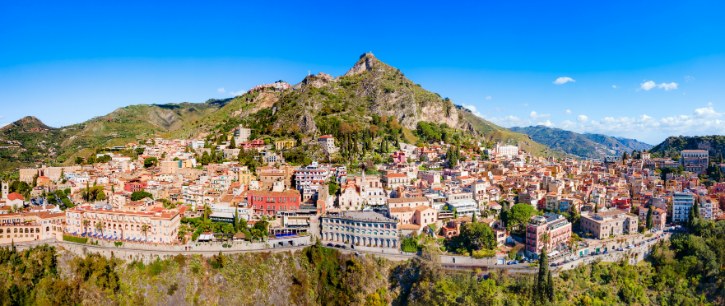
a. Sicily’s Balcony Above the Sea
Taormina sits high on a hillside, spread across steep terraces facing the Ionian Sea. Behind the town rises the active volcano Mount Etna, often trailing a plume of steam. Warm roofs, pink marble, and tumbling bougainvillea frame that view, and it is genuinely hard to look away.
b. An Ancient Theatre With a Volcano View
The town’s crown is the Teatro Antico, carved into the hillside long ago.
- The Greeks built it, and the Romans later reworked it
- A gap in the old stage wall perfectly frames Etna in the distance
- It still hosts concerts, festivals, and film screenings
- The main seating gives you one of the best views in Sicily
c. Strolling the Main Street and Its Hidden Lanes
The heart of town is the pedestrian street Corso Umberto I.
- It runs between two old gates, lined with shops and cafes
- Stop at Piazza IX Aprile, a terrace hanging over the sea
- Look for the clock tower and the old fortified mansion along the way
- Slip into the narrow side lanes, including one of the slimmest in Italy
- These quiet corridors show you the softer side of Taormina
d. Down to the Water at Isola Bella
Below the cliffs lies Isola Bella, a tiny rocky islet ringed by clear water.
- A thin strip of pebbles links it to the shore, and the tide can cover it
- It is now a protected nature reserve
- A cable car whisks you down from the hilltop in minutes
- Sandy beaches stretch out at nearby Giardini Naxos
e. A Garden Made by an English Lady
For a quiet moment, head to the Villa Comunale, public gardens created by an English naturalist who made Taormina her home.
- The grounds are filled with cypresses, bougainvillea, and rare plants
- Quirky little brick pavilions dot the paths, once used for bird watching
- Wide walkways run along the cliff edge, with shaded benches and open views over the bay
- After the busy main street, it feels like a cool, calm breath
Read More: This Sicily Road Trip Connects 17 of the Island’s Most Beautiful Places
4. Alberobello (Puglia)
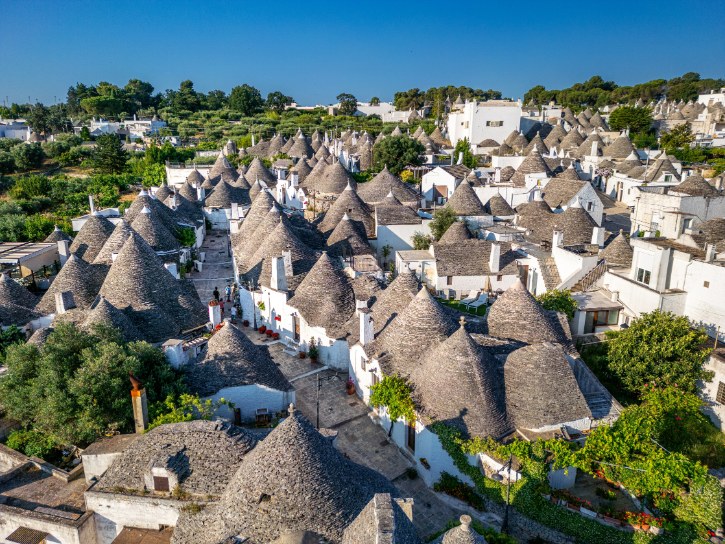
a. The Town of Little Stone Cones
Alberobello looks like a storybook. Its streets are filled with trulli, small white houses topped with cone shaped stone roofs. They were built without any mortar, using a very old drystone technique, and nothing quite like them exists anywhere else.
b. How the Trulli Came to Be
There is a clever story behind all those mortarless walls.
- A local count ordered homes built without mortar so they could be pulled down fast
- That let the village dodge taxes whenever inspectors came
- Each roof is topped with a carved stone tip
- Many carry old painted symbols, a mix of pagan and Christian signs
- More than 1,500 trulli are now protected as a World Heritage site
c. Two Quarters, Two Moods
The old town splits into two districts, and each feels different.
- Rione Monti is busier, full of shops, workshops, and tasting terraces
- Rione Aia Piccola is quieter, with private family homes and no shop signs
- Walking both lets you see the lively and the lived in sides together
- Remember these are real homes, so explore with respect
d. The Trulli Worth Seeking Out
A few standout spots reward a short walk.
- Trullo Sovrano, the only two story trullo, with a sweeping inner staircase
- Chiesa di Sant’Antonio, a church built in the trullo style with a tall cone
- Belvedere Santa Lucia, a lookout over a whole sea of gray stone roofs
e. What to Taste Between the Lanes
The food here celebrates the local countryside.
- Hand rolled orecchiette pasta with bitter greens or a slow cooked meat sauce
- Fresh, creamy burrata and other local cheeses
- Crisp ring shaped taralli and cured meats
- Full bodied regional reds like Primitivo
5. Tropea (Calabria)
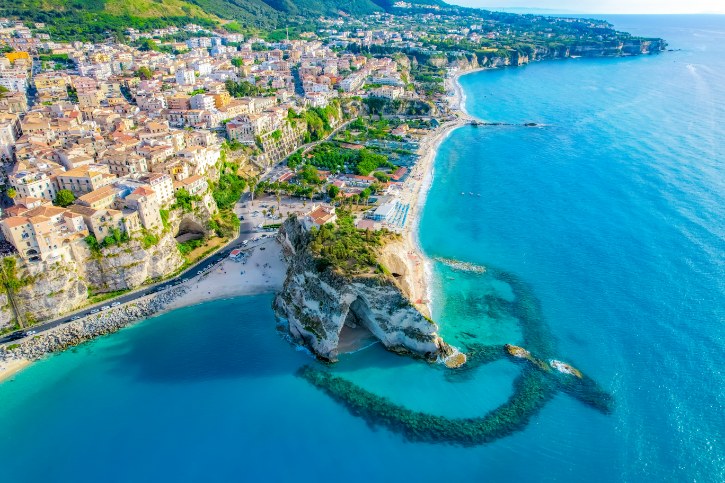
a. A Clifftop Town Over Turquoise Water
Tropea sits atop a tall sandstone cliff on Calabria’s Coast of the Gods. The warm toned rock meets clear turquoise water in a view that stops you in your tracks. Below the town lie beaches of pale sand, reached by steep stairways carved into the cliff face.
b. The Church on the Rock
The town’s most famous landmark is the Sanctuary of Santa Maria dell’Isola, perched on a rocky point below the cliffs.
- It was once a true island before sand slowly joined it to the beach
- You reach it by a staircase cut into the rock, built in the early 1800s
- A garden of cacti, olive trees, and bougainvillea surrounds the top
- The views back toward the old town are worth every step
c. The Best Spots to Drink in the View
Several balconies line the edge of the cliff.
- Balconata di Corso Vittorio Emanuele, looking straight over the sea
- Belvedere Rico Ripa, framing the sheer cliff drops
- Largo Villetta, with sightlines toward distant volcanic islands on clear days
d. The Sweet Red Onion Everyone Talks About
Tropea’s flavor is tied to one special ingredient, its famous sweet red onion.
- Grown on the sandy coastal terraces, it is crisp and genuinely sweet
- You will find it in jams, tarts, salads, and even gelato
- Local shops also sell the spicy spreadable sausage called ‘nduja
- Pottery and hand painted ceramics fill the old storefronts
e. Evenings You Won’t Want to Rush
Tropea keeps an easy southern rhythm. Mornings move slowly around espresso bars, afternoons grow quiet in the heat, and the town wakes again at dusk. The sunset sets the cliffs glowing amber, and on clear days you can watch the sun sink behind a distant volcano. As night falls, the lanes fill with the lively hum of the evening stroll.
6. San Gimignano (Tuscany)
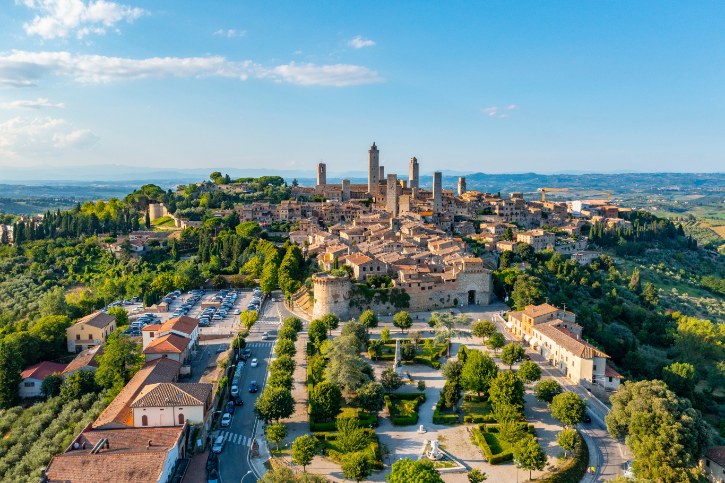
a. The Medieval Skyline of Towers
San Gimignano is famous for its skyline of stone towers, earning it the nickname of the town of beautiful towers. Rival families once competed to build the tallest, partly for defense and partly to show off. Of the many that once rose here, fourteen still stand, forming one of the best preserved medieval skylines in Europe.
b. The Towers That Still Stand
A few are worth knowing by name.
- Torre Grossa, the tallest, which you can usually climb for rooftop views
- Torre Rognosa, once used as the town prison
- Torre del Diavolo, tied to an old local legend
- For the best photos, head to the fortress park or the surrounding olive trails
c. Two Squares at the Heart of Town
Life here centers on two connected squares, and you can take them both in on one easy, flowing walk.
- Piazza della Cisterna, a triangular space around an old stone well
- Piazza del Duomo, the grander civic and religious heart
- The Collegiata church frames one side, with old town palaces all around
- Medieval towers rise over the rooftops as you move between them
- The feel shifts from open marketplace to formal, monumental space
d. Frescoes Hidden Inside the Churches
Step inside and you will find real artistic treasure.
- The Collegiata is covered in colorful medieval fresco cycles
- One chapel holds early Renaissance frescoes showing the local patron saint
- The Chiesa di Sant’Agostino tells the life of Saint Augustine across many scenes
- These add a rich layer of culture beyond the towers and streets
e. A Glass of Wine and a Scoop of Gelato
The town has deep food and wine roots you can taste as you go.
- Sip Vernaccia di San Gimignano, a crisp white with a bitter almond finish
- Look for local saffron, which once helped pay for all those towers
- Visit the celebrated gelato shop on the main square for inventive flavors
- Between the famous sights, these small tastes bring local life to you
7. Bosa (Sardinia)
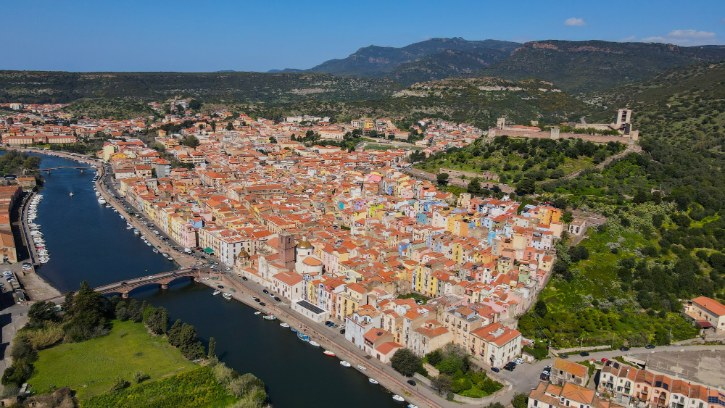
a. The Rainbow Houses by the River
Bosa rises along a river on Sardinia’s western coast, and what you notice first is color. Rows of narrow houses in terracotta, ochre, blue, and rose climb the hillside. That riverside setting gives it a character all its own, with pastel walls reflecting in the slow moving water.
b. The Castle Watching From Above
High over the town stands Castello Malaspina, a medieval fortress ringed by old towers.
- The climb up through the stepped alleys rewards you with sweeping views
- From the walls you see terracotta roofs, the winding river, and the hills
- Inside sits a small chapel with striking late medieval frescoes
c. Wandering the Old Quarter
The medieval soul of Bosa lives in the hillside quarter called Sa Costa.
- Narrow passages and stone stairs are cut right into the rock
- Cars cannot reach these upper lanes, so they stay quiet
- You will often see locals working on crafts in open doorways
- Down by the river, a tile domed cathedral and old tanneries add to the scene
d. What to Taste and Take Home
Bosa’s specialties set it apart from the rest of Sardinia.
- Malvasia di Bosa, a rare amber dessert wine with notes of apricot and honey
- A delicate hand knotted lace made by local women, a craft passed down for generations
- Seasonal seafood and hearty coastal dishes along the water
Read More: The Best Sardinia Road Trip: 17 Amazing Stops Along One Incredible Route
8. Spello (Umbria)
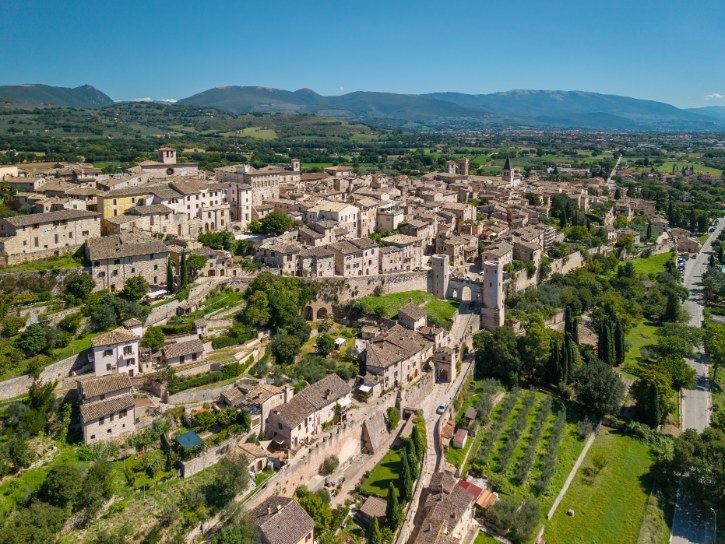
a. Umbria’s Town of Flowers
Spello climbs the lower slopes of Mount Subasio and is loved as the town of flowers. Locals decorate their stone alleys, staircases, and balconies with geraniums and herbs for friendly competitions. The old town is built from pale stone quarried on Mount Subasio, the same mountain behind neighboring Assisi, and it warms to a soft rose tone in the afternoon light.
b. The Flower Festival Worth Planning Around
Spello’s biggest moment is Le Infiorate di Spello, held in late spring.
- Artists gather petals for months, then work through the night
- They lay carpets of flowers stretching nearly 1.5 kilometers through the streets
- The designs show religious scenes and intricate geometric patterns
- A procession walks over them the next morning
- Note that flower displays peak in late spring and early summer, not all year
c. Roman Gates and Pink Stone Streets
Spello began as an ancient Umbrian settlement and later became the Roman colony of Hispellum, and its Roman bones still show.
- Enter through Porta Consolare, a grand Roman gate topped with statues
- Climb to Porta Venere, flanked by twin twelve sided towers
- Follow the lanes uphill toward a belvedere over the plain
- Walking from the bottom up slowly reveals each layer of history
d. A Renaissance Treasure Inside the Church
Spello’s artistic highlight waits inside the church of Santa Maria Maggiore.
- The Cappella Baglioni was frescoed by the Renaissance master Pinturicchio
- He even slipped a self portrait into one of the painted scenes
- Overhead, seated figures fill the vaults in rich color
- The floor still keeps its original glazed tiles
- It is a small space, but packed with detail worth lingering over
e. Quiet Lanes and Golden Olive Oil
Spello has a calm feel that sets it apart from busier towns nearby.
- Most visitors cluster around the main church, so the upper lanes stay peaceful
- The surrounding slopes produce excellent extra virgin olive oil
- In November, local mills celebrate the fresh harvest with tastings on warm bread
- Wander slowly, admire the flowers in season, and let the scenery do the rest
9. Montepulciano (Tuscany)
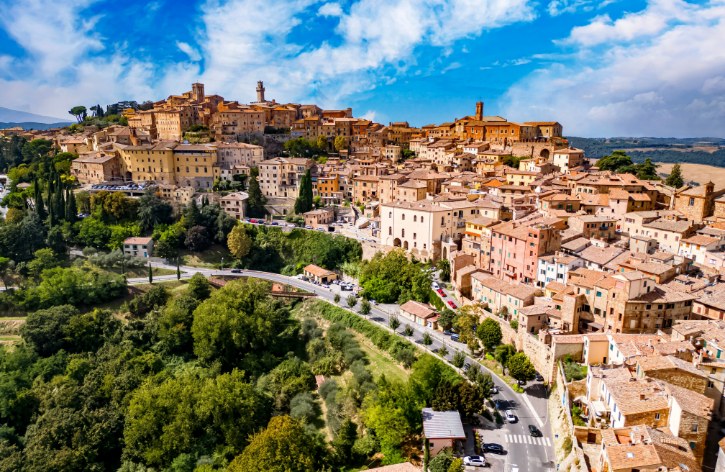
a. A Renaissance Town Along a High Ridge
Montepulciano runs along a high ridge between two Tuscan valleys. Under the Medici dukes, the old fortress town blossomed into a showcase of Renaissance palaces and squares. The reward for climbing its steep streets is a mix of grand architecture and wide country views.
b. The Climb Up the Main Street
The main street climbs steadily toward the top of town.
- It changes name as it rises, so follow it upward and enjoy the journey
- Pass a palace whose base is set with ancient Etruscan and Roman urns
- Reach Piazza Grande, the grand square at the summit
- Take in the unfinished cathedral and the elegant palaces that frame it
c. Wine Cellars Beneath the Palaces
Montepulciano is the home of the prestigious red wine Vino Nobile di Montepulciano. What makes the wine culture special is where it lives.
- Historic cellars are carved into the rock beneath the palaces
- You descend from street level into vaulted underground chambers
- Huge oak casks age the wine in the cool, quiet dark
- Even if tasting is not your focus, the cellars are a wonder to see
d. Views Worth the Uphill Walk
Perched on its ridge, the town offers wide views over southern Tuscany.
- Climb the town hall tower for a full circle panorama over both valleys
- Relax in the quiet gardens behind the Medici fortress
- From the western walls, spot the lone temple church on its green meadow below
e. A Church, a Theatre, and a Barrel Race
A few more highlights round out a visit.
- The Tempio di San Biagio, a Renaissance masterpiece standing alone among olive groves
- A historic indoor opera house named for the town’s famous poet
- The Bravìo delle Botti in late August, when teams push heavy wine barrels uphill through the streets
10. Erice (Sicily)
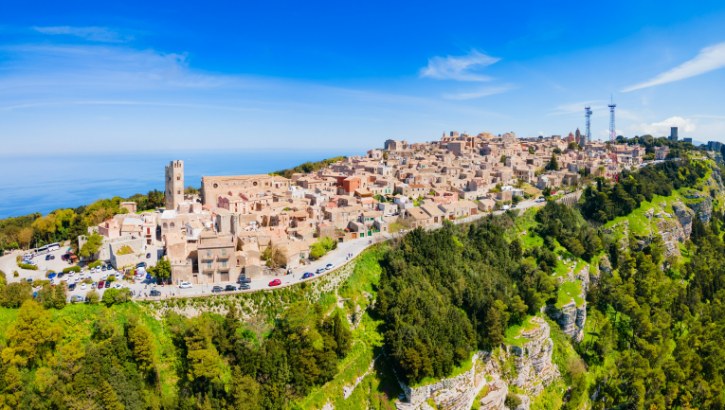
a. A Village in the Clouds
Erice sits on an isolated summit high above the Sicilian coast. Its streets, paved with dark polished stone, often disappear into a drifting mountain mist that locals know well. That cool, hushed air gives the whole village a quiet, almost magical feel.
b. Ancient Fortresses on the Edge
Erice has guarded this peak since ancient times.
- Castello di Venere, a Norman fortress built over an ancient temple to Venus
- Public gardens wrapped around the castle crag, hanging over the drop
- A 19th century pavilion built as a scholar’s private retreat, now a small museum
- Spend time around these viewpoints to see why so many cultures prized this spot
c. Churches Around Every Corner
Erice was once called the city of a hundred churches.
- The main church has a Catalan Gothic portal and a separate bell tower
- A second church nearby shows a rose colored stone facade
- Along one old street, massive ancient walls still carry carved letters
- Even if faith is not your focus, the architecture is a joy to discover
d. The Convent Sweets You Have to Try
Erice is famous for pastries once made by cloistered nuns.
- The signature treat is a warm shell filled with lemon scented custard
- You will also find chewy almond sweets and marzipan shaped like tiny fruits
- A beloved local pastry maker keeps the tradition alive in her shop
- Pausing for a fresh pastry is one of the simple joys here
e. Why the Mist Makes It Magic
When the afternoon mist rolls in, streetlamps glow amber through the fog on the cobbles, and the village feels pulled out of time. Keep in mind the mist and the clear views come and go with the weather, so you take what the mountain gives you on the day. That contrast, a cool refuge above a sunlit coast, is what you remember.
11. Volterra (Tuscany)
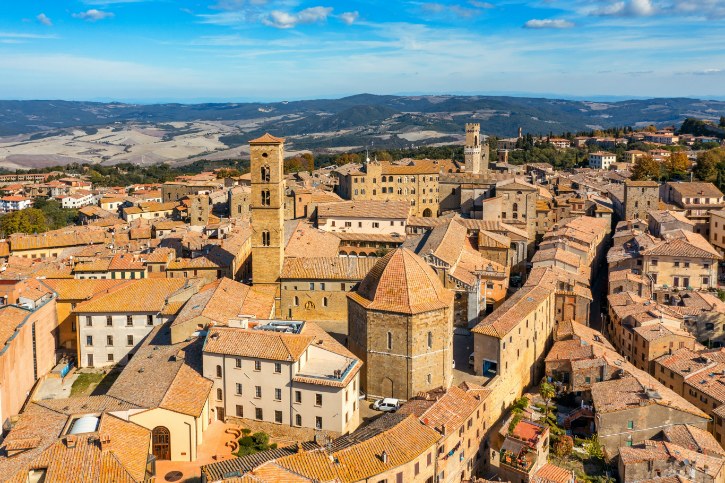
a. Three Thousand Years on a Hilltop
Volterra sits on a broad plateau overlooking rugged, eroded valleys. Few towns in Italy have been lived in so continuously. It grew from an ancient Etruscan city, and you can read that long history in walls where massive ancient stones sit beneath later medieval work.
b. Etruscan and Roman Treasures
Volterra is a dream for anyone curious about the ancient world.
- The Porta all’Arco, an Etruscan gate still guarded by three worn stone heads
- A renowned museum holding hundreds of carved Etruscan funerary urns
- A striking, elongated bronze figure that later inspired modern sculptors
- A Roman theatre built into the hillside just outside the old walls
c. The Glowing Stone Called Alabaster
Volterra is the world capital of alabaster, carved here for nearly 3,000 years.
- The local stone is prized for its softness and glowing translucency
- You can visit working artisan studios right in the center
- Carvers shape delicate sculptures, bowls, and glowing lamps
- A dedicated museum tells the full story of the craft
d. The Cathedral and the Fortress
A few landmarks anchor the old center.
- The Duomo, with a gilded wooden ceiling and Renaissance chapels
- An octagonal baptistery facing it, banded in white and green marble
- The towering Fortezza Medicea, now known for a pioneering prison theater program
e. Views Over a Wild Landscape
Thanks to its height, Volterra offers wide, dramatic views.
- A terrace looking south over the river valley and distant steam vents
- Parco Enrico Fiumi, shaded gardens beside the fortress, set among the old Etruscan acropolis ruins
- The northern town walls, where you look down onto the Roman theatre ruins below
- Le Balze, a dramatic chasm where erosion has carved sheer cliffs over the centuries
12. Assisi (Umbria)
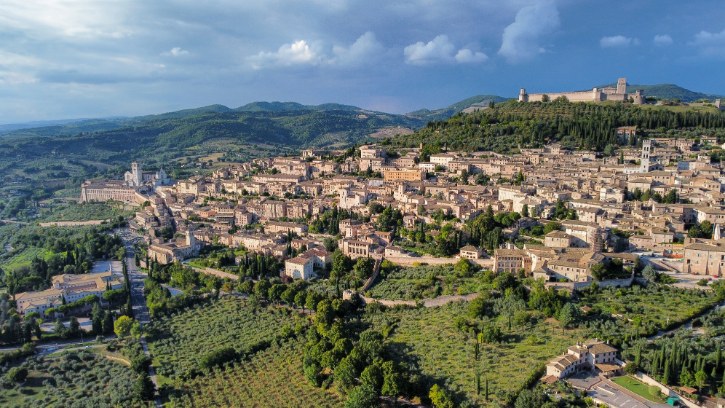
a. The Pink Stone City of Saints
Assisi rests on the slopes of Mount Subasio, looking out over a wide, fertile valley. It is known worldwide as the birthplace of Saint Francis and Saint Clare. Built from pink and white local limestone, the whole town glows warmly as the daylight shifts. You do not need to be religious to love its art, history, and calm.
b. The Basilica and Its Famous Frescoes
The centerpiece is the Basilica di San Francesco, really two churches stacked together.
- The lower church is hushed and contemplative, holding the tomb of Saint Francis
- Its walls shine with masterpieces by early Italian painters
- The upper church is tall and bright, famous for its fresco cycle on the saint’s life
- These paintings marked a major turning point in Western art
c. Roman Roots in the Main Square
The heart of Assisi, Piazza del Comune, sits over the old Roman forum.
- A Roman temple front, now a church, faces the square with tall columns
- A medieval tower rises beside it
- Beneath the paving, you can walk among the original Roman stones
- Lovely medieval lanes link the squares with Gothic arches and stone houses
d. The Climb to the Fortress
High above the rooftops stands the Rocca Maggiore, a medieval fortress worth the climb.
- The walk up winds through steep olive terraces
- From the battlements, the whole valley opens up beneath you
- You look over the terracotta roofs of Assisi and the great basilica on the plain
- The wooded slopes of Mount Subasio rise in the distance
e. Forest Trails and Umbrian Flavors
Assisi sits inside a protected mountain park, so nature is close at hand.
- A remote stone hermitage hides in the woods above town, once used by Saint Francis
- Shaded trails wind through ancient oaks where wildlife thrives
- Local tables highlight black truffles, handmade pasta, and wild boar
- Regional wines round out a slow, satisfying meal
f. Why Assisi Stays With You
Walk the stepped stone alleys as evening falls and the bells ring across the plain, and you feel an unhurried pace that has shaped this hillside for centuries. That is the gift these twelve towns share. From the ordered beauty of Pienza to the cliffs of Polignano, the trulli of Alberobello, and the quiet of Assisi, each one trades hurry for something slower and more human. Visit even a few, and you will carry a little piece of them home.