Paris has a hidden visual language, and most visitors never learn to read it. Once you know what to look for, small marks on walls, bridges, and pavement start telling stories about kings, revolutions, trade, faith, science, and disaster.
Some are older than France itself. Others look ancient but are surprisingly modern. And a few popular explanations are legend, not documented history. Here’s how to read the real stories. 😊
1. The Mysterious Ship You Keep Seeing All Over Paris
a. What it is
That little ship tucked inside a shield is the coat of arms of the City of Paris. Historically called the nef, it belonged to the medieval marchands de l’eau, the water merchants who ran river trade on the Seine. It began as a legal seal of commercial and municipal power, not decoration.
b. Key facts
- Earliest documented version: a seal from 1210, under King Philippe Auguste.
- A more elaborate ship appears on the municipal seal of 1412.
- The merchants’ leader, the prévôt des marchands, grew into the head of city government.
- In 1358, royal fleurs de lys were added above the ship after Étienne Marcel’s revolt, signaling that civic power now sat beneath the crown.
c. The myth to drop
Many guides say the ship was created to illustrate the motto Fluctuat nec mergitur (“tossed by the waves, but does not sink”). The order is reversed. The ship existed for centuries first. The motto was only formally added by Haussmann and the Prefect of the Seine in 1853. Today’s version is a deliberate return to an older design, not an untouched medieval one.
d. Where to see it
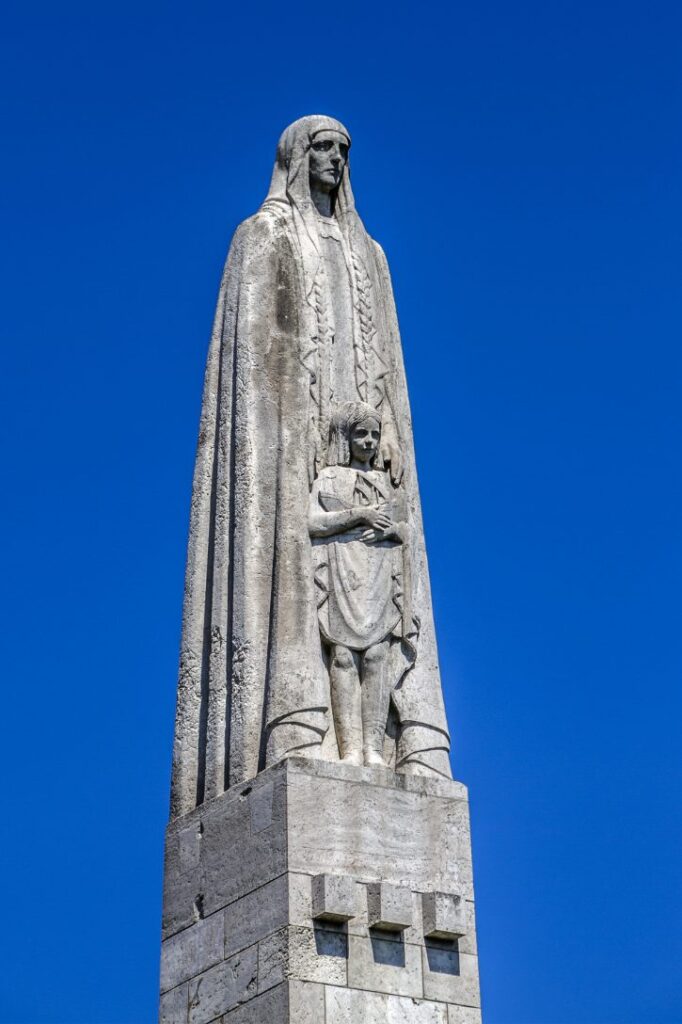
- Pont de la Tournelle: the Sainte Geneviève statue (1928) has a small child at the saint’s feet holding a tiny nef. Look at the upstream side of the pier.
- Musée Carnavalet: carved coats of arms frame the upper windows of the Cour des Drapiers, visible in the garden.
- Hôtel de Ville: hundreds of ships on door handles, radiators, and ceilings, but access needs a tour, an event, or Heritage Days.
e. Photo tips
Use a phone zoom at Pont de la Tournelle, since the nef is tiny. Indoors, check door plates, iron railings, and radiator covers, not just one big shield.
2. The Fleur de Lys Hidden Across Paris
a. Fact versus legend
The story that King Clovis received a golden lily from heaven is a 14th-century legend, created later to give the royal line divine prestige. What’s documented is that the fleur de lys became an official royal emblem in the 12th century, under Louis VI and Louis VII.
b. What it looks like
- A three-part shape: one upright petal, two curving outward, bound by a small bar.
- In royal heraldry, gold on royal blue.
- The plant is debated. The strongest evidence points to the yellow marsh iris, not the white lily, so recognize the shape without naming one flower.
c. Two royal versions
- France Ancienne: a blue shield strewn with many small lilies.
- France Moderne: around 1376, Charles V cut the arms to three lilies, honoring the Holy Trinity.
d. The star example: Sainte-Chapelle
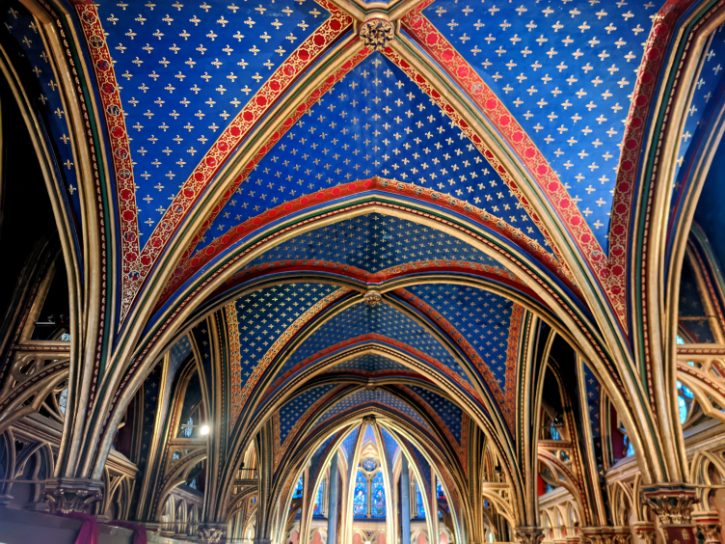
Commissioned by Louis IX and consecrated in 1248, Sainte-Chapelle is the best place to read royal symbolism. In the lower chapel, painted columns alternate golden lilies on blue with golden castles on red, the castles honoring Blanche of Castile, the king’s mother.
e. What you’re really seeing
- The chapel was damaged in the Revolution, then heavily restored between 1840 and 1868.
- About two-thirds of the upper chapel glass is original 13th-century material.
- Much of the wall paint is 19th-century reconstruction, so not every lily is medieval.
f. Photo tips
Use a wide shot for the repeating columns in the lower chapel, and a zoom for the high vaults. Expect timed tickets and security screening.
Read More: Sainte-Chapelle in Paris: What Most Tourists Miss Inside This Famous Chapel
3. The Sun Symbols Left Behind by France’s “Sun King”
a. What the sun meant
In the 1660s, Louis XIV chose the radiant sun as his personal emblem. It was allegory, not a claim to be a god. The sun linked him to Apollo, god of order and the arts, presenting his rule as a source of light, stability, and order.
b. Forms to recognize
- Sun disks, often a human face ringed with rays.
- Apollo scenes, especially his golden chariot.
- Cosmic order: seasons, times of day, the zodiac.
- Not every sun face is Louis XIV. Sunbursts were common decoration in that era.
c. Best outdoor example: Hôtel des Invalides
On the north facade, high above the entrance, a carved human-faced sun sits inside the central arch, with a relief of Louis XIV on horseback below. The complex was commissioned in 1670. The central Louis XIV relief was designed by Guillaume Coustou, but it was destroyed during the Revolution and restored in 1815 by Pierre Cartellier, working from Coustou’s model. So the version you see today is a 19th-century restoration of an older royal design, not an untouched 1730s carving.
d. How to view and photograph it
- This relief is on the north facade, which faces the Esplanade des Invalides.
- Stand on that northern side, in front of the main entrance. (Place Vauban is on the south side, by Napoleon’s Tomb, so it’s the wrong spot for this relief.)
- Use a zoom or binoculars, since the detail sits high above the portal.
- The facade shows best in late-morning light, when the carving stands out.
e. Best indoor example: Galerie d’Apollon
After a fire in 1661, Louis XIV had the Louvre’s Petite Galerie rebuilt. Charles Le Brun designed an Apollo and solar-cycle scheme around 1663, a direct prototype for Versailles’ Hall of Mirrors. The ceiling shows Apollo’s chariot surrounded by cosmic order.
f. The fullest expression: Versailles
Here’s the fun part. If you want to see where all this leads, take the day trip to Versailles, about 20 km southwest of Paris. The Sun King symbolism is everywhere:
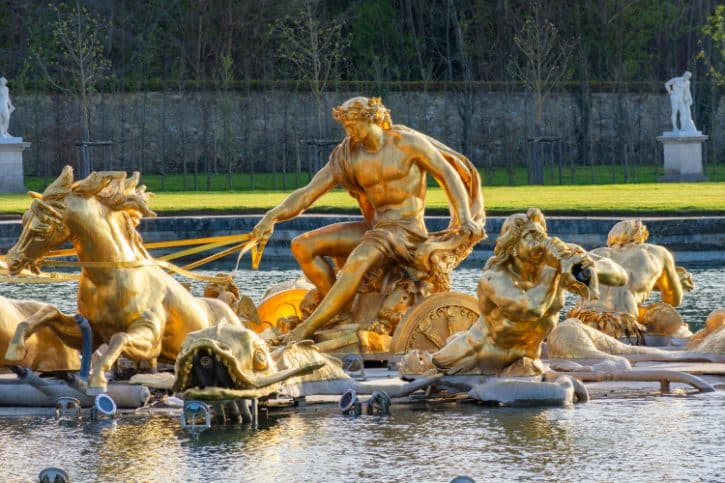
- The Apollo Fountain, where Apollo rides his four-horse chariot out of the water as the rising sun, standing in for the king.
- The Latona Fountain, featuring Apollo’s mother.
- The King’s Grand Apartment, originally the “Apartment of the Planets,” with each room tied to a heavenly body.
- The Hall of Mirrors, built as a corridor of light to magnify royal power, and the grand successor to the Galerie d’Apollon.
Read More: 9 Best Day Trips from Paris
4. Marianne and the Strange Red Cap of the French Republic
a. Who she is
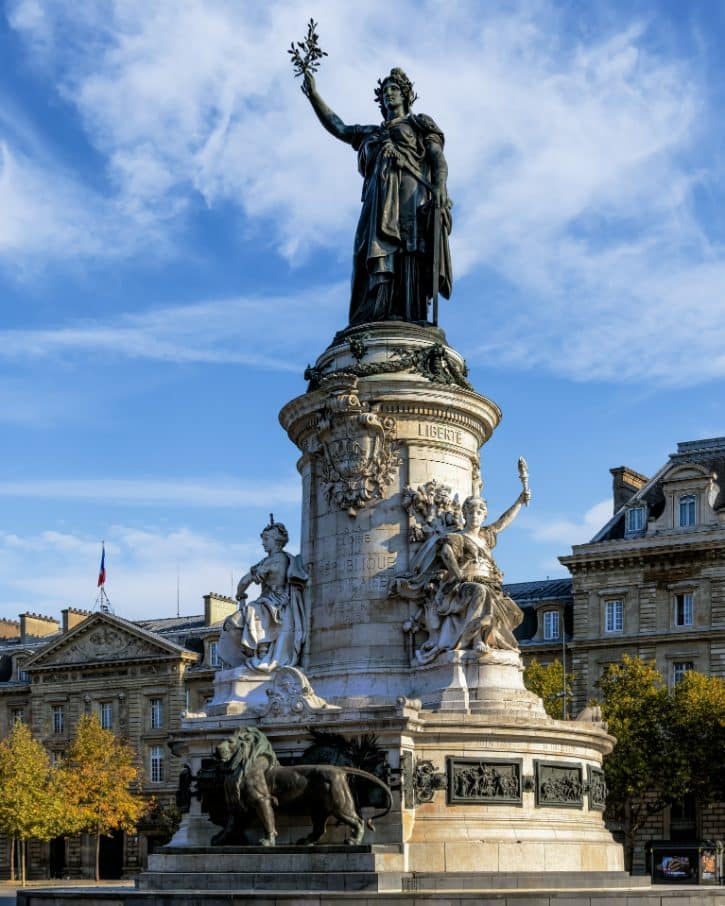
Marianne is the female symbol of the French Republic, standing for liberty and equality. She is not a real person. She was born in the 1789 Revolution, when republicans replaced royal images with classical ones.
b. How to identify her
- The soft Phrygian cap (bonnet phrygien), from the Roman cap given to freed slaves.
- A tricolour flag, fasces, laurel, or a Rights of Man tablet.
- She has no single official look, and later versions often swap the cap for a diadem.
- The cap is red in prints, but stone and bronze statues show it in their natural material.
c. Where the name came from
The name combined Marie and Anne, common rural names. Counter-revolutionaries first used it as an insult meaning “common”. Republicans then embraced it as a symbol of a republic for ordinary people.
d. Best example: Place de la République
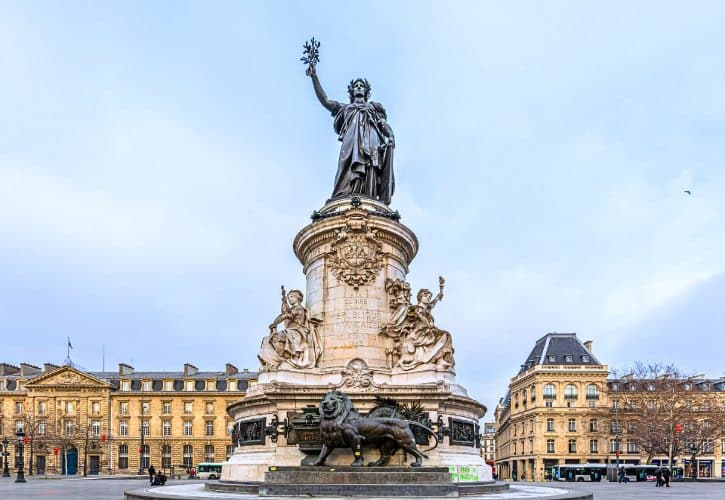
The Monument à la République (1883) by the Morice brothers has a bronze Marianne about 9.5 meters tall. Around the base sit three stone figures, Liberty, Equality, and Fraternity, turning the national motto into sculpture.
e. What tourists get wrong
- Not every female statue is Marianne. Paris is full of allegories of Liberty, Victory, Justice, and the City itself.
- She is Marianne only with republican attributes: the Phrygian cap, the tricolour, or RF.
- Museum busts may not always be on display, so check first.
f. Photo tips
Shoot the whole monument for scale, then circle the base to photograph the lower figures, which sit near eye level.
5. The Letters “RF” Hidden on Buildings Across Paris
a. What RF means
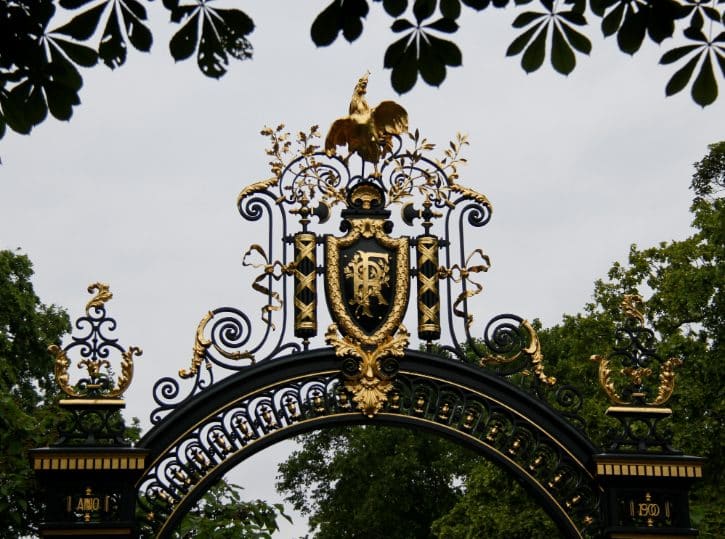
RF stands for République Française. Unlike a royal monogram tied to one ruler, it stands for the impersonal, ongoing French state.
b. Why it’s everywhere
- It spread widely under the Third Republic, founded in 1870.
- After the Franco-Prussian War and the 1871 Commune, the Republic stamped RF on schools, courthouses, town halls, and post offices.
- Because several Republics reused it, RF marks a regime but cannot date a building on its own.
c. The clever hidden example
At Place de la République, look at the seated figure of Equality. The letters R.F. are carved near the top of the flagstaff she holds. This one monument stacks Marianne, Liberty, Equality, Fraternity, flags, and RF together.
d. A building full of symbols
During the 1874 to 1882 rebuild of the Hôtel de Ville, architect Théodore Ballu worked RF into window guards, door plates, shield cartouches, and ceilings, often beside the city ship. Here national and municipal symbols share the same rooms.
e. Two sets of initials
- At the Mairie du 10e, painted door panels show RF and PX (for Paris 10e).
- That pairing shows two layers of identity, national and local district.
f. Photo tips
Look for RF on iron school gates, mairie pediments, and public fountains. Frame it with surrounding architecture so the context reads clearly. And remember, RF is a state emblem, not a coat of arms.
6. Napoleon’s N, Eagles and Mysterious Golden Bees
a. A new imperial brand
After crowning himself Emperor on 2 December 1804, Napoleon built a fresh identity instead of copying the Bourbons. He chose three motifs: the N, the eagle, and the bee.
b. The N and the eagle
- The Roman-style N was his personal cipher, usually wrapped in laurel and crowned. It glorifies one man, unlike the impersonal RF.
- The eagle copied the Roman legions’ Aquila and Jupiter, shown with wings spread on a thunderbolt, standing for military power and imperial Rome.
c. The surprising bees
In 1653, workers found the 5th-century tomb of King Childeric I, holding over 300 gold insect ornaments that scholars called bees. Napoleon adopted them to claim roots older than the Capetian and Bourbon lilies. Modern analysis suggests they were probably cicadas, but Napoleon’s use of them as bees is an established historical fact.
d. Where to see real First Empire pieces
- The Musée de l’Armée at Les Invalides is the place.
- Ingres’s 1806 portrait shows the coronation mantle studded with golden bees, with eagles on the throne.
- Cases hold surviving textiles and metalwork from the 1804 coronation at Notre-Dame.
e. The big trap: Napoleon I versus III
Napoleon III (Second Empire, 1852 to 1870) reused these symbols on huge projects. The Ns and eagles around the Louvre’s Cour Napoléon are mostly his, not Napoleon I’s. Rule of thumb: identify the building campaign first, then decide which Napoleon the symbol belongs to.
f. Photo tips
Compare a bee, an eagle, and an N side by side inside the museum. Outdoors, shoot both the detail and the wider wing, since the architecture tells you the era.
7. The Tiny “ARAGO” Discs Most People Walk Straight Over
a. Modern art on an old line
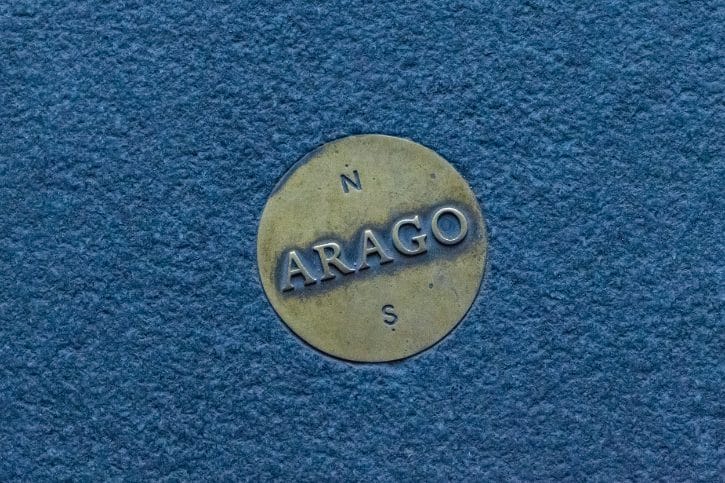
Those small bronze discs stamped ARAGO are not ancient. They are a 1994 artwork, Hommage à Arago, by artist Jan Dibbets, honoring astronomer François Arago. The 135 discs form a 9.2-kilometer “invisible monument” along the Paris Meridian.
b. What they look like
- About 12 centimeters across, solid bronze, flush with the pavement.
- The word ARAGO in capitals.
- Small pointers marked N (north) and S (south).
c. The three layers of history
- The Paris Meridian, first calculated in 1667 under Louis XIV, and the Observatory built along it.
- Arago’s 19th-century re-measurement, which fed the metric system.
- Dibbets’s 1994 discs. So Arago did not create the meridian, and the discs did not establish it.
d. The “Rose Line” myth
The idea that these mark a secret “Rose Line” comes from The Da Vinci Code (2003). No historic document ever used that name. The famous bronze strip in Saint-Sulpice is an 18th-century Easter calculator sitting about 115 meters from the real meridian.
e. Where to find them
- Palais-Royal and Galerie de Nemours, near the southern arcades.
- Louvre grounds, in the Cour Napoléon paving and Denon Wing passages.
- Luxembourg Gardens, along the north-south path.
- Many of the original 135 are gone, lost to theft and roadwork, so not all survive.
f. Photo tips
This is a look-down section. Use morning or late-afternoon light so the bronze pops, shoot low with a shoe for scale, and stay clear of traffic.
8. The Small Marker Outside Notre-Dame That Defines Distances Across France
a. Correct the premise
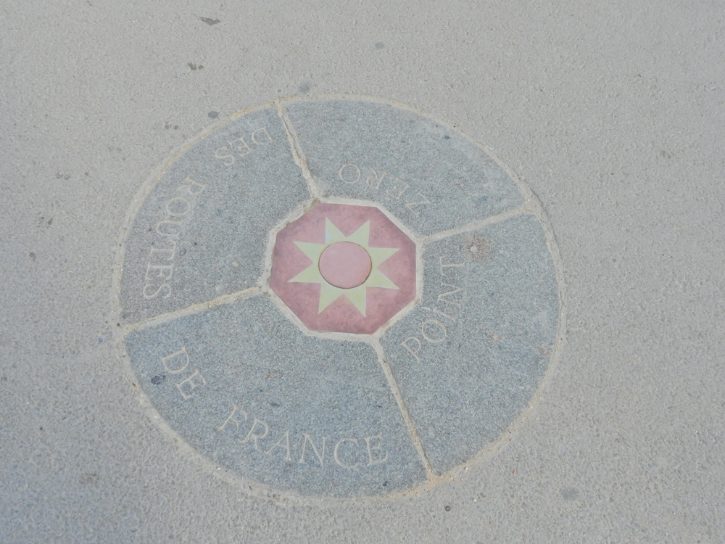
The Point Zéro des routes de France is not just a historic curiosity. It is still the active baseline used to measure road distances from Paris. When a sign says “Paris 300 km”, that’s measured to this marker. A new medallion was installed on 1 July 2025.
b. What it looks like
- A circular brass medallion in an octagonal granite stone.
- A carved compass rose at the center.
- The border reads POINT, ZÉRO, DES ROUTES, DE FRANCE.
- It sits flush with the pavement, so crowds hide it easily.
c. Where the idea came from
Distances have been measured from this square since the Middle Ages. A 1768 royal decree under Louis XV set up a stone post here, and the modern circular design dates to 1924. Long before that, this spot on the parvis was tied to public penance rituals, useful context but not the reason for the marker.
d. The post-fire story
- After the 2019 fire, the parvis closed for cleanup.
- The damaged 1924 medallion was removed and sent to the Musée Carnavalet.
- An identical copy was cast and reinstalled on 1 July 2025.
- The location and function stayed constant, but the physical object was replaced.
e. What tourists get wrong
- It is not the geographic center of Paris. It’s a transport reference.
- The “step on it to return to Paris” belief is 20th-century folklore, not an old ritual.
- It is not the Paris Meridian. Point Zéro measures roads. The meridian is astronomical.
f. Finding it and photo tips
It’s about 30 meters west of the central portal on the parvis. Go early before the queues, take a top-down shot of the compass rose, then a wide shot with the towers behind. Check current Notre-Dame works before planning close access.
Read More: 10 Breathtaking Churches in Paris You Can’t Miss
9. The Scallop Shells That Secretly Point to an Ancient Pilgrimage Route
a. The wording correction
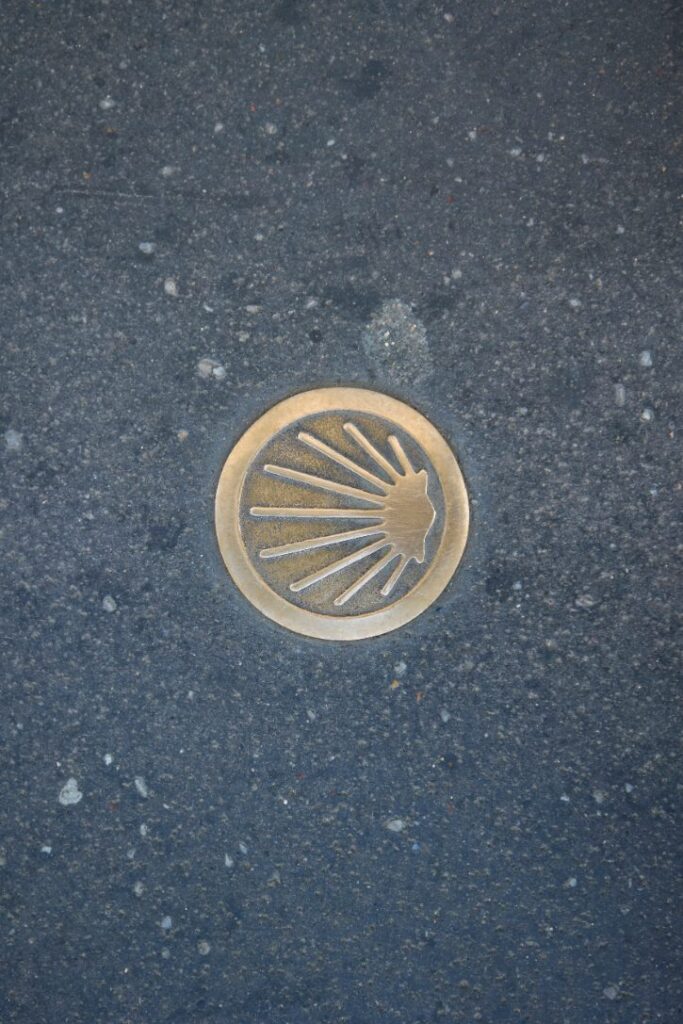
The scallop tradition is ancient, but the brass shell studs in Paris sidewalks are modern wayfinding. They mark the historic Via Turonensis, the Paris and Tours route toward Santiago de Compostela.
b. What the shell means
- The coquille Saint-Jacques was the medieval badge of pilgrims to Saint James in Spain.
- The graphic on the studs is modern: a 1993 Council of Europe design, a yellow shell on blue.
c. The direction myth
A common claim says the shell’s rays point toward Santiago. Official French route guidance disagrees. The stud is a route confirmation marker, not a compass. Turns are shown separately with painted arrows or signs.
d. Tour Saint-Jacques
This 52-meter Gothic tower, built 1509 to 1523, is the only surviving piece of the Church of Saint-Jacques-de-la-Boucherie. In the Middle Ages it was where pilgrims gathered before heading south, and it’s the official start of the modern Paris route.
e. How recent the markers are
- Installed by Compostelle 2000 and the City of Paris.
- Roughly 70 studs set between 2020 and 2022.
- About 83 studs across Paris Centre by 2025.
- So you’re walking a 21st-century trail marking a medieval tradition.
f. Walking route and photo tips
Start at Tour Saint-Jacques, cross to the Île de la Cité near Notre-Dame, then walk up Rue Saint-Jacques in the Latin Quarter, where studs appear near intersections. Remember: a carved shell on a building is often just decoration, not a pilgrim marker. Shoot one stud close up and one wide with the tower behind.
10. The Strange Lines on Paris Walls That Show How High the Seine Once Rose
a. The city’s flood memory
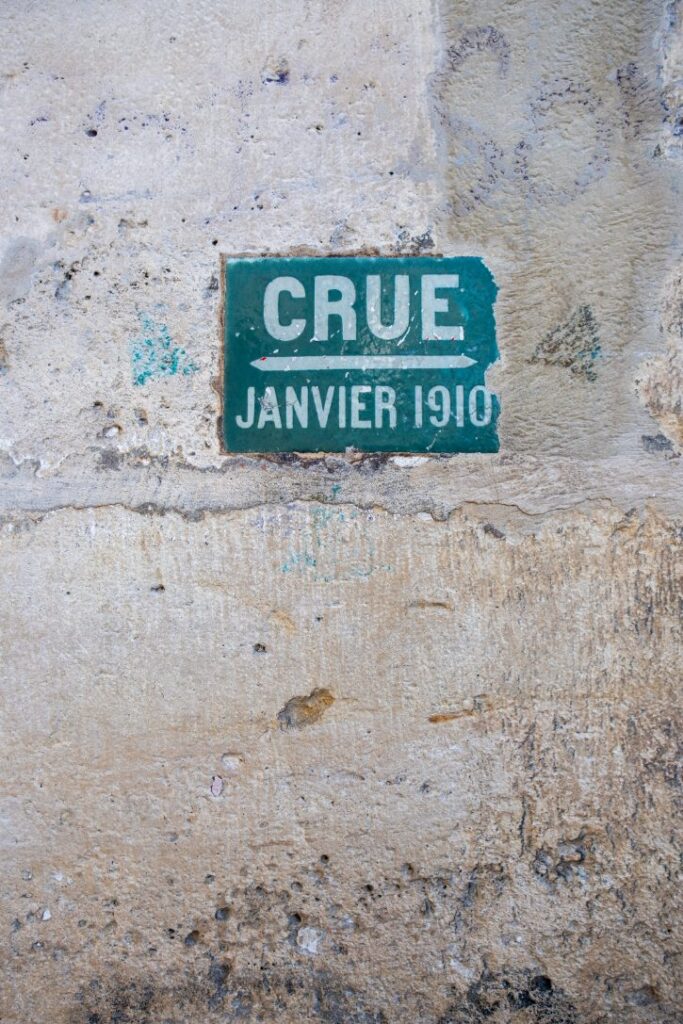
Paris’s repères de crue (flood markers) record the peak water level of major Seine floods at each spot. Together they act as a scattered street-level memory, cataloged and protected by French environmental agencies.
b. What they look like
- An incised horizontal line in stone.
- A carved year or date.
- A blue and white enamel or metal plaque, the official type.
- Not every marker is a horizontal line.
c. The benchmark: January 1910
Between 20 and 28 January 1910, the Seine overflowed, flooding over 20,000 buildings and the metro. It peaked at a gauge height of 8.62 meters at Pont d’Austerlitz. But that figure is a gauge reading, not the street depth. Actual water ranged from a few centimeters to over two meters, depending on ground level.
d. Best example: rue des Ursins
A clear, officially recorded 1910 marker sits on the Île de la Cité, behind Notre-Dame, where rue des Ursins meets quai aux Fleurs. On the river-facing wall, look about 1.5 to 1.8 meters up for an incised line and inscription. It’s listed in the national flood-marker database.
e. What tourists get wrong
- A dark line or stain is not automatically a flood marker.
- Not every marker is from 1910. Older ones for 1658 or 1740 survive on buildings like the Hôtel de Lauzun.
- A historic marker is not the same as a modern river gauge.
- Look for a real date, inscription, or plaque before believing it.
f. The bigger lesson and photo tips
French law requires these markers to be preserved, both as history and as a warning about future floods. And that’s the quiet point of this whole walk. Many “mysterious” Paris marks were never mysteries.
They were practical signs that only became puzzles once people forgot how to read them. Photograph a close-up of the date, then a wider shot showing the height against a door or the pavement, which reveals the scale far better.